



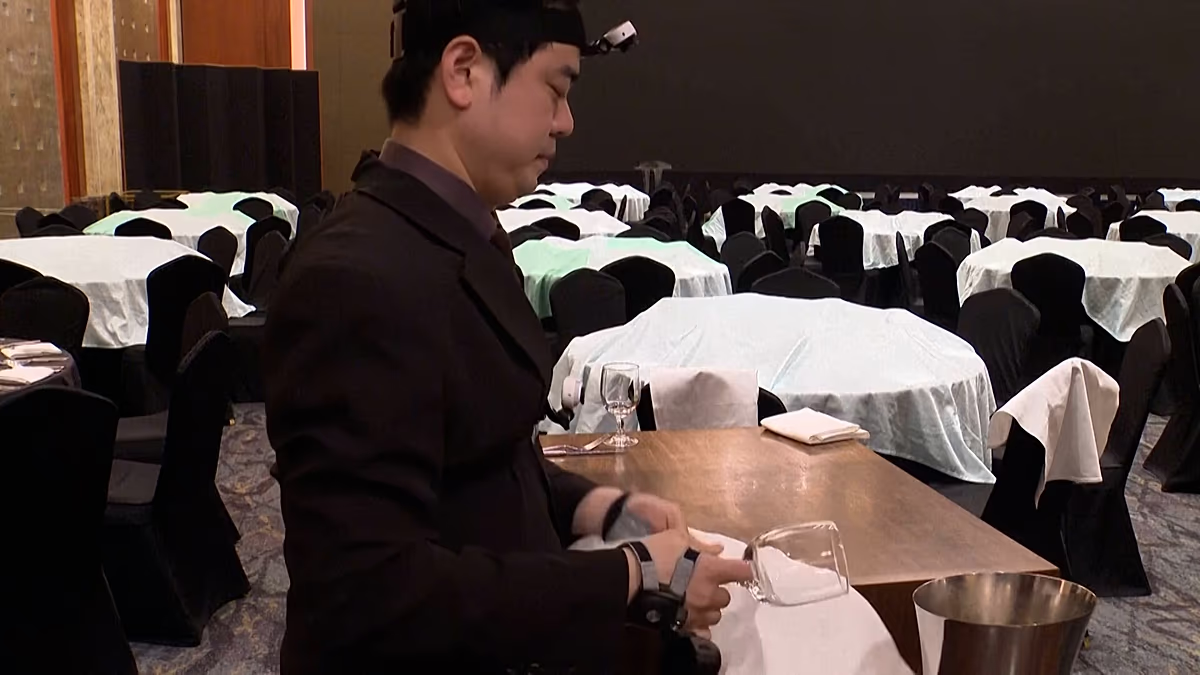
In the serene, meticulously ordered world of a high-end Seoul hotel, a quiet revolution is taking place. David Park, a veteran hospitality worker, performs his duties with practiced grace—folding napkins into sharp creases, polishing glasses to a flawless shine, setting tables with precise alignment. Yet, this is no ordinary shift. Cameras are strapped to his head, chest, and hands, capturing every subtle rotation of his wrist, every delicate pinch of his fingers, and the exact pressure applied to linen and porcelain. Park is participating in a cutting-edge project run by the South Korean AI company RLWRLD, aiming to teach robots the nuanced art of human dexterity. By recording these highly detailed movements—finger positioning, joint angles, and applied force—developers are creating vast datasets to train robots equipped with remarkably humanlike metal hands and onboard cameras. The goal is not merely to automate, but to replicate the sophisticated touch and control that define quality service, a task beyond the capability of simple robotic grippers.
In demonstrations, the results of this laborious data collection are beginning to materialize. Robots with five-fingered hands can now be seen sorting cutlery, lifting cups without crushing them, organizing trays, and attempting to fold cloth napkins within recreated hotel environments. However, the current reality underscores the immense gap between machine and human capability. RLWRLD acknowledges that a robot would require several hours to clean a hotel room that a human staff member prepares in about 40 minutes. The journey from clumsy mimicry to fluid execution is long, but the company believes advances in AI software and robotic hardware are accelerating. They target 2028 for deploying their technology in industrial settings, viewing the precision-demanding world of hospitality as the perfect training ground. By also collecting data from logistics workers in warehouses and staff at convenience stores arranging food displays, RLWRLD aims to build versatile AI software that can operate across various workplace robots, with a future vision of expansion into domestic settings.
This project is a key component of South Korea’s strategic push into “physical AI”—a sector focused on robots that can perceive, decide, and act autonomously in the complex, unpredictable real world. Just as large language models like ChatGPT are trained on colossal datasets of text, physical AI requires extensive records of human action to learn advanced tasks. South Korea believes it holds a distinct advantage in this global race, leveraging its robust manufacturing base and a deep pool of skilled industrial workers whose expertise can be digitally captured and translated into robotic training systems. This is part of a broader national effort to convert the country’s strengths in semiconductors and advanced manufacturing into a leadership position in AI robotics, even as technological superpowers like the United States and China dominate the wider field. The government is actively fueling this ambition, recently launching a $33 million project dedicated to recording the “instinctive know-how” of experienced technicians to train the next generation of AI-powered manufacturing robots.
The corporate sector is equally committed, with South Korea’s industrial giants making significant bets on this automated future. Hyundai Motor, which owns the renowned robotics firm Boston Dynamics, plans to introduce humanoid robots into its automobile factories starting in 2028. Similarly, Samsung Electronics has declared its intention to transform all its manufacturing facilities into “AI-driven factories” by 2030, deploying a mix of humanoid and task-specific robots across production lines. This wave of investment signals a profound shift toward a new era of automation, where robots are designed not just for repetitive, single-function tasks but for adaptable roles that require a semblance of human judgment and dexterity within structured environments like factories, warehouses, and hotels.
Naturally, this technological march raises urgent questions about the future of human labor. Labor groups have expressed concern that the drive for automation could eventually lead to widespread job displacement. Yet, for workers like David Park, who has spent nine years in hospitality, the perspective is notably more nuanced and optimistic. He estimates that humanoid robots might capably assume about 30% to 40% of the back-of-house workload—the repetitive, physically taxing preparation tasks. However, he believes the core of service—the remaining 50% to 70% of work involving genuine, empathetic human-to-human interaction—will remain irreplaceably in human hands. For Park, the technology represents not a threat, but a potential ally that could alleviate mundane burdens, allowing human workers to focus on the creative, interpersonal, and truly hospitable aspects of their roles that define the industry.
The scene in Seoul, therefore, is more than a technical experiment; it is a poignant snapshot of a collaborative transition. It is not about humans being replaced, but about humans teaching machines through the silent language of their own movements. The cameras recording David Park are capturing more than data; they are encoding a legacy of skill, precision, and care developed over a career. As South Korea positions itself at the forefront of this physical AI race, the narrative unfolding is one of partnership. The ambition is to build machines that can handle the heavy, the repetitive, and the precise, thereby refining—not erasing—the human role. In this envisioned future, the robot folds the napkin, but the human attendant ensures the guest feels truly welcomed, preserving the irreplaceable heart of service within an increasingly automated world.