


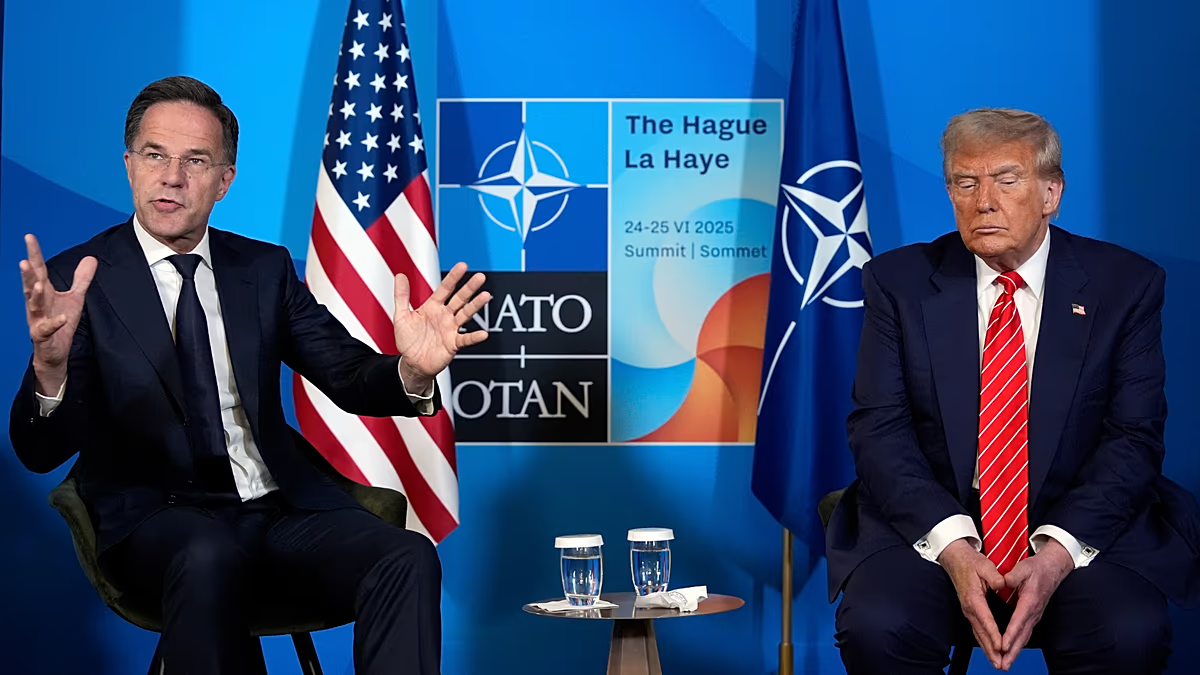
A profound and unexpected shift in the transatlantic security landscape is underway, catching America’s closest allies off guard. Senior NATO officials received no prior warning before the Pentagon’s abrupt announcement that the United States would withdraw approximately 5,000 troops from Germany within the coming year. This move, impacting a nation that has served as the cornerstone of U.S. and NATO defense posture in Europe for decades, was delivered not through diplomatic channels but via public statement, leaving alliance planners scrambling. The announcement, described by insiders as startlingly devoid of critical detail, immediately raised urgent logistical and strategic questions. Military commanders are left in the dark about which specific units—be they a rotating brigade, an air squadron, or a core combat team—will be packing their bags, making it impossible to assess the real operational impact. This lack of consultation has sown confusion and concern across NATO capitals, which had long anticipated a potential U.S. troop review but assumed any changes would be managed through orderly, collaborative discussion.
The decision, however, appears to be less a product of meticulous strategic reassessment and more a sudden, reactive gesture from the White House. According to multiple U.S. and NATO sources who spoke anonymously, the specific figure of 5,000 troops was essentially “made up” or “taken out of the sky” by President Donald Trump. The timing points directly to a recent diplomatic spat. Just days before the announcement, German Chancellor Frederic Merz critiqued U.S. strategy regarding Iran, stating the country was “humiliating” the United States. President Trump swiftly retaliated on social media, suggesting the Pentagon was studying a drawdown and criticizing Germany’s leadership. Within a remarkably short span of time, the study became an order. This sequence has led many within the alliance to conclude the troop movement is primarily a punitive measure aimed at Berlin, a demonstrative slap in response to political friction rather than a coherent defense policy.
In the wake of the announcement, NATO officials and military planners are now forced to mitigate the potential fallout while grappling with the unsettling precedent of unilateral action. Officially, the alliance has responded with careful diplomacy. A spokesperson for the NATO Secretary General noted they are working with the U.S. to understand the details and framed the move as underscoring the need for greater European defense investment. Behind the scenes, there is a concerted effort to downplay the immediate military impact. Planners argue that modern warfare increasingly relies on technology, cyber capabilities, and advanced weaponry rather than sheer troop numbers, and they note that European allies, particularly Germany, have significantly bolstered their own defenses in recent years. Yet, this technical reassurance does little to calm the political and symbolic storm. The core grievance for European allies is the breach of trust and process; they expected to be partners in a decision that directly affects the security of NATO territory.
The implications of this withdrawal extend far beyond a simple reduction in personnel headcounts. The presence of over 36,000 U.S. troops in Germany is not merely a relic of the Cold War but a critical component of America’s global power projection. These forces facilitate rapid deployment to crises in Africa, the Middle East, and Eastern Europe, and they are integral to complex, joint training and intelligence operations. As former U.S. Ambassador to NATO Ivo Daalder argues, the Trump administration is missing this bigger strategic picture. In seeking to punish allies for not supporting U.S. actions like potential conflict with Iran, the move ultimately undermines American interests. Daalder contends that President Trump mistakenly views the troop presence as a “favor” to Europe, rather than a fundamental asset to U.S. global strategy and deterrence. This perspective, he warns, signals a dangerous downgrading of the transatlantic alliance in Washington’s priorities.
Compounding the uncertainty, President Trump hinted that the drawdown could go much further, suggesting the initial 5,000 is only the beginning. This casts a shadow of ambiguity over the entire future of the U.S. military footprint in Europe, leaving allies to wonder where the next cut might fall. The episode also reinforces the President’s past criticisms of NATO as a “paper tiger” and his frustration with allies he perceives as insufficiently supportive. The combination of impulsive decision-making, a personal dimension to foreign policy, and the absence of detailed planning has created a deep sense of vulnerability within the alliance. It demonstrates that long-standing defense postures, once considered stable pillars of the international order, can be altered overnight by presidential whim.
Ultimately, this sudden troop decision represents more than a logistical challenge; it is a stark symptom of the profound transformation in America’s role on the world stage. The transatlantic bond, forged in the aftermath of World War II and solidified during the Cold War, is being tested not by an external enemy, but by internal friction and a redefinition of American interests. While NATO militaries may adapt to the reduced numbers, the political and psychological damage may be longer-lasting. The message received in European capitals is clear: the era of predictable, consultative American leadership within the alliance is over. Whether this leads to a more divided, fragile NATO or becomes the catalyst for a genuinely more self-reliant European defense pillar remains the defining question for the future of Western security.