


In a significant blow to European defence ambitions, France and Germany announced on Monday the formal termination of their joint Future Combat Air System (FCAS) fighter jet programme. Launched with high hopes in 2017, the project was conceived as a cornerstone of a more militarily independent Europe, designed to replace France’s Rafale and Germany’s Eurofighter jets with a state-of-the-art, networked system of crewed fighters, drones, and advanced sensors. Its collapse, stemming from irreconcilable corporate and strategic disagreements, deals a sobering reality check to visions of seamless EU defence integration. At a time of profound geopolitical instability, with Russia’s war on Ukraine raging and transatlantic alliances under strain, the failure underscores the enduring difficulty of aligning national industrial interests and military doctrines, even between Europe’s core powers.
The roots of the breakdown lie in a fundamental clash between the corporate giants at its heart: France’s Dassault Aviation and the Airbus consortium representing Germany and Spain. For years, the programme was paralysed by disputes over leadership, workshare, and the fiercely guarded intellectual property rights crucial to national sovereignty and competitive edge. Dassault, builder of the acclaimed Rafale, insisted on retaining design authority over the next-generation fighter, a stance Airbus refused to accept as a subordinate partner. This corporate stalemate was compounded by divergent military needs; France required a carrier-capable jet capable of delivering nuclear weapons, capabilities of little relevance to Germany’s continental defence posture. Attempts to reconcile these visions by developing two variants within the same programme ultimately failed, revealing a partnership built more on political necessity than a shared operational blueprint.
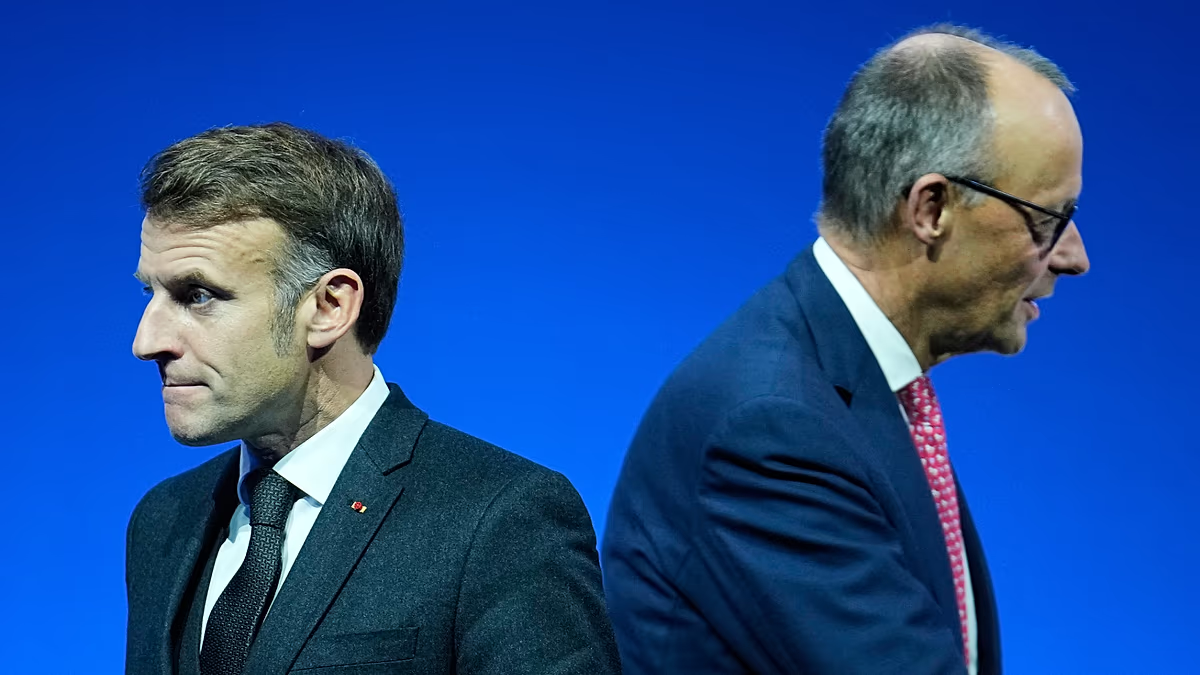
This industrial impasse arrives at a moment of acute strategic urgency for Europe. The war in Ukraine has entered its fifth year, starkly highlighting Europe’s defence vulnerabilities and dependence on American military aid—a reliance cast into doubt by the potential return of a more isolationist U.S. presidency under Donald Trump. Leaders like German opposition leader Friedrich Merz and French President Emmanuel Macron have passionately argued for greater European sovereignty, with Macron recently insisting, “Europe has never needed unity, greater independence and greater sovereignty more than it does now.” Against this backdrop, the shelving of FCAS is more than a contract dispute; it is a symbolic setback for a continent striving to present a united, capable front in an increasingly hostile world. It lays bare the painful gap between geopolitical rhetoric and the gritty realities of merging defence-industrial bases.
However, the announcement does not signify a complete dissolution of cooperation. The broader FCAS ecosystem, notably the ambitious “Combat Cloud,” is slated to continue development. This digital network, intended to seamlessly connect various assets across future battlefields, represents the technological backbone of modern warfare. French and German defence ministries have pledged to refocus their collaboration on this and other “realistic and relevant projects.” This suggests a pragmatic pivot: instead of forcing a single, compromised aircraft design, the nations may pursue separate, nationally-led fighter programmes—perhaps a next-generation Rafale from Dassault and a new project from Airbus—that could later interconnect via shared digital standards and the Combat Cloud. In this model, interoperability is pursued through common networks rather than common hardware.
The fallout now pushes both industrial champions toward new paths. Airbus is already looking beyond France, with industry insiders pointing to potential partnerships with Sweden’s Saab or the separate British-Japanese-Italian Global Combat Air Programme (GCAP). Dassault, meanwhile, is poised to advance its own sovereign expertise, developing an evolution of the Rafale independently. This fragmentation risks diluting scarce European resources and talent across competing projects, potentially ceding technological ground to consolidated American and Chinese defence sectors. The end of FCAS as originally envisioned marks the close of one of Europe’s most ambitious armament ventures, but it also forces a strategic recalibration, asking whether a “networked” approach to cooperation can succeed where a “monolithic” one could not.
Ultimately, the collapse of the Franco-German fighter jet is a story of unmet political ambition colliding with entrenched national interests. It serves as a powerful reminder that building a unified European defence is a marathon, not a sprint, fraught with technical, industrial, and political hurdles. The drive for strategic autonomy remains urgent, but the path forward now appears more modular and complex. Success will depend less on grand, single-platform projects and more on patient, incremental collaboration—forging trusted connections in cloud-based systems, agreeing on common standards, and finding pockets of shared need. The dream of a truly integrated European defence persists, but its realization will require a humility and pragmatism forged in the ashes of this high-profile failure.