


A Serious Incident Brings Vital ThamesLink Route to a Halt
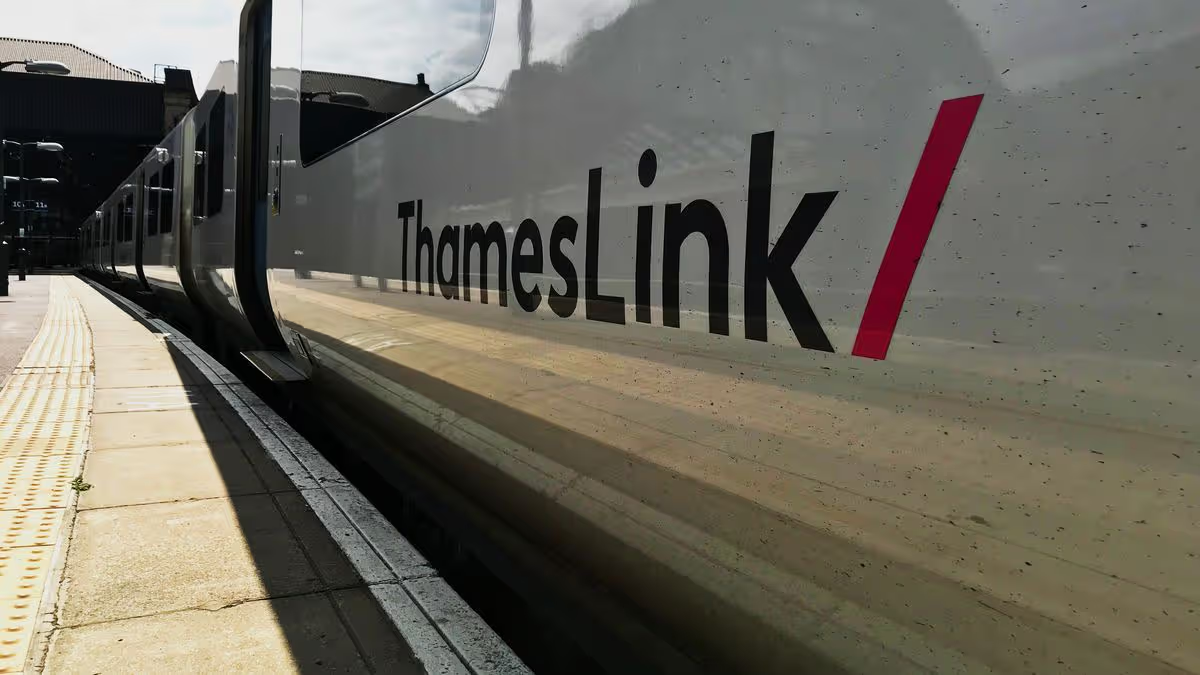
In the early hours of Wednesday, May 13th, 2026, a profound and sobering disruption descended upon a key UK rail corridor. ThamesLink services, the vital artery connecting communities across the Home Counties and into the heart of London, were brought to a complete standstill between St Albans City and Bedford. The cause, reported with heavy hearts by the rail operator, was a tragic incident where an individual was struck by a train between Luton and Bedford. This news cast an immediate pall over the network, transforming bustling routes into scenes of stillness as emergency services swiftly converged on the location. For passengers aboard trains suddenly halted in the darkness, and for those awaiting early morning departures, journeys were abruptly interrupted, replaced by uncertainty and concern.
Recognizing the severity and sensitivity of the situation, ThamesLink moved quickly to communicate with those affected. A company spokesperson expressed profound sadness at the event, confirming the complete blockage of all lines between the stations involved. The message to passengers, particularly those stranded on stationary trains between stations, was clear and prioritized both safety and compassion: “Please stay on board and listen for updates.” This directive, while undoubtedly frustrating for those eager to continue their travels, was issued with urgent regard for personal safety, as railway tracks and adjacent areas remain extremely dangerous environments, especially during nighttime emergency operations. The company assured passengers they were aware of every train’s location and were working to resolve the situation.
The ripple effects of such an incident are extensive and meticulously managed. ThamesLink anticipated significant disruption lasting until at least 5 a.m., with warnings of cancellations, revisions, and delays of up to sixty minutes. Beyond the immediate track closure, the incident triggers a complex, coordinated response. ThamesLink, alongside Network Rail and the emergency services—including British Transport Police—began the delicate and necessary work of responding to the incident. This process is conducted with the utmost sensitivity for all involved, while also focusing on safely clearing the area and investigating the circumstances, a procedure that invariably takes considerable time and care, extending the period of service suspension.
For the traveling public, the sudden halt necessitated practical alternatives. ThamesLink provided guidance on ticket acceptance to help people complete their journeys where possible. In a gesture of goodwill and necessity, Thameslink tickets were accepted at no extra cost on relevant London Bus night routes connecting areas like Elstree & Borehamwood, Central London, Croydon, and Purley. Furthermore, passengers could use their tickets on London Northwestern Railway services between Milton Keynes Central and London Euston, and on early-morning Thameslink and Great Northern services on an alternative route via Peterborough, Hitchin, and Stevenage into London Kings Cross. These measures, while unable to fully mitigate the disruption, offered crucial pathways for displaced travelers.
Behind the operational updates and travel advice lies the human heart of this tragedy. The brief news report, updated just a minute after its initial publication, underscores the developing and grave nature of the event. While factual details are sparing, the impact is deeply felt—by the emergency personnel at the scene, by the train crew involved, by the passengers unexpectedly caught in the aftermath, and, most profoundly, by the individual’s family and friends. In recognition of this, the report included a vital resource, a reminder that in moments of distress, support is available. It signposted the Samaritans helpline (116 123), a confidential service for anyone affected, directly or indirectly, by the incident, emphasizing that such events resonate beyond the timetable and touch the broader community.
As dawn approached, the priority remained the careful and dignified management of the scene on the tracks near Luton. For ThamesLink and its partners, the tasks were twofold: to compassionately address the immediate human tragedy, and to methodically restore a critical piece of the national transport infrastructure. For every passenger delayed, the morning served as a stark reminder of the fragility that underpins our daily routines. The incident between St Albans and Bedford was more than a travel inconvenience; it was a collective pause, a moment of shared reflection on the complexities of human life, witnessed silently by the darkened carriages and empty platforms along a normally thriving railway line.