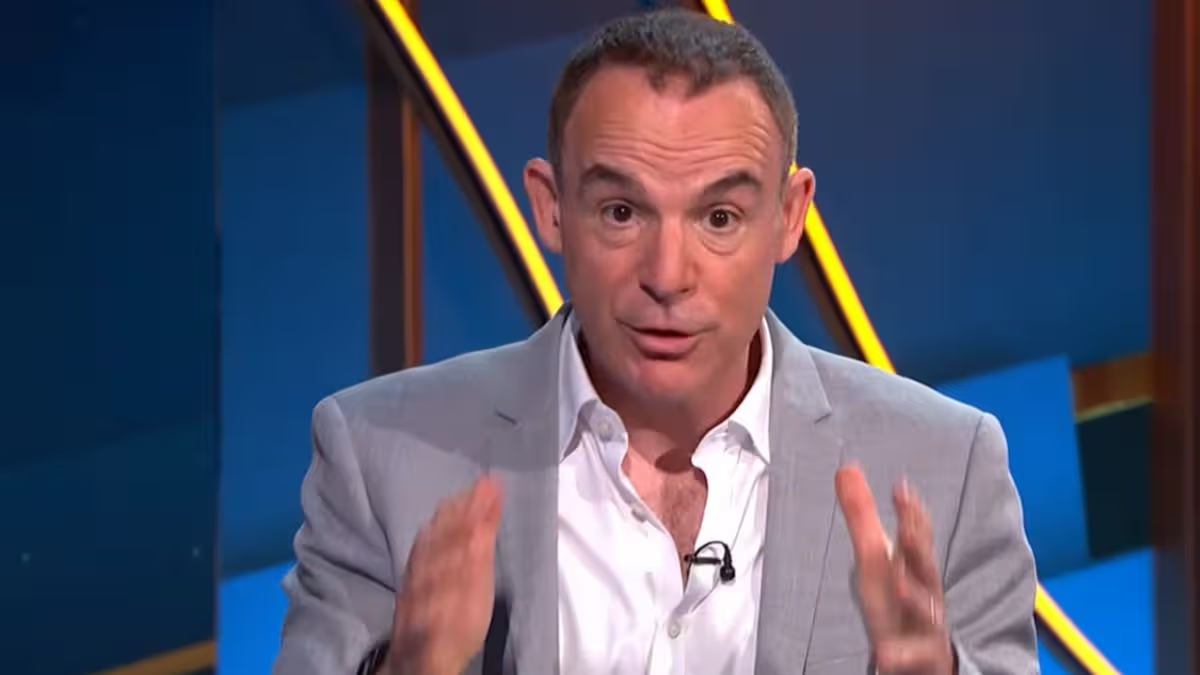




In a recent episode of his ITV programme, following his BAFTA win, financial journalist Martin Lewis delivered a compelling and urgent message to the British public: by overwhelmingly favouring cash savings over investment, most people are missing out on significantly better returns and potentially jeopardising their long-term financial health. Lewis, the founder of MoneySavingExpert.com, used his platform to demystify investing and challenge the nation’s ingrained aversion to the stock market. He argued that while saving feels safe, the hidden risk of inflation steadily eroding purchasing power means that avoiding investment altogether is itself a risky strategy. His core contention is that “far more people should have a shares ISA than do,” positioning these accounts not as niche products for the wealthy, but as essential tools for building wealth over the medium to long term.
Central to Lewis’s advice is the Stocks and Shares ISA, a tax-efficient vehicle that allows individuals to invest up to £20,000 per tax year without paying UK income or capital gains tax on the returns. He was careful to clarify that investing is fundamentally different from saving; it involves putting money into assets like shares or funds with the hope of growth, but with the accepted risk that the value can go down as well as up. To manage this risk, he laid out non-negotiable “golden rules”: only invest money you won’t need for at least five years, ensure all expensive debts (like credit cards or loans) are cleared first, and build a solid cash emergency fund of three to six months’ worth of essential bills. This foundation, he stressed, must be in place before anyone contemplates the investment market.
To illustrate the powerful potential of investing, Lewis provided a stark ten-year comparison. He showed that £1,000 placed in even the best-paying savings account a decade ago would have grown by less than the rate of inflation, meaning its real purchasing power would have actually diminished. In contrast, the same sum invested in a fund tracking the UK’s FTSE 100 would be worth approximately £2,400 today. The growth was even more dramatic in broader markets: a global stock market tracker would have turned £1,000 into around £3,600, and an investment following the US S&P 500 would have grown to roughly £4,110. This data powerfully underscores his argument that, over the long term, the stock market has historically offered the most effective defence against inflation and a pathway to genuine wealth accumulation.
For beginners daunted by the complexity of the financial world, Lewis offered clear, practical guidance. His strong recommendation is to start with funds—specifically, diversified “passive” or tracker funds—rather than attempting to pick individual company shares. An active fund employs a manager to try to beat the market, while a passive fund simply aims to replicate the performance of a specific index, like the FTSE 100 or a global market index. Lewis and the experts on his show advised novices to opt for passive funds, citing their typically lower fees and the difficulty active managers have in consistently outperforming the market over time. This approach allows an individual to own a small slice of hundreds of companies simultaneously, spreading risk and offering a “fire and forget” entry point into investing.
Addressing a common concern about safety, Lewis drew a crucial distinction between the security of cash and the nature of investment. Responding to a viewer accustomed to cash ISAs, he explained that while cash deposits are protected up to £85,000 by the FSCS guarantee, investing carries no such capital protection. The value of a Stocks and Shares ISA is directly tied to the performance of its underlying assets. While it is very unlikely you would lose all your money in a widely-diversified fund, its value will fluctuate. However, Lewis emphasised that this accepted short-term volatility is the trade-off for the potential of higher long-term returns. The goal is not to avoid risk entirely, but to take a calculated, long-term risk that, based on historical precedent, is likely to outpace both savings rates and inflation.
In essence, Martin Lewis’s message is a call for a cultural shift in the UK’s approach to personal finance. He acknowledges the fear and perception that investing is “risky, scary, something other people do,” but argues that this mindset has led to a nation that “under-invests,” with most people’s only exposure to the market being through their pension. By following his foundational rules—securing debts, building an emergency fund, and committing to a five-year minimum horizon—and by starting simply with a low-cost, globally-diversified passive fund within a Stocks and Shares ISA, he asserts that ordinary individuals can responsibly begin to harness the power of the markets. His conclusion is that for anyone with their financial basics in order and a long-term perspective, the greater risk may well lie in keeping all their money on the sidelines, where its growth is almost guaranteed to lag behind the real cost of living.