



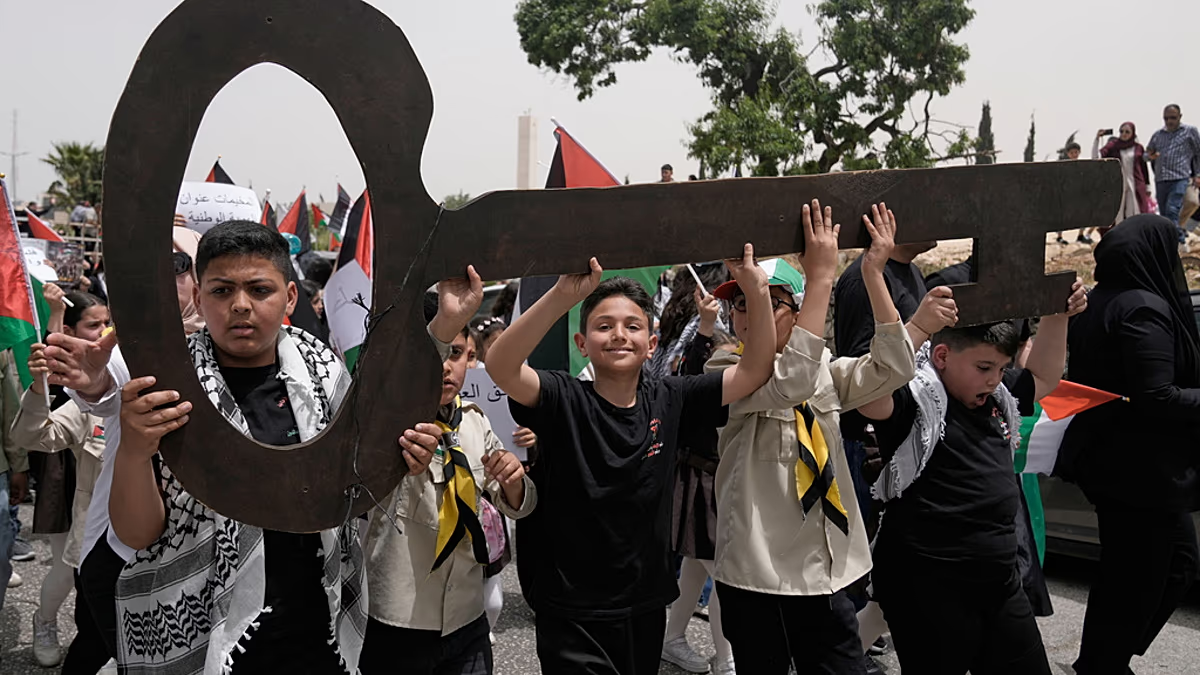
In the heart of Ramallah, the administrative center of the Palestinian Authority, the city pulsed with memory and resolve as hundreds gathered to mark the 78th anniversary of the Nakba. The air filled with a solemn, 78-second siren from mosques across the city, a temporal echo of years of displacement. The commemorations transformed the streets into a river of people, marching from the grave of Yasser Arafat towards Manara Square. Palestinian flags, ubiquitous in squares and draped across thoroughfares, waved above a crowd moving with a rhythmic beat of drums, scout music, and bagpipes. Amidst this, the most potent symbols emerged: a massive key, representing the lost homes and the “right of return,” and banners declaring a commitment to “historic Palestine,” visually anchoring the day’s purpose in a deeply personal and collective history.
The participants articulated a profound sense of an open, ongoing wound. For them, the Nakba is not a concluded historical event but a living reality, its effects reverberating through lives in the occupied territories and in refugee camps across the region. Abdel Kareem Abu Arqoub, present at the gathering, framed the day as a reminder of a “national tragedy” that persists, underscoring that justice must be achieved through the restoration of the right of return. This sentiment was amplified by Jihad Dar Ali, who called the right “sacred” and beyond any statute of limitations. He directed a demand for moral and material compensation towards Britain, linking the present directly to a colonial past, stating that the United Kingdom, by giving “the land of our ancestors to the Jewish people,” was the root cause of the Nakba and the ensuing decades of suffering.
This narrative traces the origin of the catastrophe back beyond 1948 to 1917, with the Balfour Declaration. In that promise, the British government pledged support for a “national home for the Jews” in Palestine, a land then under Ottoman rule and later administered under a British mandate. The trajectory continued in 1947 with a United Nations partition plan, which proposed dividing Palestine and awarding over half the land to a prospective Jewish state—a plan rejected by Palestinians and Arab nations. The pivotal moment came in May 1948 with the end of the British mandate and the declaration of the establishment of Israel. This triggered widespread violence, displacement, and documented massacres, such as those at Deir Yassin, Tantura, and Haifa, forcing an estimated 750,000 Palestinians from their homes.
The immediate regional response saw forces from Arab nations—Egypt, Syria, Jordan, Lebanon, Saudi Arabia, and Iraq—enter the fray to counter the Israeli advance. However, the military operations concluded with the defeat of those armies, while Israel expanded its control beyond the borders outlined in the UN partition plan. In the wake of this conflict, the United Nations General Assembly passed Resolution 194 in December 1948. It became a cornerstone of the Palestinian legal case, explicitly stipulating the right of refugees to return to their homes “as soon as possible” and to receive compensation for losses. Yet, decades later, this resolution remains unimplemented, a document of principle contrasted by the ongoing Israeli policy preventing the return of Palestinian refugees.
Thus, the Nakba has solidified as the central pillar of the Palestinian national struggle. Nakba Day events are annually observed not only in the occupied West Bank and Gaza Strip but also across the diaspora, where millions of refugees reside. The “right of return” has transcended a political demand to become an essential component of Palestinian identity itself. It is a historical narrative, a personal inheritance, and a collective promise, meticulously passed from generation to generation. The keys, the flags, and the stories carried in Ramallah are not merely memorials of a past; they are active declarations of a future aspiration, keeping the memory alive as a guiding force for continued resilience and advocacy.
In this way, the commemoration in Ramallah was a vivid tapestry of sound, symbol, and speech, weaving together historical grievance with present-day determination. It illustrated how a community holds its history not as a static record but as a living compass, directing its sense of justice and its vision for the future. The echoes of the 78-second siren, the sight of the giant key, and the voices demanding return all served to affirm that, for Palestinians, the Nakba is both a point of origin for their contemporary plight and an unending call for restoration and recognition.