



The news that Robert Brown, the man who brutally killed his wife Joanna Simpson, will not be granted parole has brought a profound, collective sigh of relief to a family and a community that has lived under a shadow of fear for years. In a decision announced in May 2026, the Parole Board unanimously ruled that the former airline pilot must remain in custody until at least 2036, or until they are satisfied he no longer poses a risk to the public. This conclusion was not a foregone conclusion; it was the hard-fought result of a relentless three-year campaign by Joanna’s loved ones, who fought to ensure that public safety, not bureaucratic process, would be the paramount consideration. For Joanna’s mother, Diana Parkes, and her close friend, Hetti Barkworth-Nanton, the ruling lifts a cloud that has darkened their lives since Brown’s original sentencing, a cloud fueled by the terrifying possibility of his early return to society.
The horror of Joanna’s death in October 2010 remains chilling in its detail and cruelty. Robert Brown, in the throes of a bitter divorce, bludgeoned his 46-year-old wife to death with a claw hammer inside their family home in Ascot, Berkshire, while their two young children, then just nine and ten years old, were present and within earshot. In a act of cold premeditation, he then transported her body to Windsor Great Park and buried it in a grave he had dug beforehand. Only the following day did he confess to police. At his 2011 trial, he was found not guilty of murder, with the jury accepting his defense that the divorce proceedings had caused him extreme stress, leading to a verdict of manslaughter. He was sentenced to 24 years for the killing, with an additional two years for obstructing a coroner—a sentence structure that, with standard provisions, could have seen him automatically released much earlier, a prospect that became a source of ongoing anguish for Joanna’s family.
This anguish transformed into determined action. Joanna’s family and friends, led by her mother Diana and her friend Hetti, embarked on a sustained campaign to keep Brown behind bars. They argued passionately that the nature of his crime—a ferocious, premeditated act of violence witnessed in its aftermath by his own children—marked him as a continuing danger. Their campaign garnered significant public and media support, and crucially, prompted a review by the Ministry of Justice. This groundswell of effort ensured that Brown’s parole hearing would be subjected to the utmost scrutiny, moving it beyond a mere administrative checkmark to a serious assessment of genuine risk. Even Brown himself seemed to acknowledge the gravity of the proceeding, dispensing with his legal team and choosing not to attend the hearing that would decide his fate.
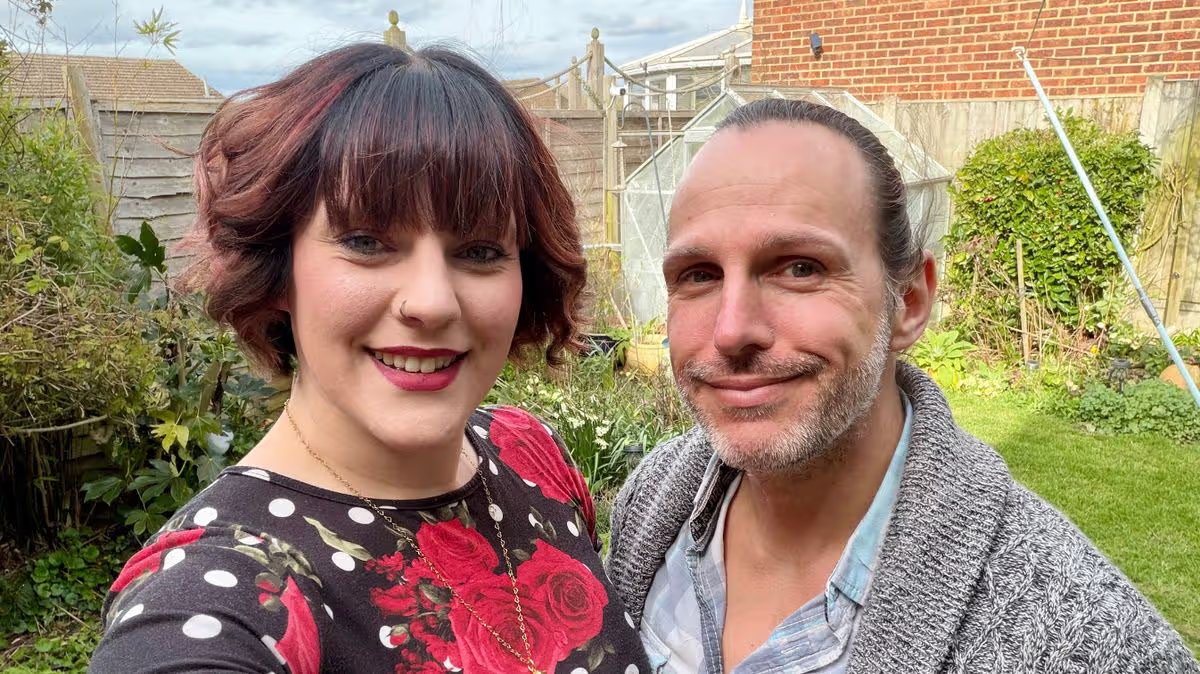
For Joanna Simpson’s grieving mother, Diana Parkes, the board’s decision is a watershed moment of justice and validation. In a heartfelt statement, she expressed her immense relief, revealing how the family had lived with the dread of Brown’s potential release. She poignantly remembered her daughter on what would have been her 62nd birthday, not as a victim frozen in time, but as the “beautiful and vivacious woman” she was at 46. Diana’s words also turned to Joanna’s children, who have grown into “wonderful young people,” and whose resilience she attributes to the loving foundation their mother built in their early years. Her statement is a tapestry of sorrow, pride, and enduring love—a testament to a life brutally taken and a legacy that continues in the strength of the children she adored.
Hetti Barkworth-Nanton, a close friend and champion of the campaign, underscored that this outcome was the direct result of their unwavering preparedness to fight. She highlighted the collaborative effort that included public support, media attention, political engagement, and the rigorous, independent investigation by the Parole Board itself. “Each played a vital role,” she stated, “in ensuring that public protection, not process, determined the outcome.” This sentiment strikes at the heart of their mission: to prioritize human safety over procedural timelines. Furthermore, the positive ruling was also welcomed by The Joanna Simpson Foundation, established in Joanna’s memory to transform the support for children affected by domestic abuse. In this way, a campaign born from profound personal tragedy continues to seek broader societal healing and protection.
Ultimately, the decision to keep Robert Brown incarcerated is more than a bureaucratic update; it is a reaffirmation of a fundamental social contract. It acknowledges the unimaginable trauma inflicted upon two children, the enduring pain of a family, and the calculated brutality of the crime itself. While the legal system initially categorized his actions as manslaughter, the Parole Board’s rigorous assessment has effectively recognized the enduring dangerousness his act represents. For Joanna Simpson’s loved ones, it is a crucial affirmation that her life and her death mattered, and that the safety of the community and the memory of the vibrant woman they lost will not be sacrificed to the calendar. The road to this point has been long and harrowing, but this ruling allows a measure of security and peace, ensuring that the story of Joanna Simpson is defined not by her killer’s freedom, but by her lasting legacy and the unwavering love that continues to fight for her.