


Of course. Here is a humanized and expanded summary of the content, structured into six paragraphs.
In the hustle of modern life, we place implicit trust in the built environment around us—trusting that doorways, seats, and public facilities are designed to accommodate us safely. A pressing concern now emerging from research, however, suggests a critical piece of this everyday infrastructure is operating on dangerously outdated assumptions: the humble elevator. According to experts from University College London (UCL), the standard weight limits displayed in lifts across Britain and Europe have not been meaningfully updated for decades, creating a hidden risk of breakdowns and, more insidiously, perpetuating social stigma against larger-bodied individuals. This failure to adapt is a direct consequence of rising obesity rates, with the average UK citizen now significantly heavier than in the 1970s, when current standards were effectively set.
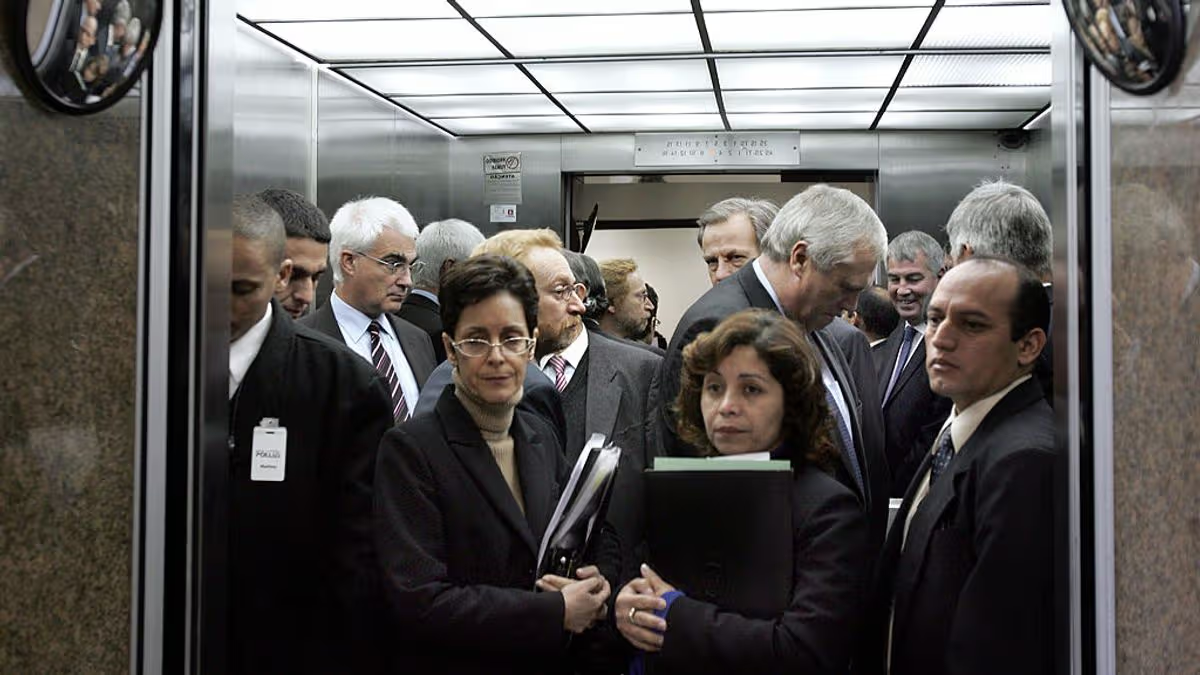
The core of the issue lies in a stark numbers gap. Industry standards determine a lift’s maximum passenger number by dividing its total weight capacity by an assumed average weight per person. Research presented at the European Congress on Obesity reveals this assumed weight was calibrated at just under 12 stone (75kg)—which accurately reflected the average UK man in the mid-1970s. Today, the reality is markedly different: the average UK man weighs approximately 86kg, and the average woman 73kg. While capacity limits did increase in line with public weight up until around 2002, they have since stagnated. Professor Nick Finer, the study’s author, warns this means the posted passenger number is often an overestimate. A lift filled to its stated person limit may now be dangerously overloaded, leading to increased breakdowns—”cut-outs”—or extended, unreliable journey times, a frustrating phenomenon anyone who has waited in a busy hospital lift will recognise.
The consequences extend far beyond mechanical nuisance into the realm of personal dignity and safety. Professor Finer recounts anecdotes of people getting stuck in lifts that halted because the weight limit was exceeded, even though fewer than the maximum number of people were inside. This creates a fraught social dynamic. When a lift is near capacity and a person with obesity attempts to enter, or is already inside, they often encounter visible discomfort or judgement from other passengers. The space calculations themselves are flawed, as manufacturers often base floor space on an outdated “oval” shape rather than accounting for the wider girth that can accompany higher weight. Thus, the environment becomes not just potentially unsafe, but also a site of daily embarrassment and exclusion for millions.
This elevator dilemma is symptomatic of a much broader societal oversight. With nearly one in three UK adults now classified as obese—around 16 million people—our communal spaces have largely failed to evolve. Professor Finer notes that train and plane seats, doorways, and many other public facilities remain poorly sized for larger citizens. Some airlines, like Southwest in the US, require plus-sized passengers to purchase a second seat if needed, while Air France offers a discount on the second ticket. These policies, though practical from a safety perspective, often come at a significant financial and emotional cost. As registered nutritionist Louise Payne emphasises, this is not merely about comfort but about fundamental accessibility and inclusion. People living with obesity face daily barriers that much of society never contemplates.
The call from experts and advocacy groups is clear: our infrastructure needs a conscious, compassionate upgrade for the 21st century. Jane DeVille-Almond of the British Obesity Society states we must accept that society is unlikely to revert to the body sizes of fifty years ago and must proactively develop inclusive facilities. This isn’t about assigning blame, but about pragmatic adaptation to demographic reality. It requires manufacturers to revise standards—U.S. proposals to raise the average weight assumption to 80kg are a start—and for architects, planners, and policymakers to integrate size inclusivity into public design. As Professor Finer succinctly puts it, “We need, sadly, to super-size many of the things in life.”
Ultimately, the stuck elevator is a powerful metaphor. It represents how societal progress can grind to a halt when we rely on old data and refuse to accommodate human change. Addressing this is an engineering challenge, but more profoundly, it is a social one. It asks us to build a world that does not just tolerate, but fully and safely accommodates, the diverse spectrum of human bodies, ensuring dignity and access for all. Updating a weight placard is a simple technical step; changing our mindset to one of universal design is the true lift we all need.