


The world of professional golf has long prided itself on a tradition of decorum and self-discipline, but a recent incident at the US Open has ignited a fresh debate about where that line is drawn. During the first round at Shinnecock Hills, Chile’s Joaquin Niemann, frustrated after hitting two successive tee shots out of bounds on the par-four sixth hole, hurled his sand wedge in a moment of raw frustration. This act, committed just as play was suspended for darkness, led tournament officials to invoke a new code of conduct. Upon returning to complete his round the next morning, Niemann was informed he had been assessed a two-stroke penalty for “serious misconduct” under Rule 1.2b, turning his score on the hole into an 11 and contributing to an opening 78. The USGA’s firm stance marked the first significant application of this new standard, signaling a clear intent to curb on-course outbursts.
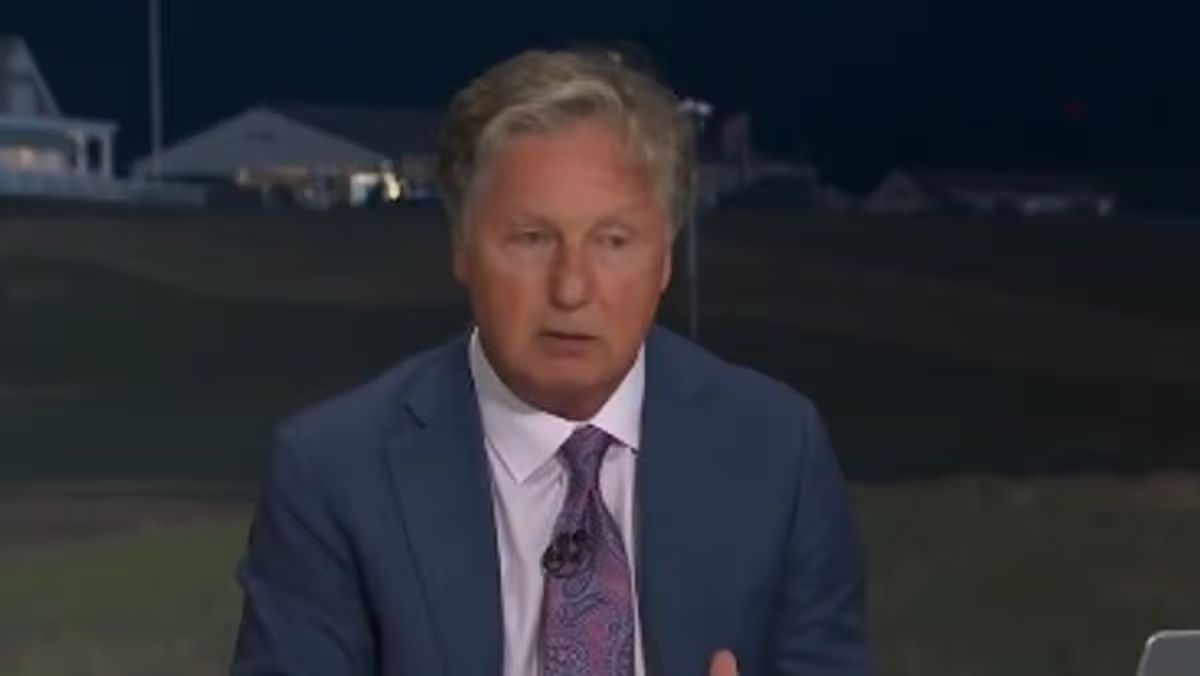
The penalty sparked immediate discussion, with Golf Channel analyst Brandel Chamblee offering a pointed and controversial thesis on the origins of such behavior. Reflecting on golf’s legends, Chamblee noted he never witnessed icons like Jack Nicklaus, Arnold Palmer, or Tom Watson throw clubs or unleash profane tirades, even in defeat. He extended this observation to modern greats like Phil Mickelson. Chamblee then presented a stark contrast, stating, “the same’s not true of Tiger Woods.” While acknowledging Woods as the greatest player ever and the economic engine of modern golf, Chamblee asserted that Woods was “one of the most profane golfers to ever play the game.” He argued that the current generation of tour pros, whom he called “Tiger’s progeny,” grew up emulating his intense, sometimes fiery competitive demeanor, leading to a normalization of club-throwing and explicit language that now “rains” on the PGA Tour.
Chamblee elaborated on this point, stressing that while he understands the immense pressure of competition, composure is itself a vital skill for a professional athlete. He contended that with the “unimaginable wealth” and fame afforded to today’s golfers comes an increased burden of scrutiny and responsibility. To lose control in front of a global audience, including families with children, is, in his view, “lazy.” He welcomed the new code of conduct as a necessary corrective, referencing other recent episodes of poor sportsmanship, such as Sergio Garcia’s infamous green-damaging incident at Augusta National and instances of players like Rory McIlroy and Wyndham Clark damaging tee markers. For Chamblee, the penalty for Niemann was a long-overdue message that such conduct, which he feels had run amok, would no longer be tacitly accepted.
For his part, Joaquin Niemann accepted the ruling with a mixture of resignation and self-reproach. After his second round, he explained the sequence of events, admitting he knew he had misbehaved but was shocked by the severity of the two-stroke penalty. He engaged in a debate with the rules committee, attempting to argue his case, but ultimately respected their decision. Niemann displayed notable maturity, stating, “I feel like I wouldn’t be happy seeing players throwing clubs and behaving that way so, yeah, I agree. I’m the first one to judge myself.” He clarified that his frustration boiled over after the horn had sounded to suspend play, leaving him alone on the course, but he took full ownership: “I’m not proud of it.”
Demonstrating remarkable resilience, Niemann channeled his frustration into a spectacular second-round performance. He stormed out of the gates with five birdies in his first six holes, carding a brilliant 65 that easily secured his place for the weekend at three over par. In a twist of irony, he later suggested the penalty might have served as a catalyst, saying, “It definitely helped me a little bit to have a better round today.” His aggressive, focused mindset post-penalty paid dividends, showcasing the mental fortitude that defines champions. This turnaround provided a perfect narrative counterpoint: a lesson learned in real-time, followed by a display of elite skill and focus.
The incident, therefore, transcends a simple rules infraction. It sits at the intersection of golf’s evolving culture, the legacy of its biggest star, and the governing bodies’ attempts to steward the game’s values. Brandel Chamblee’s commentary, while sure to be divisive, forces an uncomfortable conversation about the trickle-down influence of superstar behavior and the standards expected of role models. Niemann’s respectful acceptance and subsequent stellar play offer a blueprint for accountability and redemption. Together, they highlight a sport in a moment of self-reflection, grappling with how to preserve its cherished etiquette in an era of heightened emotion, visibility, and influence, where every action is magnified and every reaction scrutinized.