
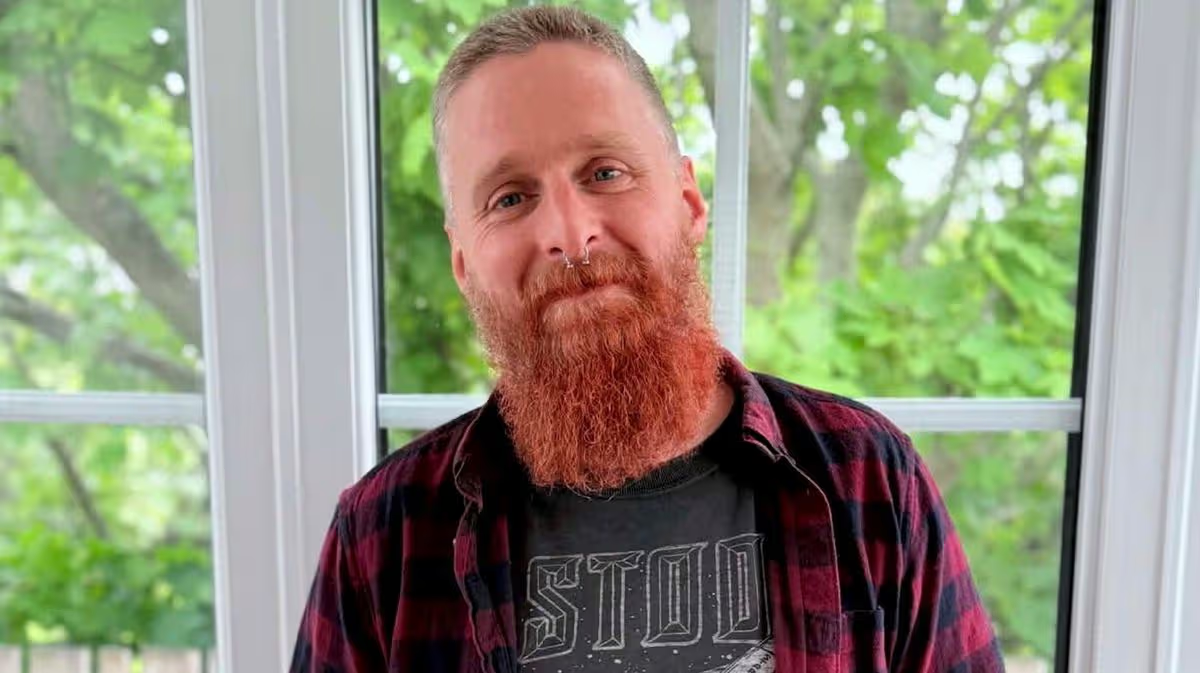


Gavin Sutherland’s ordinary workday at a jewellery workshop in Orkney was shattered in an instant by a sound that began as an innocuous hiss. That faint noise, accompanied by a slight movement in his pocket, was the only warning before the vape battery he was carrying detonated. The device exploded with violent force, searing his thigh with intense heat and sending plumes of smoke billowing from his clothing. In a panic, Gavin ran, the burning battery falling from his melted pocket as he struggled to process the searing pain. His immediate, frantic instinct was to cool the wound with water, but the damage was already severe. The fabrics of his denim jeans and boxer shorts had fused to his skin, creating a horrifying amalgam of cloth and burnt flesh. Forced to assess the injury himself, he used a sharp knife to cut away the material, revealing a wound that was both deep and agonizingly painful, a visceral testament to the explosive power contained within the small, everyday object.
The aftermath of the blast was a harrowing journey through escalating medical care. After colleagues applied a burns pack, Gavin was driven to the local Balfour Hospital in Kirkwall, where the severe pain ultimately caused him to collapse. Initially underestimating the injury, he soon realized the situation was grave when medical professionals began the meticulous and painful process of rinsing the wound and picking away the melted synthetic fibers that had adhered to his skin. The wound, roughly the size of a finger, was deemed serious enough to require specialized treatment far beyond local resources. Consequently, Gavin was airlifted by a Scotland’s Charity Air Ambulance (SCAA) helicopter to Aberdeen Royal Infirmary. Sedated by morphine for the journey, he placed his trust in the air ambulance crew, whose compassionate and professional care—even sharing sweets with him—provided a crucial human comfort amidst the trauma.
Gavin’s ordeal culminated in a skin graft operation, a necessary procedure to repair the significant damage left by the blast. While he fortunately escaped muscle damage, the incident left him with permanent scarring, a lifelong physical reminder of the sudden explosion. The profound impact of the SCAA’s service extended beyond Gavin’s own recovery, deeply inspiring his nine-year-old son, Caleb. Motivated by the crew who helped his father, Caleb and a friend embarked on a sponsored cycle, raising an astonishing nearly £7,000 for the charity. This heartfelt response underscores how a single accident reverberates through families and communities, transforming personal tragedy into collective action and support.
Gavin’s frightening experience is not an isolated incident but a stark illustration of the potential dangers lurking within the unregulated vape market, particularly concerning batteries and device safety. His story emerges amidst growing concerns from councils and campaigners about the proliferation of cheap vaping products. Although the UK government banned single-use vapes a year ago in an effort to curb youth usage and environmental harm, manufacturers have reportedly adapted by producing new, ostensibly reusable models that are sold and priced similarly to disposable ones. These products, critics argue, effectively circumvent the ban’s intent, maintaining a cycle of cheap accessibility and waste.
The scale of the problem remains significant. Research by the campaign group Material Focus estimates that while the weekly number of discarded vapes has decreased from a pre-ban figure of 8.2 million, a staggering 6.3 million vapes and pods were still being thrown away each week in the past year. This continued waste highlights the challenges of enforcement and the ingenuity of manufacturers in bypassing regulations. Environment Secretary Emma Reynolds defended the government’s actions, stating that the ban, alongside mandated takeback schemes, has led to fewer young people using disposable vapes and is helping to combat a damaging “throwaway culture.” Officials have committed to supporting retailer compliance and reviewing the enforcement of the ban within the next three years.
Ultimately, Gavin Sutherland’s nightmare—from the hissing prelude to the permanent scars—serves as a powerful human narrative within a complex public health and environmental debate. It personalizes the abstract statistics of vape-related injuries and electronic waste, reminding us that behind policy discussions on bans and recycling rates are real people suffering life-altering consequences. His ordeal underscores the urgent need for robust safety standards, effective regulation, and public awareness to prevent such accidents, while his son’s fundraising efforts beautifully reflects the capacity for resilience and community solidarity that can arise from even the most traumatic events.