
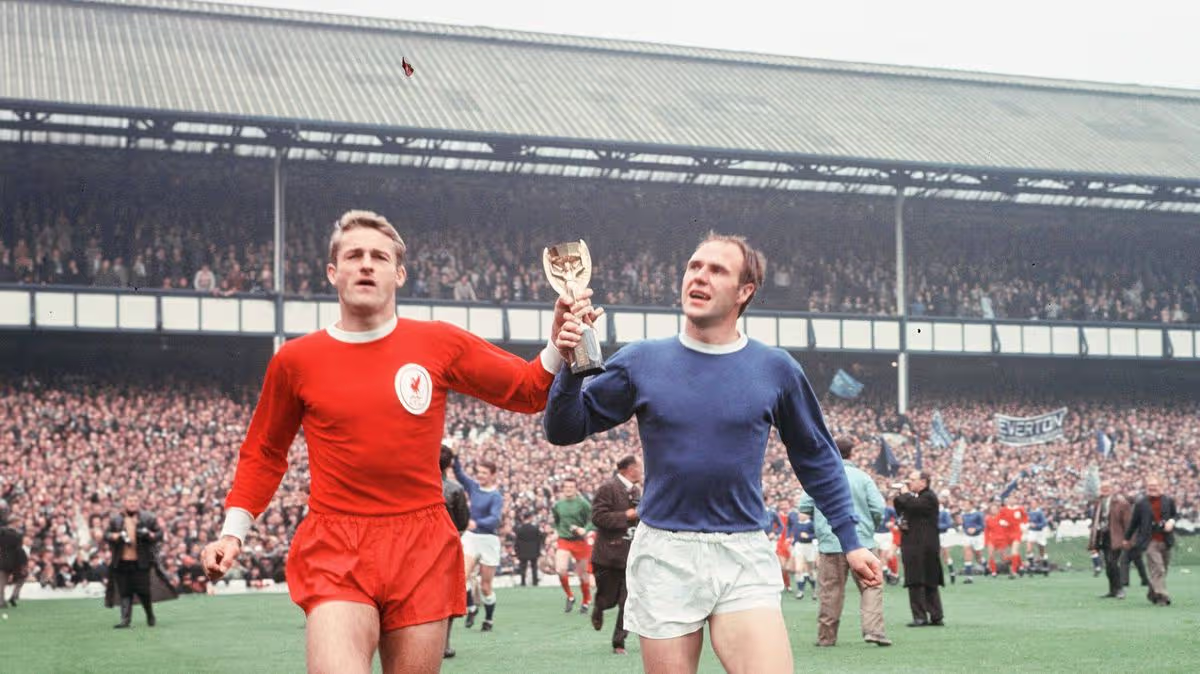


Ray Wilson’s name is etched forever in English football history as the left-back in the 1966 World Cup-winning team, yet the story of his life beyond that immortal summer at Wembley reveals a man of remarkable humility and quiet resilience. On the pitch, Wilson was a cornerstone of Alf Ramsey’s legendary side; at 31, he was the eldest member of the squad and a model of consistency, playing in every match of the tournament. Alongside George Cohen, Jack Charlton, and the captain Bobby Moore, he formed a famously resolute defensive unit, but his contribution was not merely defensive. His intelligent runs and precise crossing were crucial, most memorably setting up Roger Hunt for the opening goal in the semi-final victory over Portugal. Yet, when the celebrations faded and the spotlight dimmed, Wilson embarked on a path that was profoundly ordinary and, in its own way, extraordinary.
After retiring from professional football in 1971, following distinguished service with Huddersfield Town—where he was nurtured by Bill Shankly—Everton, Oldham, and a brief stint as caretaker manager at Bradford, Wilson returned to Huddersfield with his wife Pat, whom he had married in 1956. There, far from the roar of the crowds, he chose a second career that stood in stark contrast to his first: he became an undertaker. Joining his father-in-law’s funeral business, he embraced this new vocation with the same dedication he had shown on the football field. It was a practical choice, a means to provide for his family, but also one that required sincere commitment. So determined was he to master the craft that he returned to education to obtain the necessary O-level qualifications, demonstrating a work ethic that transcended his sporting fame.
Wilson ran the funeral firm with quiet professionalism until his retirement in 1997. To those who knew him, he was noted for his dry wit and unassuming nature. His former teammate George Cohen once recounted that when Wilson learned of Cohen’s cancer diagnosis, he phoned and deadpanned, “I was ringing to offer you a deal,” a typical blend of dark humour and underlying warmth. This anecdote captures the essence of the man: a World Cup hero who never sought the limelight, preferring the grounded realities of family and community life. His 63 caps for England and his pivotal role in the nation’s greatest sporting achievement were chapters in his life, not the definition of it.
In 2000, Wilson’s service to football was formally recognized with an MBE, a belated honour for his part in the 1966 triumph. He reflected on that victory with characteristic modesty, telling a journalist, “We were basically a defensive team. That was the first quality of the team,” underscoring the collective discipline over individual glory. However, personal challenges soon emerged. In 2004, he was diagnosed with Alzheimer’s disease, a cruel blow that slowly eroded the memories of the very triumphs he had helped create. He lived with the condition for 14 years before passing away in May 2018 at the age of 83.
His legacy, however, endured. In 2016, Huddersfield Town honoured him with a special second-change kit bearing the tagline “Legends Are Rarely Made,” a fitting tribute to a player who remained deeply connected to his hometown club. His story is a poignant reminder that a legend is not only forged in moments of universal celebration, but also in the choices made in everyday life. Wilson’s transition from World Cup hero to funeral director speaks of a profound sense of duty, a rejection of celebrity, and an embrace of a quiet, purposeful existence.
Ray Wilson’s life narrative—from Shirebrook to Wembley, and from the pitch to the funeral home—offers a unique lens on the human dimension behind sporting iconography. It is a tale not just of footballing greatness, but of adaptability, humility, and quiet strength. In a world often obsessed with perpetual stardom, Wilson’s journey reminds us that true legacy can be built in the unassuming chapters after the final whistle, in the steadfast commitment to family and craft, and in the grace with which one navigates life’s latter challenges. He remains, in every sense, a rare legend.