



Youth is a dizzying, almost magical orbit above the mundane world, a time when everything feels possible and identity is a thrilling work in progress. It is, as the article suggests, the most formative era of our lives. Yet, for all its universal power, the raw, creative energy of youth has rarely been granted its own permanent home in the cultural landscape. That changes now with the opening of the Museum of Youth Culture in London’s Camden, a district long synonymous with subcultural rebellion. Founded by archivist Jon Swinstead after a twenty-five-year journey, the museum represents a collective dream to finally place young people—their history, their expression, their very essence—at the heart of our shared heritage.
The museum’s mission is to celebrate how young people have actively shaped history and continue to mould our future. As Creative Director Jamie Brett notes, the teenage years—that potent, hormonal mix of biological change and burgeoning independence—have been a “completely overlooked part of heritage.” This museum seeks to rectify that, dedicating time and space to the amazing scenes and subcultures born from this volatile, vibrant life stage. It is an act of recognition, insisting that the passions and rebellions of youth are not trivial phases but vital cultural forces worthy of preservation and respect.
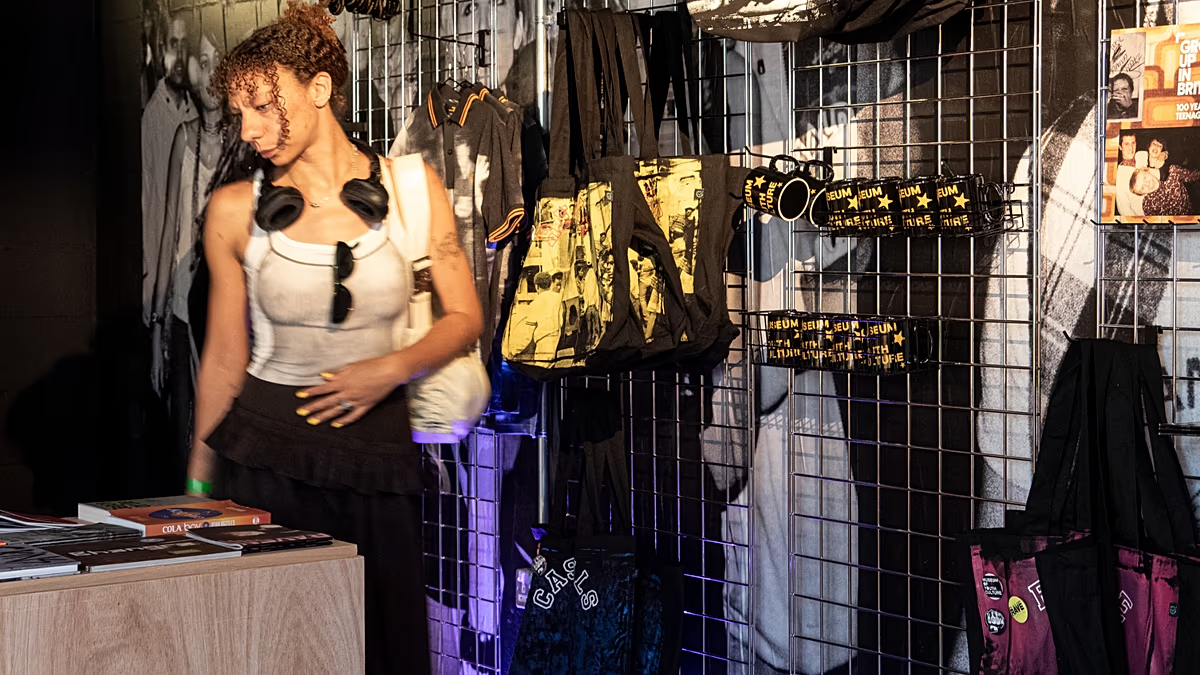
Stepping into the museum is designed to feel like entering your best friend’s bedroom: an intimate, subterranean space packed with personal photos, gig flyers, teenage trinkets, and handwritten confessions. Above, a bar and shop blend industrial and nostalgic decor, where the clack of a foosball table meets arcade game blips and vintage band t-shirts. While compact, its main archive spans a century, from 1920s flappers to 1990s female DJs battling for space in male-dominated clubs. Crucially, this is a living collection. Much of the material is crowdsourced through initiatives like the “Grown Up In Britain” campaign, gathered by staff like Archive Projects Manager Lisa der Weduwe, who travels across the UK collecting personal stories and ephemera.
The power of the exhibition lies in its evocative simplicity. Artefacts often bear just a name, year, and location, inviting visitors to fill in the gaps with their own memories. In these snapshots—whether of 1980s goths or 2000s emos—we see our own blunder years reflected. This visual dialogue underscores a universal truth: across decades and subcultures, youth is a time of unrestrained expression, a brief period when the world feels like ours to rebel against and reshape. As der Weduwe observes, “Young people coming together and finding themselves and finding each other really shapes so much of society.”
The museum naturally prompts the question: what defines a youth subculture? Here, it focuses on those tribes formed around distinct music and fashion—mods, punks, goths, ravers—whose defiant values consciously reject mainstream ideals. While some fear that the digital age has homogenised culture or replaced tangible community, the museum argues that subcultures have simply evolved. Today’s teenage K-pop fans, for instance, with their coordinated style and shared passion, embody the same spirit, seamlessly blending online connection with real-world gathering. Subcultures, the museum asserts, are not extinct; they move with the times, proving that the human need to belong and to define oneself against the status quo remains undimmed.
Ultimately, the Museum of Youth Culture aspires to be more than a repository of the past; it is determined to be a dynamic, intergenerational space focused on the future. In an era where austerity has shrunk youth spaces and their voices are often sidelined, the museum aims to be a platform “to have a space to be and to do.” This forward-looking ethos is embodied in exhibitions curated by young people themselves, such as the UK Youth collective’s “Things I lied to my parents about,” which explores identity formation and necessary rebellion. Like youth itself, the museum is still figuring things out, ready to be steered by those it serves. For visitors, it is a poignant reminder that while we may grow old, we were all young once, and the core desires for belonging, creativity, and self-invention connect every generation. It is, as the article concludes, definitive proof that it was never just a phase.