

Of course. Here is a humanized and expanded summary of the content, crafted into six cohesive paragraphs.
Paragraph 1: An Introduction of Artistic Kinship
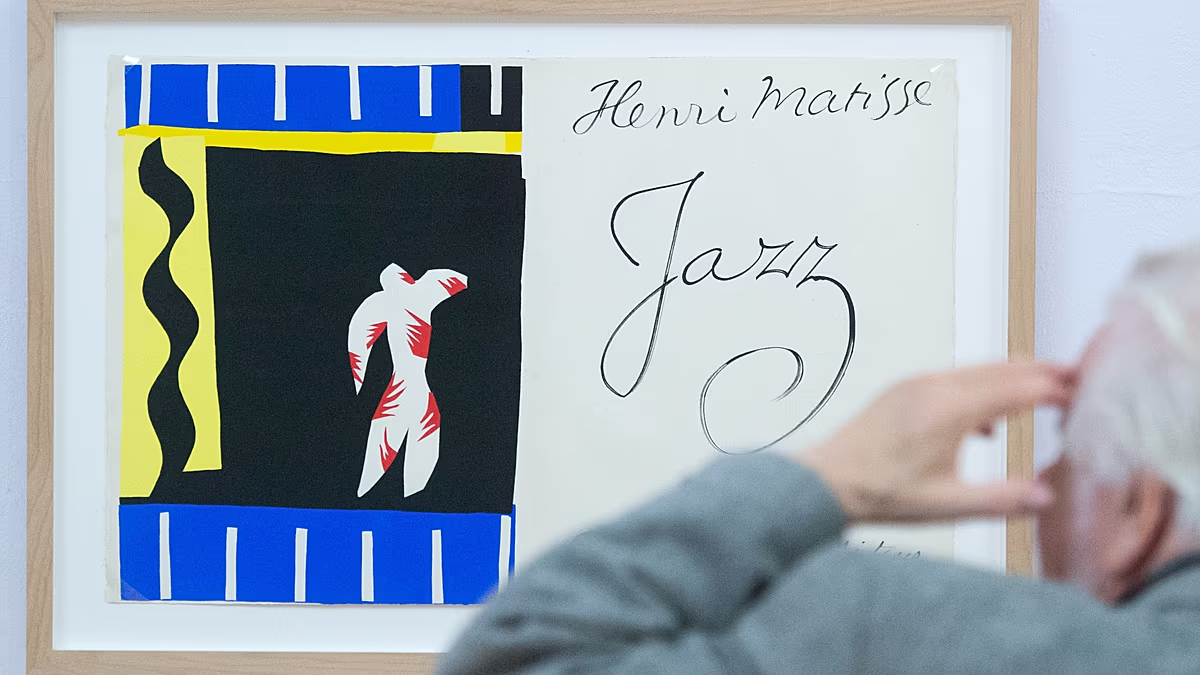
In the sun-drenched city of Nice, France, a remarkable conversation between two giants of 20th-century creativity is unfolding. The Musée Matisse Nice, nestled in the vibrant Cimiez neighborhood, has become the stage for a groundbreaking exhibition that pairs the revolutionary painter Henri Matisse with the iconic fashion designer Yves Saint Laurent. This is not merely a side-by-side display; it is a deep, curatorial exploration of a shared visual language. By bringing together 160 of their works, the exhibition proposes a powerful thesis: that the spirit of Matisse’s liberated color, sensual form, and joy de vivre found its most direct and magnificent descendant not in another painter, but in the atelier of a master couturier. It invites us to see the drape of a gown with the same eye we use to admire the sweep of a brushstroke.
Paragraph 2: Thematic Dialogues Across a Century
Walking through the galleries, visitors are guided not by chronology, but by a symphony of themes that obsessed both artists. One room pulsates with what Matisse called his “arabesques”—those sinuous, flowing lines that define the curves of a nude or the tendrils of a plant. Here, these lines leap from his canvases and drawings to manifest in the voluptuous contours of a Saint Laurent evening dress, where fabric itself seems to breathe and move like a living drawing. Another space is an explosion of color, celebrating their mutual love for bold, unmodulated hues. The electric “Yves Klein blue” of a tailored jacket dialogues with the radiant vermillion of a Matisse interior, while the sunny ochres of Morocco, a land that inspired both men, warm the entire ensemble. The exhibition deftly illustrates how Saint Laurent translated Matisse’s pure painterly joy into wearable emotion.
Paragraph 3: More Than Inspiration – A Language of Form
The connection goes beyond superficial inspiration into the very grammar of their art. The exhibition highlights their shared fascination with the concept of “decorative” as a supreme virtue, not a dismissal. For Matisse, patterning—from floral wallpapers to intricate textile designs—was a crucial element of composition. Saint Laurent, a virtuoso of print and texture, elevated this principle, turning the female body into a dynamic canvas where pattern interacted with movement. Furthermore, the show reveals a profound dialogue with the female form itself. Matisse’s odalisques, with their languid grace and exoticism, are reimagined in Saint Laurent’s powerful, structured yet sensual “Le Smoking” tuxedo or in the transparent blouses that hinted at liberation. Both artists explored facets of femininity, from intimate reverie to empowered spectacle.
Paragraph 4: The Practicalities of a Must-See Event
This exceptional exhibition, titled “Matisse / Saint Laurent,” is a once-in-a-decade opportunity to witness this dialogue materialize so comprehensively. It opened in the spring and will remain on view until 28 September 2026, offering ample time for art and fashion enthusiasts from across the globe to make a pilgrimage to Nice. The Musée Matisse itself, housed in a 17th-century Genoese villa surrounded by Roman ruins and olive groves, provides a perfectly serene and luminous setting for this vibrant display. The museum’s permanent collection of Matisse’s work, donated by the artist himself, forms a resonant backdrop, allowing visitors to extend the exhibition’s themes into a deeper study of Matisse’s own evolution.
Paragraph 5: The Human Legacy Behind the Icons
To humanize these monumental figures, the exhibition also touches on the personal threads that bind them. Both Matisse and Saint Laurent were artists who worked in series, obsessively refining a single idea—be it the theme of the dance or the structure of a Mondrian-inspired dress. Both struggled with periods of intense anxiety and found solace and explosive creativity in the luminous light of North Africa. And crucially, both understood their work as a vocation dedicated to creating happiness and beauty. Seeing a simple Matisse cut-out of a leaf beside a delicately embroidered leaf motif on a Saint Laurent cape reminds us that at its heart, this is a story about two men who found endless wonder in the world’s visual poetry and dedicated their lives to reshaping it for others.
Paragraph 6: A Concluding Reflection on Enduring Influence
Ultimately, the exhibition is a celebration of influence that transcends mere imitation. It shows how a visual legacy can be inherited, translated, and re-energized across different mediums. Saint Laurent did not copy Matisse; he thought like him. He understood that color could be emotional armor, that line could dictate attitude, and that design at its best is a profound art form that shapes how we see ourselves and interact with the world. As visitors leave the museum, they carry with them a new, unified vision: the painter who dreamed of an art of balance and serenity, and the designer who made that dream walk down the street. It confirms that great art is never confined to its frame; it can flow from a museum wall onto the fabric of our lives, as timeless and exhilarating today as it was when first conceived.