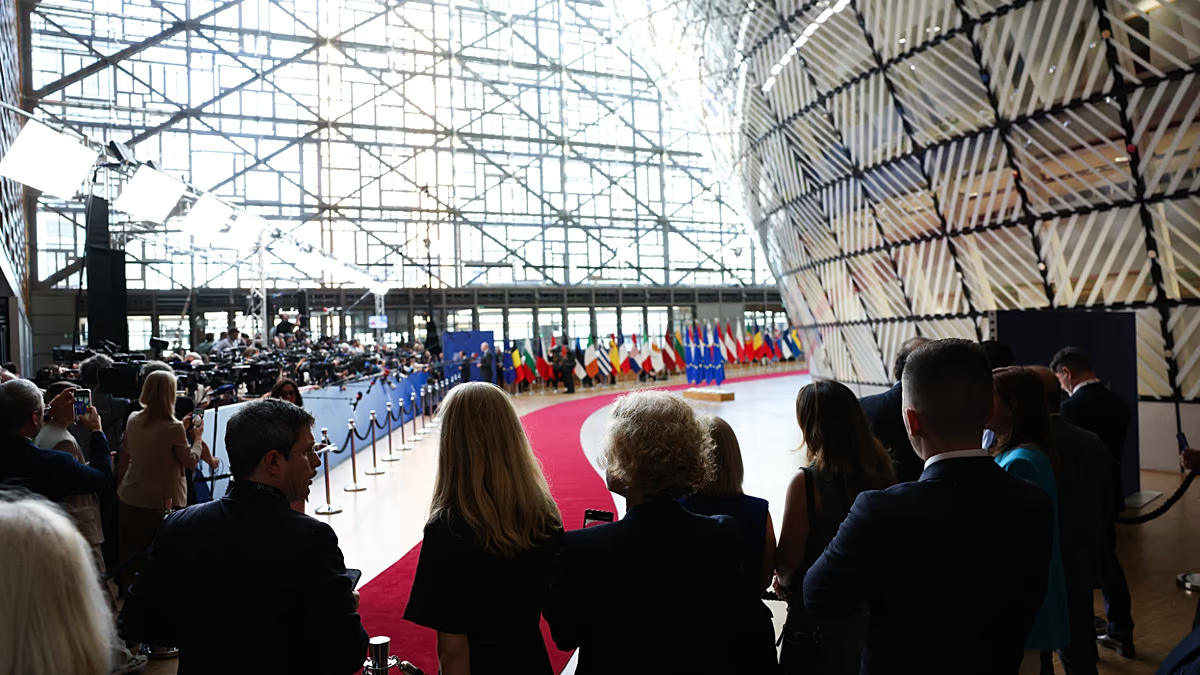


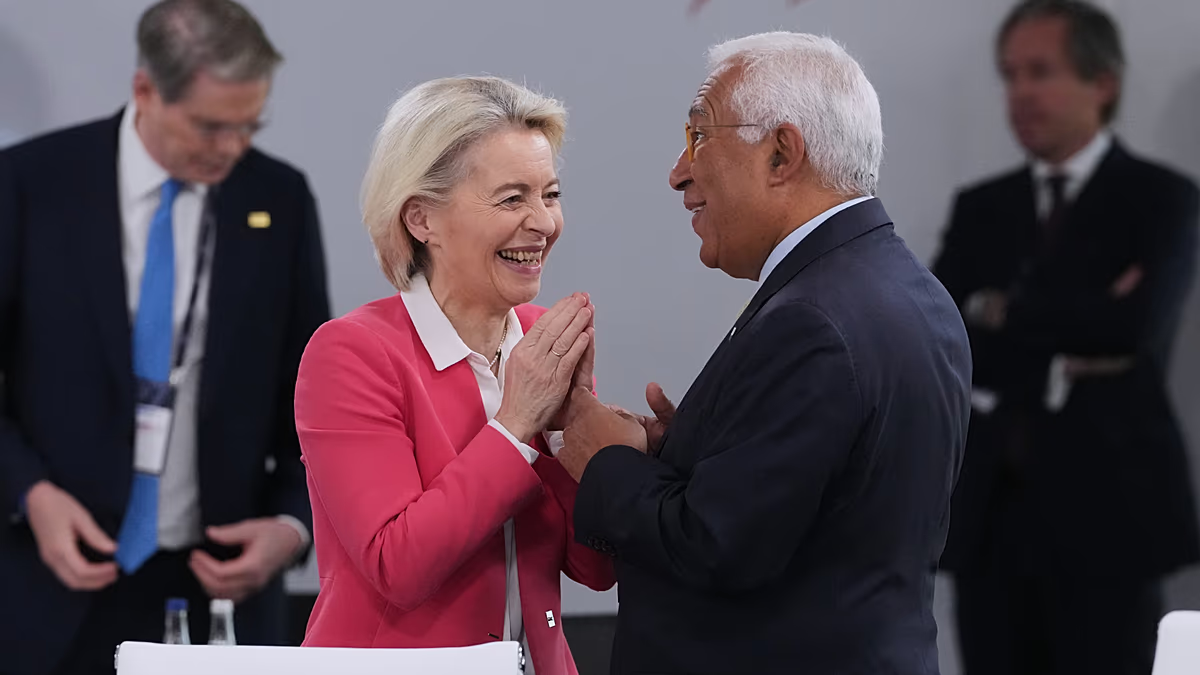
In a significant and private discussion among European Union leaders this Thursday, a nuanced debate unfolded regarding the future of diplomacy with Russia concerning the war in Ukraine. European Commission President Ursula von der Leyen presented a cautiously optimistic assessment, arguing that the current moment may be opportune to begin preparing for potential negotiations. She emphasized that while the European Union should start considering a formal mandate to engage in peace talks, the ultimate authority must remain unequivocally with Kyiv, ensuring Ukraine retains full control over its diplomatic destiny. Von der Leyen bolstered her position by pointing to economic data suggesting that the extensive sanctions regime is indeed applying severe pressure, with the Russian economy purportedly running out of steam and inflation rising. Furthermore, she expressed a belief that the military momentum on the battlefield is shifting remarkably in Ukraine’s favor, a turning tide that could strengthen its hand in any future diplomatic forum.
However, this suggestion of preparatory talks was immediately enveloped in controversy, largely due to revelations earlier in the week about a separate, discreet diplomatic initiative. It emerged that European Council President António Costa, who coordinates the EU’s 27 member states, had instructed his chief of staff to open a communication channel with the Kremlin, specifically reaching out to a senior aide of Russian President Vladimir Putin. While Costa informed von der Leyen beforehand, only a select few national leaders were consulted, leaving many to learn of the move through subsequent media reports. This lack of broad consultation caused palpable unease as leaders gathered in Brussels, exposing deep-seated divisions within the Union regarding the optimal path forward. Several member states, particularly those on the EU’s eastern flank with historical experience of Russian aggression, vehemently opposed the notion that now is the right time for any engagement. They argued instead for doubling down on sanctions to force Moscow into making tangible concessions, viewing even preliminary diplomatic outreach as a potential sign of weakness.
President Costa sought to clarify his actions during the high-level meeting, stressing that he had not initiated formal negotiations but had merely established a line of communication—a step he described as within his institutional purview for coordinating EU positions. The discussions revealed a complex understanding of the EU’s diplomatic mandates. Several leaders pointed out that while Costa has clear authority on bloc-wide issues such as sanctions enforcement, EU enlargement, and the management of frozen Russian assets, matters of fundamental security guarantees fall under the sovereignty of individual member states. Consequently, they suggested that any substantive negotiations on security should be led by the existing “Coalition of the Willing,” a group spearheaded by France and the United Kingdom, rather than by a single EU representative. Costa himself firmly agreed, acknowledging that no EU figure could possibly negotiate on territorial matters on behalf of Ukraine, a principle that is non-negotiable.
The perspective from Kyiv, as conveyed by President Volodymyr Zelenskyy, provided crucial context for the European debate. Zelenskyy has consistently urged Western allies to be prepared for eventual talks with Russia, explicitly requesting that the European Union be present at the negotiating table alongside Ukraine when that time comes. Nevertheless, during Thursday’s discussions, he reiterated his firm conditions for any meaningful diplomacy. Zelenskyy asserted that the only durable path to ending the war is through the continued weakening of Russia’s military and economic capacity. He warned that a mere ceasefire, without robust and enforceable security guarantees for Ukraine, would be entirely insufficient and potentially dangerous. Most importantly, he underscored that the entire concept of an EU negotiation mandate remains purely hypothetical as long as the Kremlin shows no genuine willingness to engage in good faith. Zelenskyy stressed that Vladimir Putin currently demonstrates no readiness for serious talks, implying that premature diplomatic formalism could be counterproductive.
The closed-door meeting thus laid bare the delicate tightrope the European Union must walk. On one side is the pragmatic need to prepare for a potential diplomatic endgame, ensuring the EU is not caught flat-footed should a negotiation window suddenly open. Von der Leyen’s comments reflect this strategic foresight, grounded in a belief that Ukraine’s fortified position—both militarily and economically—creates a new dynamic. On the other side is the imperative of maintaining absolute unity and pressure, a principle championed by the eastern member states who fear that any perceived softening could fracture the international coalition and embolden Moscow. The controversy over Costa’s unilateral channel highlights the profound sensitivity of these steps and the absolute necessity for transparent coordination among all 27 members to preserve trust and a common front.
In conclusion, the EU leaders’ discussion marks a subtle but notable evolution in the European stance, moving from a unified focus solely on sanctions and military support to a parallel, albeit contentious, consideration of long-term diplomatic scaffolding. The consensus, however fragmented, appears to center on several key pillars: any process must be Ukrainian-led; the EU’s role is to support, not supplant, Kyiv’s authority; and substantive talks cannot commence without a demonstrable shift in Russia’s posture. For now, the path forward involves a dual track: intensifying pressure to change Moscow’s calculus while cautiously constructing the diplomatic frameworks that would be necessary to secure a just and lasting peace, whenever that possibility truly emerges. The coming months will test whether the Union can balance these two imperatives without compromising the unity that has been its greatest strength throughout the conflict.