



In a striking departure from the typically guarded language of diplomatic discourse, Italian Prime Minister Giorgia Meloni has issued a forceful public rebuttal to former US President Donald Trump, expressing her profound displeasure over comments he made regarding their recent encounter. The incident, stemming from a G7 summit meeting in France, reveals a significant and very public fraying in what was once considered a close political alliance. Meloni, in a social media video, stated she was “shocked” by Trump’s account, which she dismissed as “completely made-up claims.” Her pointed rhetorical question—”I don’t know why the President of the United States behaves this way with his own allies”—underscores a sense of personal betrayal and confusion, elevating a private disagreement into an international spectacle that questions the very foundations of diplomatic courtesy between allied nations.
The controversy centers on Trump’s characterization of his interaction with Meloni, as reported by an Italian journalist. According to these accounts, Trump claimed Meloni was “probably happy I talked to her,” and went on to assert, “She begged me to take a picture with her. She wanted a picture with me so badly. I wouldn’t have taken it, but I felt sorry for her.” This narrative, portraying the Italian Prime Minister as a supplicant seeking his favor, stands in stark contrast to the image of sovereign equality that defines meetings between world leaders. Such remarks are perceived not merely as a personal slight against Meloni, but as a demeaning gesture toward the office she holds and the nation she represents, reducing a formal diplomatic engagement to the level of a trivial and one-sided fan encounter.
This public clash is not an isolated incident, but rather the latest and most personal manifestation of growing tensions between Rome and the Trump administration. Recent months have seen a discernible chill in relations, marked by substantive policy disagreements. Italy’s refusal to support certain US military operations, coupled with Trump’s criticism of the Pope—a figure of immense cultural and moral significance in Italy—have created a bedrock of discord. Against this backdrop, Trump’s comments about the photo appear less like an offhand gaffe and more like a deliberate tactic, potentially aimed at undermining a leader who has charted an independent course or at rallying a domestic base by showcasing dominance over a foreign ally.
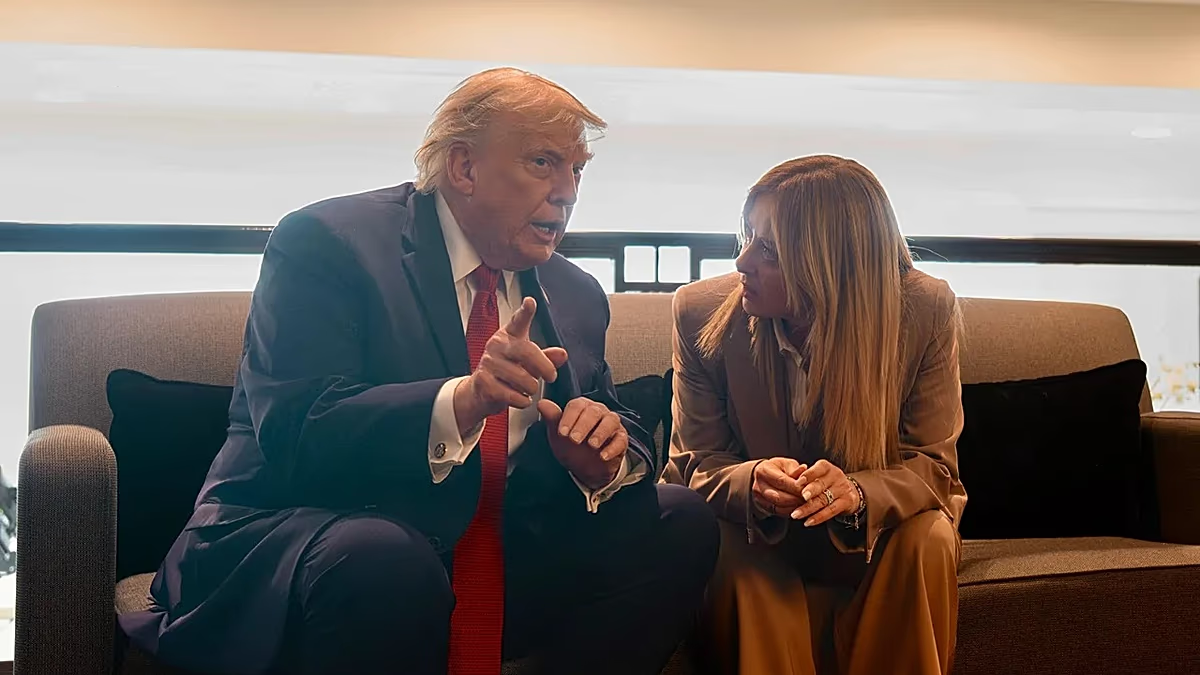
Prime Minister Meloni’s response has been a masterclass in controlled, yet unequivocal, damage control. Prior to Trump’s specific allegations, she had already addressed the broader rumors of tension between them. She framed their dynamic as one between two strong-willed leaders, telling the press, “Donald Trump and I are people with fairly strong characters; we are two people who strongly defend our national interest.” She emphasized that disagreements do not require “clear[ing] the air,” as mutual understanding allows them to resume cooperation with ease. This framing was a strategic effort to project strength, normalcy, and mutual respect. To visually counter Trump’s narrative, her office proactively published official photographs from their meeting, showing a standard handshake and professional engagement, effectively weaponizing imagery to assert her version of events as the official record.
The implications of this spat extend far beyond a war of words between two individuals. It serves as a stark case study in how modern diplomacy is being reshaped by social media, personal politics, and the erosion of traditional norms. When a former and potentially future US President openly mocks a sitting G7 ally, it undermines the collective trust and shared purpose essential to such alliances. For Italy, a nation deeply invested in the transatlantic partnership, the episode is a sobering reminder of its vulnerability to the whims of American domestic politics. For observers worldwide, it highlights a destabilizing trend where personal rapport and public perception can threaten to overshadow critical discussions on global issues like artificial intelligence, security, and economic stability—the very topics ostensibly at the heart of the G7 summit.
Ultimately, this episode transcends the question of whether a photo was requested or not. It lays bare the profound challenges facing international relations in an era of transactional politics and performative statesmanship. Meloni’s shock and public rebuttal reflect a fundamental expectation of dignity and respect that appears to be increasingly negotiable. The coming months will reveal whether this rift can be mended behind closed doors or if it signifies a more permanent recalibration of the Italy-US relationship. For now, the image of two leaders—one claiming pity, the other professing shock—stands as a powerful symbol of a diplomatic landscape where alliances are no longer forged solely in treaties, but are constantly tested in the court of public opinion and personal pride.