




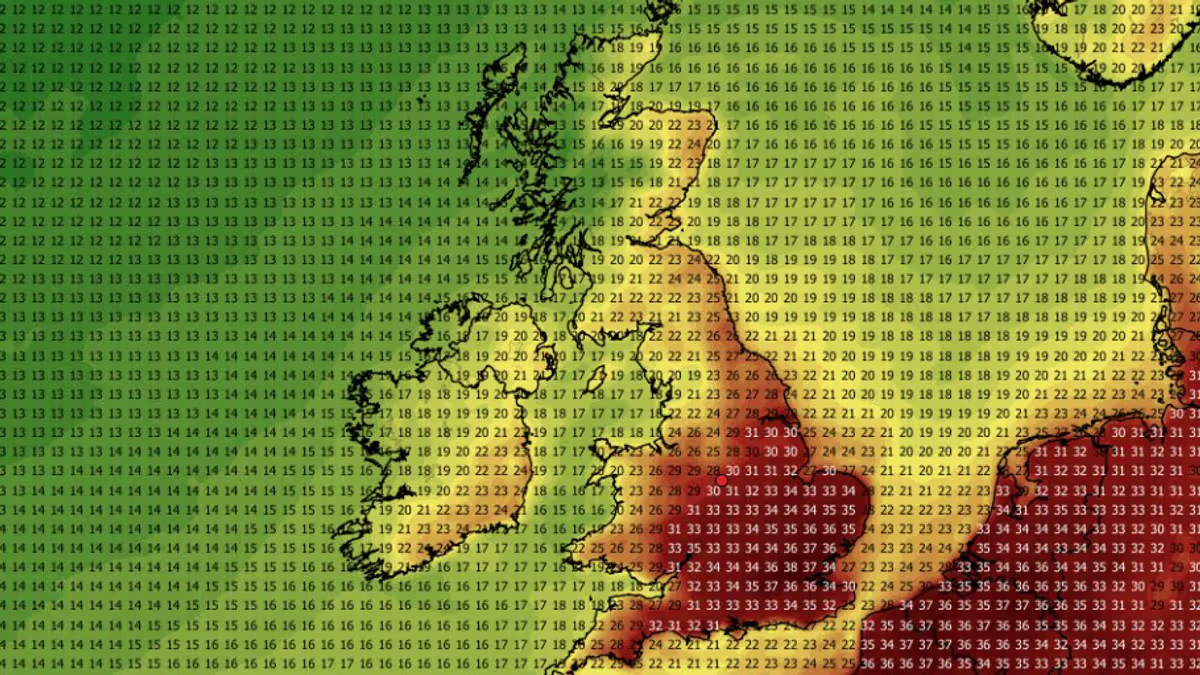
As summer asserts its full presence, the United Kingdom is bracing for an exceptional and potentially historic bout of heat. Forecasters are warning that a building hot spell is set to intensify dramatically across England in the coming days, with the distinct possibility of shattering long-standing temperature records. The focus of this impending heat dome is the capital, where London could see the mercury soar to a staggering 38°C by Tuesday, June 23rd. Simultaneously, a swath of surrounding counties—Essex, Hertfordshire, Kent, Surrey, and Suffolk—could bask in highs of 36°C or more. This event is not merely a warm interlude but a significant meteorological event that has prompted the Met Office to issue serious warnings, as the nation prepares for conditions more commonly associated with continental Europe than the British Isles.
The historical context underscores the severity of this forecast. The current UK record for the hottest June day stands at 35.6°C, a milestone reached in Camden Square, London, and Mayflower Park, Southampton, back in 1957 and later equalled in 1976. This record has remained unchallenged for nearly half a century, making it a formidable benchmark. The Met Office has now stated there is a 40% probability that this record will be broken during this upcoming spell, with advanced modelling even suggesting a jump to 38°C. Such an increase would not just break the record but smash it by a significant margin, underscoring the intensity of the air mass set to envelop the region. There is also a noted, though lower, chance that the June maximum temperature record for Wales could be exceeded.
In response to the looming crisis, the Met Office has escalated its alerts to an amber level for extreme heat, covering a vast portion of the country. This warning is in effect from the early hours of Monday through to late Tuesday night, encompassing 51 areas across the East of England, London, the Southeast, the Southwest, and parts of Wales. An amber warning signifies that temperatures will have a “high impact” on most people, not just the vulnerable. The forecasters are explicit about the risks: adverse health effects are likely, including sunburn, heat exhaustion—characterised by dehydration, nausea, and profound fatigue—and other heat-related illnesses. The public is urged to treat this not as an opportunity for mere sunbathing, but as a serious weather event requiring preparation and caution.
The ramifications of such extreme heat extend far beyond personal health. The national infrastructure, largely designed for a temperate climate, faces severe stress tests. The Met Office warning explicitly notes the expectation of delays to road, rail, and air travel, with potential welfare issues for those stranded in prolonged delays without adequate cooling or hydration. Perhaps more alarmingly, there is an increased risk of failure for heat-sensitive systems and equipment. This raises the spectre of localized power cuts and the loss of other essential services to homes and businesses, as cooling systems strain the grid and electronic components succumb to the sustained high temperatures. The cumulative effect could be a disruptive ripple through daily life and commerce.
Meteorologically, the pattern is clear. The heat is expected to build through the weekend, with Sunday seeing headline highs of around 32°C in the south and southeast, climbing further to potentially 34°C in parts of the south on Monday. This steady crescendo sets the stage for the peak on Tuesday. Deputy Chief Forecaster Gregory Wolverson confirms that areas in the south and southeast are likely to meet the official heatwave criteria—defined as three consecutive days with daily maximum temperatures meeting or exceeding a threshold, which varies by county. His emphasis on the “potential for temperatures to reach the low 30s in the warmest locations” now appears a conservative precursor to the more extreme predictions for Tuesday’s climax.
As Britain looks ahead to the next week, the message from authorities is one of heightened vigilance. This is not a typical summer hot spell; it is an extreme weather event with the power to affect health, disrupt travel, and test the resilience of services. While the sunshine may be inviting, the underlying advice is to seek shade, stay hydrated, check on vulnerable neighbours and relatives, and avoid the peak afternoon sun. The coming days will reveal whether the UK’s June record, a relic from 1957, will finally fall, potentially ushering in a new benchmark for summer heat in the national consciousness. The event serves as a potent reminder of the increasing frequency and intensity of such extremes in a changing global climate.