


The Rising Economic Toll of Extreme Heat in Europe
A stark new report from Allianz Trade sounds a sobering alarm for Europe’s largest economies: extreme heat is rapidly escalating from a seasonal nuisance to a major, sustained drag on economic growth. The analysis projects that by 2030, cumulative GDP losses could reach a staggering 5% to 7% in the most exposed nations, fundamentally reshaping fiscal and industrial landscapes. France stands as the most vulnerable in Europe, facing potential losses of €209 billion over the next five years, followed by Italy (€128bn), Germany (€114bn), and Spain (€104bn). These figures translate the abstract threat of climate change into concrete, daunting numbers for national treasuries. The report’s methodology, which extrapolates from recent record-hot years, presents a plausible near-future scenario that aligns with warnings from institutions like the European Central Bank. ECB Chief Economist Philip R. Lane has underscored the profound historical cost, noting that global GDP per capita could be over 20% higher today had no warming occurred since 1960—a powerful testament to the stealthy, cumulative erosion of prosperity by rising temperatures.
The Dual Burden: Lost Labour and Soaring Energy Costs
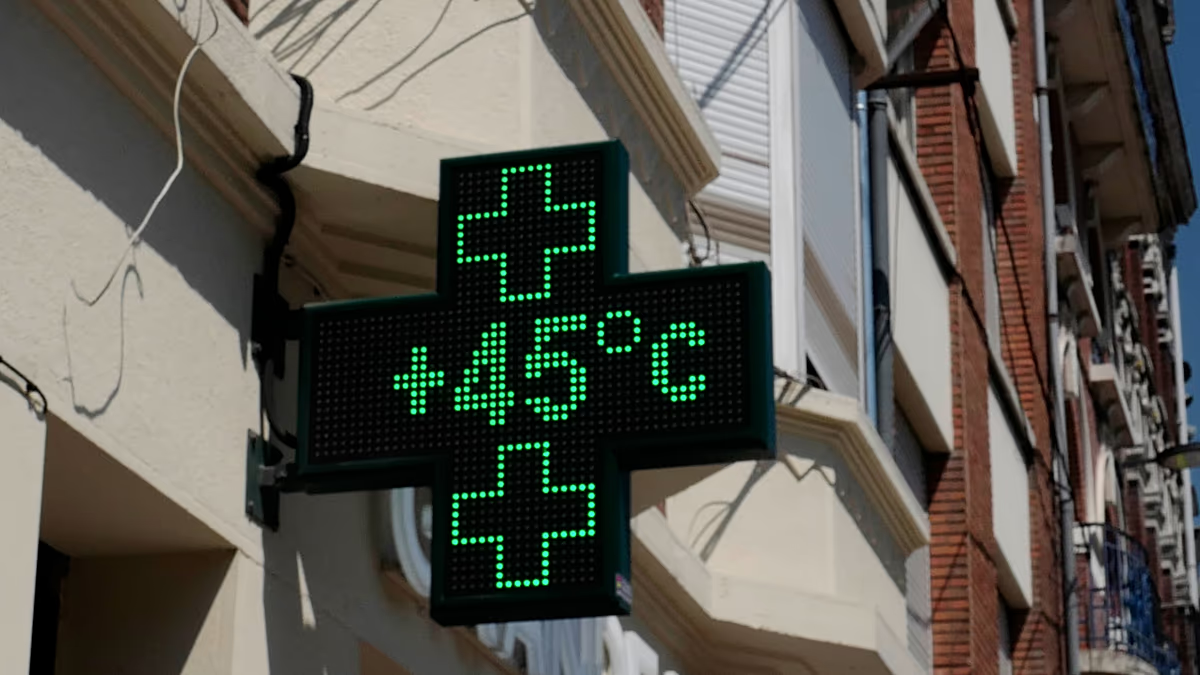
The mechanics of this economic drain are twofold and mutually reinforcing. First, heat directly impairs human capacity. For outdoor workers in construction and agriculture, as well as those in poorly cooled factories, warehouses, or delivery vehicles, productivity plummets as the mercury rises. Allianz Trade quantifies this effect, noting that beyond 30°C, labour productivity falls by about 3% for each additional degree. The physical strain, cognitive impairment, and disrupted sleep caused by relentless heat are silently sapping output. Concurrently, energy demand surges by roughly 1.2% per degree as businesses and households crank up air conditioning. This creates a vicious cycle: a less productive workforce requires more energy simply to maintain basic operational conditions. The strain on energy systems is acute; Europe’s grid, still heavily reliant on thermal power plants (gas, nuclear, coal), is itself vulnerable to heat, which reduces the cooling efficiency and water availability these plants depend on. Past events, like France’s 2019 heatwave which forced nuclear output reductions and spiked electricity prices, offer a preview of this compounding risk.
Broader Economic Repercussions: Investment, Stagflation, and Public Finances
The damage, however, extends far beyond the immediate hit to a day’s work or a monthly utility bill. The report warns that investment is likely to suffer more severely than consumer spending. As extreme heat becomes a recurrent operational and financial risk, businesses may scale back long-term capital expenditure, weakening the economy’s future productive capacity in a self-reinforcing downward spiral. Perhaps most alarmingly for policymakers, Allianz Trade anticipates that heat shocks will generate stagflationary pressures—simultaneously stoking inflation (through supply-chain disruptions and higher cooling costs) and elevating unemployment (from lost productivity). This terrible trade-off poses a nightmare scenario for central banks, particularly the ECB, which must craft a single monetary policy for a bloc where climate exposure varies drastically. Public finances will be squeezed from both sides: tax revenues will shrink alongside economic output, while expenditure will balloon to cover inflation-linked benefits, emergency healthcare, and repairs to melting roads and buckling rail lines.
Fiscal Vulnerability and the Strain on Governance
The fiscal projections are particularly grave. The report estimates annual tax revenue losses could hit 1.8% in France, and 1.3% in Italy and Spain, with fiscal balances deteriorating by an average of 0.5% of GDP annually across affected countries. This pushes already fragile budgets to the brink. Italy and Spain, for instance, risk breaching the EU’s Maastricht deficit limits once heat-related pressures are factored in. France, with a projected 2024 deficit already near the EU’s 3% limit at 4.9% of GDP, could shoulder an additional heat-related burden equivalent to 2.2% of GDP. These numbers suggest that climate impacts are no longer a distant environmental concern but an immediate sovereign risk, challenging the very framework of European fiscal governance and threatening to widen economic disparities between northern and southern member states.
A Patchwork of Preparedness Leaves Gaps
Despite the scale of the threat, Allianz Trade concludes that no major European economy is fully prepared for the economic consequences of extreme heat. While Spain scores relatively well on worker protection regulations and France leads on heat-resilient building standards, no country has yet assembled a comprehensive shield that integrates safeguards for workers, critical infrastructure, public budgets, and vulnerable households. Many nations have adaptation strategies on paper, but these are frequently underfunded, relying on reactive emergency spending after disasters strike rather than proactive, sustained investment. The EU’s overarching “Fit for 55” strategy, aiming for climate neutrality by 2050, is a critical mitigation effort that may also bolster long-term resilience by reducing fossil fuel dependence. However, the report implies that adaptation—learning to live with the heat that is already locked into the system—requires a more urgent and dedicated policy focus at both national and EU levels.
The Path Forward: Collective Action and Equitable Solutions
Addressing this multi-faceted challenge demands action from all sectors. The private sector, including the insurance industry itself, has a role in incentivizing resilience. Households, who hold some €40 trillion in financial assets across Europe, can invest in insulation, efficient cooling, and adequate insurance. Yet, the report issues a crucial caveat: such market-driven solutions risk exacerbating inequality. Lower-income households, often living in the least insulated homes and holding jobs most exposed to heat, are the most vulnerable yet least able to afford these upgrades. Therefore, while private initiative is essential, it cannot replace targeted government support. Public policy must ensure that adaptation does not become a privilege for the wealthy but a shared societal project, funded by long-term commitment and designed to protect the most exposed workers and communities. Ultimately, the Allianz Trade report frames extreme heat not merely as a weather pattern, but as a formidable economic force—one that Europe must now reckon with through unity, investment, and an unwavering focus on equity to prevent a future where summers systematically undo the progress of springs.