


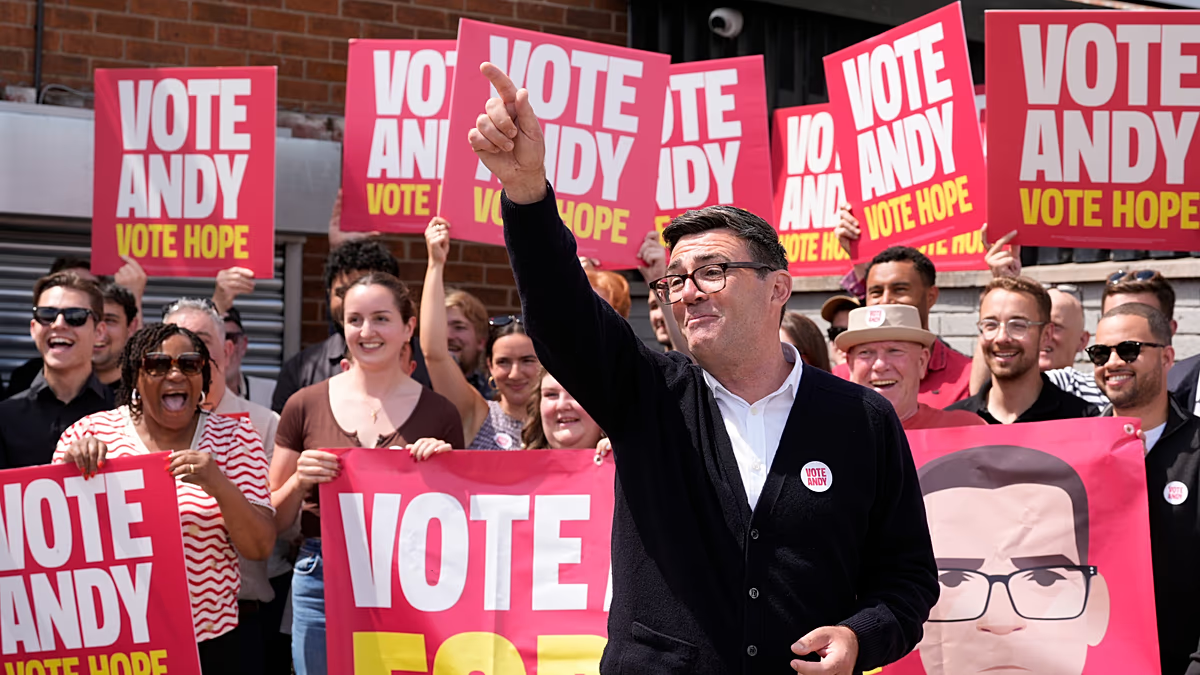
In a political upset that has sent shockwaves through the United Kingdom, Greater Manchester Mayor Andy Burnham has decisively won the Makerfield by-election, triumphantly returning to Parliament and positioning himself as the most potent challenger to the beleaguered Prime Minister, Keir Starmer. The election, forced by the resignation of sitting MP Josh Simons to explicitly clear a path for Burnham, was framed as a direct referendum on Starmer’s leadership. Burnham secured a commanding victory with 24,927 votes, representing roughly 55% of the total. This resounding win, against a second-place finish for Reform UK and a distant third for the fringe Restore Britain party, provides Burnham with an undeniable mandate and a powerful platform from which to launch his ambitions.
The context of this victory is crucial, arriving on the heels of what many within the Labour Party have termed a “nightmare” set of local election results in May. Those elections saw Labour bled dry by a resurgent Reform UK, Nigel Farage’s populist outfit, which siphoned off votes from a disillusioned electorate. Within this climate of internal panic and external threat, a significant faction of Labour MPs has come to view Andy Burnham not merely as an alternative, but as the party’s best—and perhaps last—hope for recovery. They see in him a figure capable of reconnecting with the voters Labour has lost, bridging divides, and presenting a vision compelling enough to stall Reform’s alarming advance.
From the moment of his victory speech, Burnham framed his win not as a personal triumph, but as a stark warning and a final opportunity for his party. His words were pointed and laden with consequence. “There will be no second chance,” he declared, asserting that Labour now possesses a “final chance to change.” He outlined a clear fork in the road: one path leading toward a “new politics based on unity and hope,” and the other descending into the “divided, dark politics” seen in nations like the United States. His message was a clear repudiation of the current political trajectory under Starmer, advocating instead for a radical shift towards reconciliation and practical, unifying governance to “get things working properly again.”
Prime Minister Keir Starmer, facing relentless calls for his resignation since the May debacle, had little choice but to publicly acknowledge the result. In a social media post, he offered congratulations to Burnham, attempting to co-opt the win for the broader Labour brand by stating voters had chosen “Labour’s campaign of hope and optimism over division and hate.” However, this rhetorical framing rings hollow to many observers, as it was unmistakably Burnham’s personal brand of hopeful optimism that carried the day, not Starmer’s. The result intensifies the pressure on the Prime Minister, transforming internal grumblings into a fully-fledged and very public leadership crisis, with Burnham now holding the tangible authority of a parliamentary seat.
The political dominoes have already begun to fall. Former Health Secretary Wes Streeting, a prominent figure within the party, has swiftly signaled his intention to stand in any potential leadership contest to replace Starmer. This move confirms that the question is no longer if Starmer’s leadership will be challenged, but when and by whom. Burnham’s re-entry into Westminster fundamentally alters the dynamics of any such contest; he is no longer a regional mayor speaking from the sidelines, but an elected MP with a fresh, popular mandate. His presence in the parliamentary chamber will serve as a daily, living reminder of an alternative available to disaffected Labour lawmakers.
Thus, the Makerfield by-election has transcended a simple parliamentary contest. It has become the catalyst for a profound struggle over the soul and future of the Labour Party. On one side stands Keir Starmer, a prime minister weakened by electoral setbacks and struggling to define a winning message. On the other emerges Andy Burnham, portraying himself as the architect of a necessary rebirth, aiming to heal national divisions and reclaim lost voters. The coming weeks and months will determine whether Burnham’s victory speech indeed marked the “final chance” for Labour to change course, or whether it was the opening salvo in a protracted civil war that could reshape British politics for years to come. The nation, and a watching world, now waits to see how this high-stakes drama will unfold.