


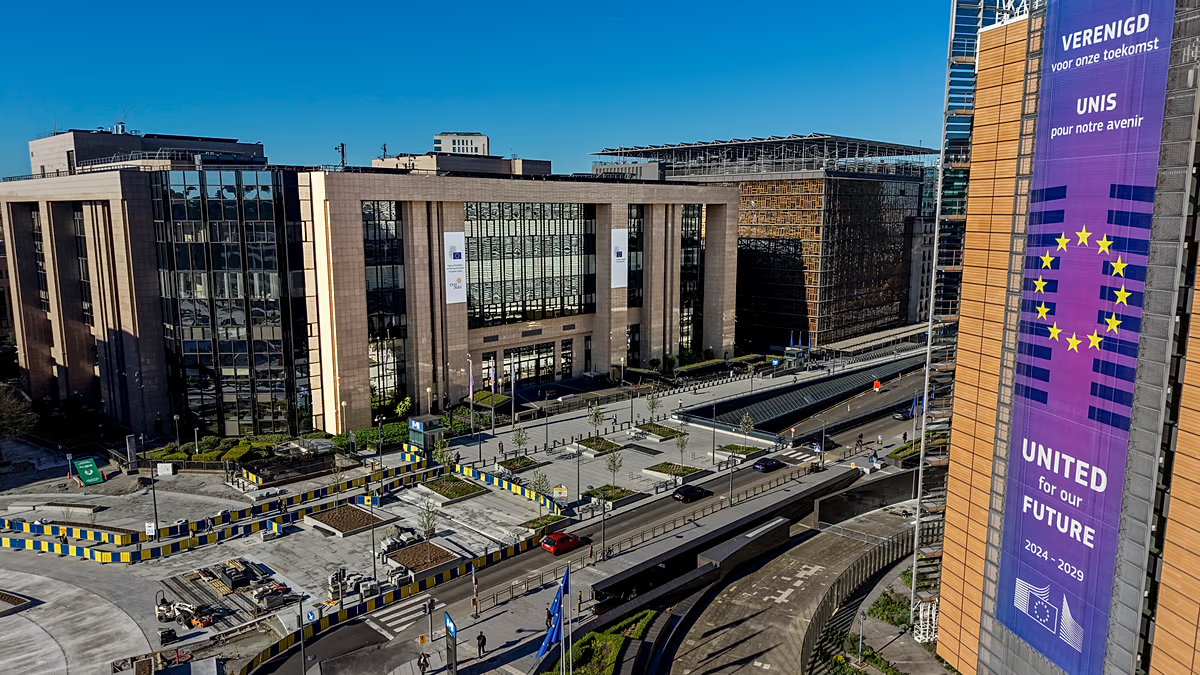
The European Union stands at a pivotal moment, embarking on complex negotiations to define its financial roadmap for the years 2028 to 2034. At the heart of the debate is the bloc’s immense Multiannual Financial Framework, a budget exceeding €2 trillion that will shape the continent’s priorities for the better part of a decade. As leaders prepare for a critical summit in Brussels, the Union is starkly divided, not merely on numbers, but on the very vision for Europe’s future. This is more than a technical exercise; it is a profound test of solidarity and shared ambition, pitting the economic realities of today against the strategic challenges of tomorrow.
The fault lines are clear and deeply entrenched. On one side stands a coalition of net-payer nations, often termed the “frugal countries”—Germany, the Netherlands, Denmark, Sweden, Finland, and Austria. Their primary stance is one of fiscal restraint, arguing that in an era of high national debt and economic uncertainty, the EU budget cannot simply expand. They firmly oppose any increase in overall spending, advocating instead for a reallocation of existing funds. Across the table are the “Friends of Cohesion,” a formidable group of 16 nations primarily from Southern and Eastern Europe, including Italy, Poland, Spain, Greece, and Hungary. They warn that disproportionate cuts would come at the expense of traditional pillars of EU solidarity: the Common Agricultural Policy (CAP) and cohesion funds designed to reduce economic disparities between regions. They fear that slashing these areas would fundamentally undermine the Union’s promise of convergence and shared prosperity.
The Cypriot presidency, tasked with steering these delicate talks, has attempted to bridge this chasm with a proposed compromise: a cut of €32.8 billion from the European Commission’s initial proposal. While framed as a middle ground, this reduction has satisfied no one entirely. The frugal camp views it as a step in the right direction but may press for even greater austerity. Conversely, the Friends of Cohesion and the European Parliament—a co-legislator whose approval is essential—have rejected the Cypriot text as dangerously inadequate. They argue it sacrifices too much on the altars of agriculture and regional development, which are projected to shrink from 60% to 44% of the total budget. The Parliament, representing citizens directly, insists that strategic investment cannot be built on a foundation of diminished solidarity.
Complicating the spending debate is an equally contentious question: how will this budget be paid for? The current proposal leaves revenue streams unresolved. The Commission had suggested innovative “own resources,” such as tapping revenues from the EU’s carbon market (ETS), a levy on imported carbon (CBAM), or taxes on digital services, crypto assets, and gambling. These ideas aim to diversify the EU’s income away from direct contributions from national treasuries. However, they are met with skepticism, particularly from the wealthier frugal states. Sweden and others argue that these mechanisms would still see their taxpayers bearing a disproportionate burden. Furthermore, a separate but related financial bombshell looms: the proposal from Italy, France, and Greece to handle the repayment of the massive pandemic recovery fund (NextGenerationEU) through “rolling debt”—essentially issuing new EU debt to repay old maturing debt. For Germany and the Netherlands, this is a red line, representing an unacceptable move toward permanent mutualized debt.
The political calendar adds immense pressure to an already fraught process. EU leaders are acutely aware that 2027 will be a major election year across the continent, with pivotal votes in France, Italy, and Poland. Negotiations spilling into that period would risk politicizing the budget to an untenable degree, potentially freezing progress altogether. The stated goal is therefore to reach a consensus by the end of 2026. Yet, the path to agreement is narrow, as any final deal requires the unanimous approval of all 27 member states and the consent of the European Parliament. This sets the stage for a high-stakes game of political brinkmanship, where every euro cut or allocated carries symbolic and practical weight far beyond its numerical value.
Ultimately, these negotiations represent a fundamental choice for the European Union. They must balance the immediate need for investment in common defense and the green transition—areas demanding significant new resources—against the enduring commitment to its farmers and less developed regions. It is a struggle between those who see the budget primarily as a balance sheet and those who view it as a binding treaty of mutual support. The outcome will reveal whether the EU can craft a budget that is both strategically forward-looking and socially equitable, proving that its unity is not just a fair-weather concept but a resilient partnership capable of navigating the storms of disagreement to secure a shared future. The numbers on the page will tell a story of who Europe believes it is and who it aspires to become.