



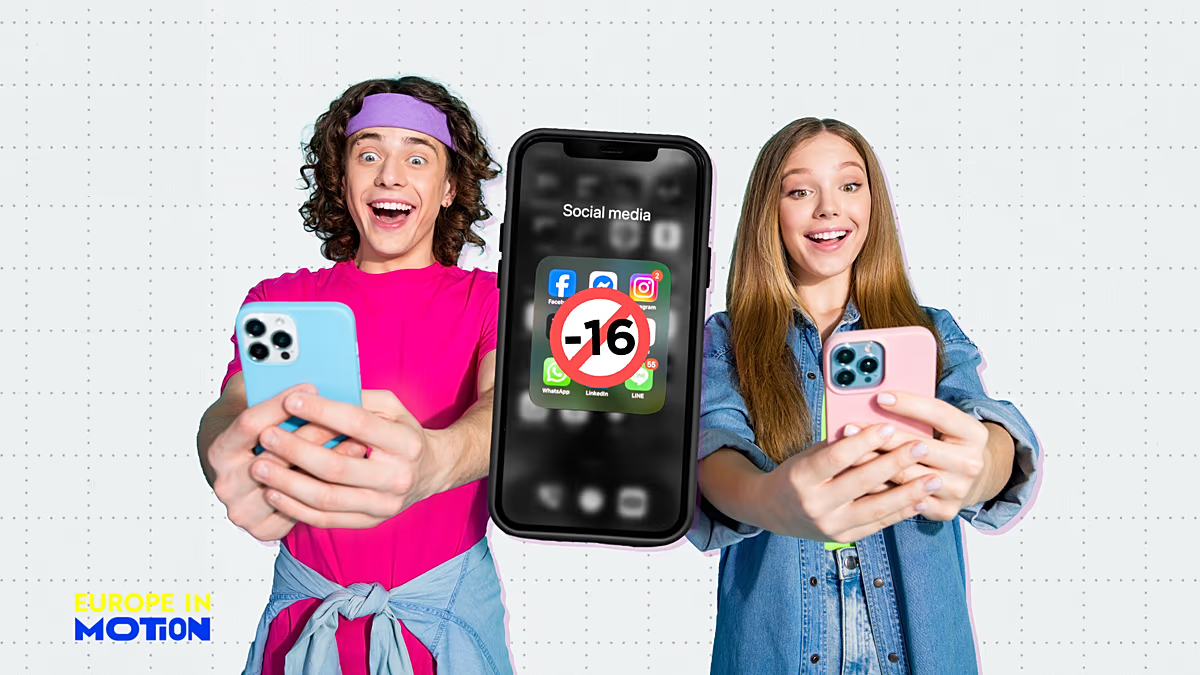
Across Europe, a significant and emotionally charged debate is intensifying as governments grapple with how to protect children and teenagers in the digital age. Sparked anew by the UK’s recent considerations, the conversation centers on proposals to ban or severely restrict social media access for young teens. This policy push, resonating from France and Spain to Austria, Greece, and Denmark, is driven by a potent mix of parental anxiety, tragic headlines, and alarming data. The core concerns are multifaceted: the insidious design of platforms that fosters addiction, the pervasive threat of cyberbullying, and the potential links between online experiences and rising rates of teen anxiety, self-harm, and suicide. This movement represents a fundamental societal questioning of how hyper-connectivity is reshaping adolescence, with lawmakers under increasing pressure to act as guardians in a virtual space that often feels beyond traditional control.
The urgency behind these political discussions is underscored by sobering statistics. A World Health Organization-backed study tracking health behaviours in school-aged children found that problematic social media use among adolescents rose significantly, from 7% in 2018 to 11% in 2022. This “problematic use” is not about casual scrolling; it is defined by a behavioural scale that identifies symptoms akin to dependency: an inability to reduce usage, the neglect of offline activities and relationships, and experiencing real-world conflicts or negative consequences due to online time. The data reveals a stark geographical and gendered divide. Nations like Romania, Ireland, and Malta report some of the highest rates, while the Netherlands, Denmark, and Estonia record some of the lowest. More consistently, across nearly all countries surveyed, teenage girls report significantly higher levels of problematic use than boys, with gaps particularly pronounced in Eastern and Western Europe.
This gender disparity points to a deeper, more nuanced reality behind the numbers. Adolescent girls are not only more socially connected online but also navigate a distinctly different—and often more hazardous—virtual landscape. Research consistently indicates that girls experience greater pressure related to appearance and body image on these platforms, contributing to higher rates of body dissatisfaction. They also report slightly higher levels of cyberbullying. Furthermore, the study noted that nearly half of 15-year-old girls are in constant online contact with friends, compared to about a third of boys, suggesting that for many girls, social standing and communication are inextricably tied to perpetual online presence. This creates a complex bind where the very tools for social connection and identity formation can simultaneously become sources of profound stress and compulsive behaviour, explaining the heightened vulnerability reflected in the data.
In response to these alarming trends, public support for stringent government intervention is remarkably high. Polls across major European nations show substantial majorities in favour of banning social media for children under 16. This sentiment is especially strong among parents, who often feel outmatched by the technological prowess and persuasive design of these platforms. Governments are heeding this political call. France’s National Assembly has approved a bill to restrict access for under-15s, Spain has proposed raising the minimum age to 16, and the UK’s deliberations are part of this continental wave. However, translating popular will into effective policy is fraught with legal and practical obstacles. European Union rules complicate unilateral national bans, and implementing robust, privacy-compliant age-verification systems presents a formidable technical challenge. Simply ordering apps like TikTok or Instagram to block millions of underage users overnight is neither straightforward nor legally simple.
Crucially, while the political and parental momentum for bans is powerful, the empirical evidence demonstrating their effectiveness remains scant. There are few, if any, long-term, large-scale case studies that clearly show banning social media improves overall teen wellbeing. Critics and experts caution that such blunt instruments could have unintended consequences: they might stifle positive aspects of digital life, such as access to supportive communities, educational resources, and creative outlets, particularly for marginalized youth. Furthermore, bans could drive teenage use underground, making it harder for parents and educators to monitor and guide online behaviour. The risk is that a focus on outright prohibition may divert attention and resources from potentially more impactful measures, such as comprehensive digital literacy education, stronger enforcement against harmful content and design, and support for parental mediation.
The European struggle to balance protection with pragmatism highlights a broader societal crossroads. The debate transcends simple policy; it is a reflection of our collective uncertainty in the face of rapid technological change. The proposed bans symbolize a desire to draw a clear, protective line around childhood, yet their limitations reveal the complexity of governing digital spaces. A sustainable path forward likely lies not in prohibition alone, but in a multifaceted approach. This would combine thoughtful, enforceable regulations on platform design and age verification with a massive investment in educating both children and adults to navigate the online world critically and safely. Ultimately, the goal is not to build a wall around a generation, but to equip them—and those who care for them—with the tools, awareness, and resilience needed to harness the benefits of connectivity while mitigating its profound risks.