

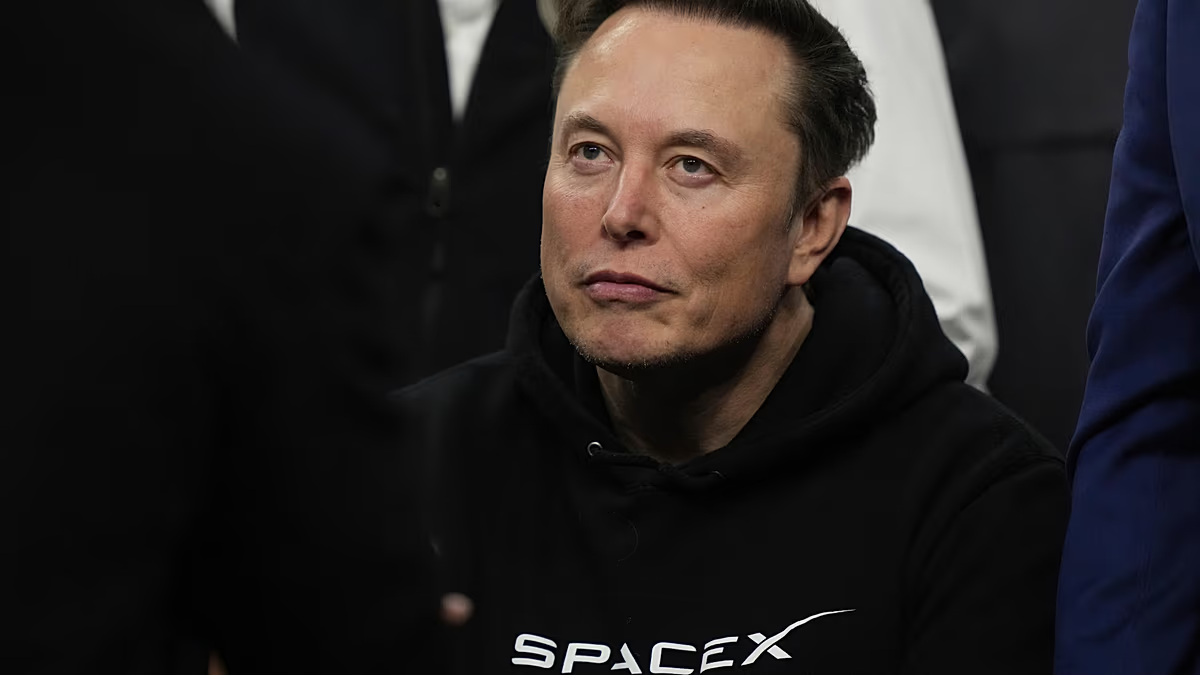
For decades, Elon Musk has been cast by the media as a real-life industrialist of the future, a “Tony Stark” figure relentlessly pursuing ventures that aim to reinvent the way we live. This journey, however, has been a high-stakes saga of near-collapses and improbable comebacks, transforming bold ideas into some of the world’s most influential and valuable companies. His empire now touches almost every frontier of modern technology—from the electric vehicles we drive and the rockets that launch into orbit, to brain implants that could merge human consciousness with computers and the social media platform now known simply as X. More than just a portfolio of separate companies, this sprawling network increasingly operates under his singular vision, making his story one of staggering financial ascension. While he became the first person to amass a trillion-dollar fortune, his path began with remarkably humble transactions, like selling a video game’s source code for $500 as a child, and was built not by cashing out early but by stubbornly holding onto his most ambitious dreams.
Musk’s entrepreneurial spirit ignited early. Born in Pretoria, South Africa in 1971, his first major commercial success came in 1995 with Zip2, an online city guide he co-founded with his brother, Kimbal. After selling it in 1999, he used his $22 million share to launch X.com, an online bank that eventually evolved into PayPal. Its 2002 sale to eBay netted him around $176 million, providing the crucial war chest for the ventures that would define his legacy. With this capital, he made two pivotal bets in quick succession: founding SpaceX in 2002 with $100 million of his own money to revolutionize space travel, and joining Tesla in 2004, investing $80 million to propel electric cars from a niche concept into a global industry. These were not safe investments; Musk himself gave SpaceX less than a 10% chance of success. Yet, these companies became the twin pillars upon which his fortune and influence were built.
SpaceX stands today as a monument to audacious ambition turned into staggering reality. From its risky beginnings, the company has achieved what many thought impossible, drastically reducing launch costs and reinvigorating the space industry. Its recent stock market debut was historic, briefly making it one of the most valuable companies in the world with a valuation soaring past $2 trillion. But SpaceX is now far more than a rocket company. It operates Starlink, a satellite internet service connecting remote corners of the globe, and sits at the heart of Musk’s broader technological ecosystem, closely linked to his artificial intelligence venture, xAI, and the social media platform X. This immense valuation reflects a faith in its future—from orbital data centers to the colonization of Mars—though it is not without its critics or financial realities, as segments like xAI currently operate at significant losses.
Concurrently, Tesla has reshaped the global automotive landscape under Musk’s leadership. He steered the company from a boutique electric car maker to a household name, proving that sustainable transport could be desirable and high-performance. While it now faces fierce competition, particularly from Chinese manufacturers like BYD, Musk consistently frames Tesla’s ultimate value not merely in car sales, but as a leader in artificial intelligence and robotics. The company’s future, he argues, hinges on perfecting fully autonomous self-driving technology and developing its Optimus humanoid robots for widespread use. Beyond vehicles, Tesla’s integration of solar energy and battery storage, stemming from its acquisition of SolarCity, positions it as a comprehensive sustainable energy company. This expansive vision continues to command immense market faith, sustaining its position as one of the world’s most valuable public companies.
Beyond transportation and space, Musk’s ventures delve into profoundly human frontiers. At Neuralink, which he co-founded in 2016, the goal is to create a direct connection between the brain and computers. Though the technology is in its early clinical stages, it has already implanted devices in patients with conditions like ALS and spinal cord injuries, offering a glimpse of a future where such interfaces could restore mobility and communication for those with severe neurological disabilities. Similarly, The Boring Company, founded the same year, tackles the terrestrial challenge of urban congestion with its tunnel-boring technology. Its flagship project, the Vegas Loop, uses modified Teslas to shuttle passengers underground, presenting a novel, if controversial, vision for city transit that has sparked debates over its practicality, safety, and environmental impact.
In essence, Elon Musk’s empire is a testament to a unique and often contentious blend of visionary engineering, relentless risk-taking, and a deep-seated belief in technology’s power to solve humanity’s greatest challenges. From a child programmer in South Africa to the architect of companies that dictate trends in transportation, space, and biotechnology, his journey is defined by an unwavering commitment to his long-term goals. While his companies—from the trillion-dollar giants SpaceX and Tesla to the speculative frontiers of Neuralink and xAI—face valid scrutiny and formidable obstacles, they collectively represent a single, driven mission: to actively shape and accelerate the future. His story is less about accumulating wealth for its own sake and more about deploying that capital as fuel for a perpetual engine of disruption, forever altering our reality here on Earth and beyond.