


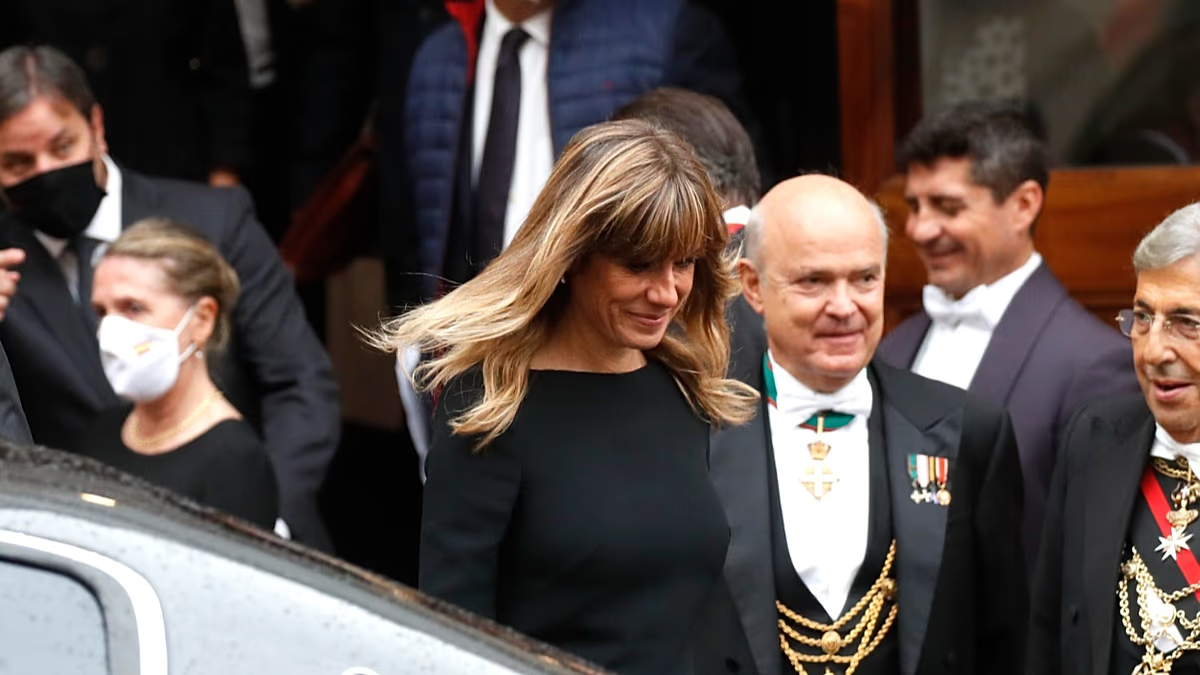
The Spanish political landscape has been profoundly shaken by a judicial order that places the wife of Prime Minister Pedro Sánchez, Begoña Gómez, at the center of a high-stakes corruption trial. In a ruling released on June 20, 2026, Judge Juan Carlos Peinado mandated that Gómez stand trial by jury on serious charges including influence peddling, embezzlement, corruption in business dealings, and misappropriation of funds. Beyond ordering the trial, the judge imposed stringent precautionary measures, requiring Gómez to surrender her passport and appear before the court twice monthly until a verdict is rendered. A similar order was issued for Cristina Álvarez, an adviser at the Moncloa Palace, the prime minister’s official residence. The court explicitly directed all border and airport authorities to enforce the travel ban, signaling a grave assessment of potential flight risk, while a third defendant, businessman Juan Carlos Barrabés, was not subjected to these restrictions. This legal escalation marks a critical point in a case that has simmered for over two years, thrusting the prime minister’s inner circle into a glaring and uncomfortable spotlight.
The heart of the allegations revolves around Gómez’s professional activities, specifically her role in co-directing a chair, or sponsored academic position, at Madrid’s prestigious Complutense University. The investigating judge has argued that this position served as “a means of private professional development” for Gómez, suggesting she may have leveraged her proximity to power and used public resources or personal connections to advance private business interests. The case, opened in April 2024, seeks to determine whether she exploited her status as the prime minister’s wife for personal gain—a claim both she and Sánchez vehemently deny. The proceedings have advanced despite forceful objections from both the Public Prosecutor’s Office and Gómez’s own defense team, who argued at a preliminary hearing this week that the case should be dismissed due to a lack of sufficient evidence for criminal charges. Their pleas were overruled, with the judge siding instead with the accusing parties, who successfully pushed for a jury trial and the strict precautionary measures.
This legal battle is inextricably woven into a fabric of intense political controversy, revealing deep fractures within Spanish society. The case originated from a complaint filed by an anti-corruption organization with reported ties to far-right groups, a detail that Prime Minister Sánchez has seized upon to frame the entire investigation as a politically motivated attack. He has publicly dismissed the allegations as a deliberate strategy by right-wing forces to destabilize his minority coalition government. This framing sets the stage for a dramatic clash between judicial independence and political perception, where every legal maneuver is interpreted through a partisan lens. The judge and accusing parties maintain that the evidence justifies a trial, while Sánchez’s allies see a weaponized judiciary. This polarization complicates the pursuit of impartial justice, turning the courtroom into an extension of the political arena.
The personal and political stakes for Pedro Sánchez could not be higher. The trial of his wife represents the most severe and personal of several corruption scandals that have entangled his family and former associates, collectively posing a significant threat to his government’s stability. Opposition parties have already demanded that the prime minister step down and call early elections, arguing that the moral authority of his administration is irreparably damaged. Sánchez has defiantly rejected these calls, choosing to stand by his wife and confront the allegations head-on. For the Spanish public, the saga forces a difficult confrontation with questions about integrity, privilege, and the blurry lines between personal networking and illicit influence within the highest echelons of power. It tests the resilience of Sánchez’s “sanchismo” political project, which has often presented itself as a bulwark against corruption.
In response to the court’s order, sources close to Begoña Gómez have indicated she will appeal the precautionary measures, particularly the confiscation of her passport. This sets in motion the next phase of a protracted legal conflict, ensuring the case will remain in headlines for the foreseeable future. The path ahead is fraught with uncertainty: a jury trial carries its own unpredictable dynamics, and the outcome, regardless of guilt or innocence, is likely to leave a permanent mark on Spain’s political timeline. An acquittal would be heralded by Sánchez’s supporters as a vindication against smear campaigns, while a conviction would trigger an unprecedented constitutional and political crisis. The proceedings against Gómez are more than a criminal trial; they are a referendum on power, accountability, and the very nature of political opposition in a deeply divided nation.
Ultimately, the case of Begoña Gómez transcends the specifics of a university chair or travel restrictions. It encapsulates a moment of profound tension for Spanish democracy, where legal institutions, media narratives, and political survival intersect. As the trial proceeds, it will scrutinize not only the actions of the prime minister’s wife but also the health of the country’s democratic safeguards. Can the judiciary operate free from the shadow of political warfare? Can a sitting government withstand a scandal of such personal proximity? The answers will shape Spain’s governance long after the final gavel falls. For now, the nation watches as its leader and his family navigate a storm where the personal is inescapably political, and where justice must be seen to be done amidst a cacophony of doubt and division.