


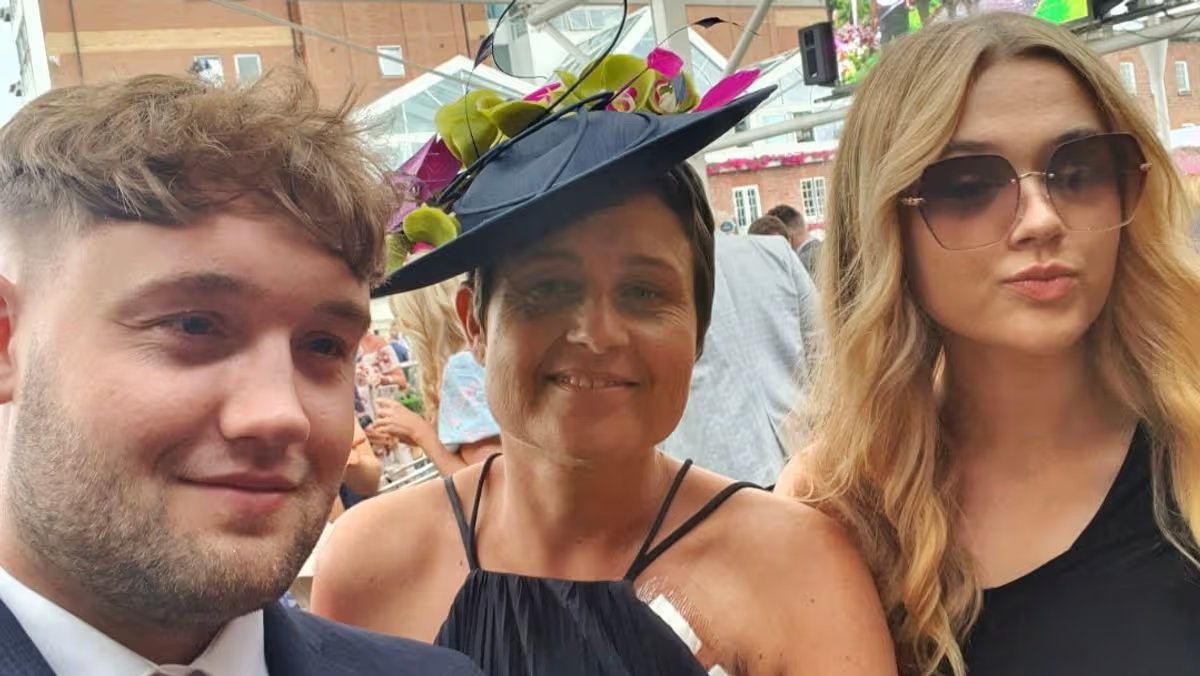
June Kelly believed she was at the peak of physical health. At 48, she was an active mother of two, a participant in triathlons and half-marathons, and ran her own cleaning business. Yet, in March 2021, subtle signs began to emerge that something was profoundly wrong. She found herself becoming unusually short of breath during runs, struggling to stay warm, and—most peculiarly—experiencing a persistent metallic taste in her mouth that even mouthwash couldn’t eliminate. Initially attributing it to her asthma or perhaps a thyroid issue, June visited her GP, expecting a routine check-up. The blood tests she underwent, however, set off an urgent chain of events that would dismantle her reality. The following day, her doctor instructed her to go to the hospital immediately; her kidneys were failing, functioning at a mere five percent. This devastating news was only the beginning of a harrowing journey, one that would teach her a new, brutal vocabulary of survival.
The initial shock of kidney failure was quickly compounded by a more sinister diagnosis. Just one week after being rushed to York Hospital, on March 30, 2021, June was told she had myeloma, a rare and incurable cancer of the blood and bone marrow. The fit, energetic life she knew vanished in an instant. “It completely blew my world apart,” she recalls. The very symptom that had puzzled her—the metallic taste—was a direct result of her kidneys struggling to filter her blood. Doctors explained that myeloma, which affects over 35,000 people in the UK, cannot usually be cured but can be managed with treatment. For June, the diagnosis meant her body, which had carried her through endurance races, was now betraying her from within, requiring her to fight not for a personal best time, but for her life.
One of the most heart-wrenching tasks was sharing this reality with her family. With the support of her husband, Adrian, 57, she had to break the news to her son Max, then 24, and daughter Mia, then 19. “There were a lot of tears,” June says, explaining that she initially avoided using the word “myeloma,” as it was unknown to them all. They simply described it as a treatable but permanent form of cancer. While June deliberately limited her own research to cope with the overwhelming information, Adrian immersed himself in learning everything about the disease. Amid the fear, June anchored herself to a powerful, personal goal: she was determined to become well enough to meet her sister’s newborn baby, due later that year. This small, profound hope became a beacon guiding her through the coming darkness.
Treatment began with relentless speed. The day after her diagnosis, June started chemotherapy, receiving weekly injections over four months. Remarkably, she experienced few side effects beyond slightly blurry vision. The combined treatment and dialysis, while grueling, paradoxically made her feel better, highlighting just how severely ill she had been without realizing it. In September, she underwent a stem cell transplant at Queen Elizabeth Hospital in Birmingham—a major procedure followed by a month-long battle with a post-transplant infection. Today, she continues maintenance chemotherapy in tablet form. However, the cancer has permanently ruled out a kidney transplant, meaning she must endure dialysis three times a week, a relentless reminder of the disease’s lasting grip on her body.
Despite these immense challenges, June’s spirit remains unbroken. She has consciously chosen to focus on living fully within the constraints of her illness. She and Adrian bought a campervan, a symbol of their refusal to be confined, and have traveled across the UK, including a trip to the Scottish Highlands and Loch Ness—carefully planning their route around dialysis appointments in places like Inverness. “I enjoy the good days and just get through the bad,” she says with resilience. Her outlook is now forward-looking and purpose-driven, setting meaningful annual goals: first, to meet her newborn niece; then, to see her son graduate; next, to watch that niece start school and her daughter graduate. Each milestone is a victory, a cherished moment reclaimed from her illness.
June is now sharing her story to mark Myeloma Awareness Week, supporting Myeloma UK’s campaign to highlight the disease’s often-missed symptoms, which include persistent bone pain, fatigue, frequent infections, and kidney problems. Dr. Sophie Castell, chief executive of Myeloma UK, emphasizes the importance of early detection, urging people to investigate persistent symptoms and use the charity’s Symptom Translator tool when visiting their GP. June’s journey from unexplained metallic taste to life-altering diagnosis underscores a critical message: listening to one’s body and seeking answers can be lifesaving. Her story is not just one of medical struggle, but a powerful testament to human resilience, the redefinition of strength, and the profound appreciation for each new day.