



A Legacy Unearthed: The Windrush Anchor and the Ongoing Journey of a Generation
Today marks Windrush Day, an annual commemoration that honors the profound contributions of the Windrush Generation to British society. This year, the milestone is imbued with a powerful new mission: a £2 million appeal to recover the sunken anchor of the HMT Empire Windrush from the Mediterranean seabed. This campaign, launched by The Windrush Anchor Memorial Foundation, seeks to physically reclaim a symbol of a pivotal historical moment. The ship’s final voyage ended in tragedy off the coast of Algeria in 1954, following an engine explosion. While over 1,400 passengers were miraculously saved, the vessel itself was lost, settling into a watery grave. Now, the quest to raise its anchor is more than a maritime recovery operation; it is an act of cultural remembrance, aiming to bring a tangible piece of this complex history home to the nation it helped to rebuild.
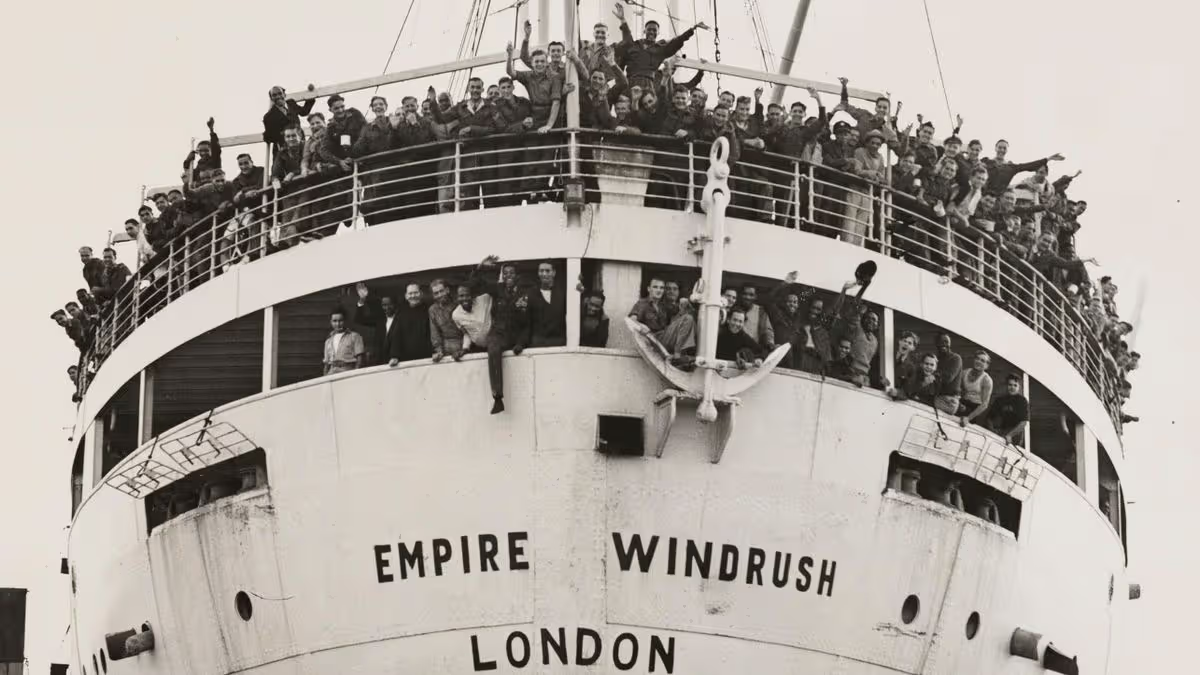
The story begins not with tragedy, but with hope. On June 22, 1948, the HMT Empire Windrush arrived at Tilbury Docks in Essex, its decks crowded with over a thousand passengers from Jamaica. They had answered Britain’s call for workers to help rebuild a country scarred by the Second World War. This moment, captured in now-iconic photographs of waving passengers, represents the proudest chapter in the ship’s storied life. Dubbed the Windrush Generation, these men and women, and the families that followed, would go on to shape modern Britain, enriching its culture, bolstering its economy, and steadfastly serving its public institutions. Their legacy is the very heart of Windrush Day, a celebration of resilience and belonging that emerged from the promise of that initial journey.
Yet, the history of the ship itself is a layered tapestry, reflecting the darkest and most hopeful arcs of 20th-century European history. Built in 1930 as the German cruise liner Monte Rosa, it was requisitioned by the Nazi regime during the war. In a chilling episode, it was used in 1942 to transport Norwegian Jews as part of the Holocaust’s machinery of death. As a spoil of war, the vessel was taken by Britain, renamed, and repurposed, its story dramatically redirected. From a symbol of oppression, it was transformed into a vessel of opportunity and renewal for Caribbean migrants. This full spectrum of history is central to the memorial campaign. As Marie van der Zyl OBE of the Foundation notes, understanding the ship’s entire past—the painful pre-Windrush years alongside its mission of hope—is crucial to comprehending the UK’s cultural makeup.
The campaign to recover the anchor is, therefore, an ambitious project of education and reconciliation. The Foundation aims not only to execute the complex technical operation of raising and conserving the anchor but also to install it as a permanent memorial. Surrounding this will be a comprehensive programme of educational and community initiatives designed to illuminate the Windrush story for all generations. This includes outreach with a replica anchor for schools and exhibitions, and the relaunch of The Windrush Board Game, an engaging tool to teach this history. Chair Sir Patrick Vernon frames the anchor as a potent symbol of “courage, hope, resilience and the contribution of the Windrush Generation.” The goal is to ensure this legacy is not forgotten but actively integrated into the national narrative, fostering a deeper understanding of the communities that shaped contemporary Britain.
This mission carries a poignant urgency, coming in the wake of the Windrush scandal that saw many of the generation’s descendants wrongly detained, deported, and denied legal rights. The scandal laid bare a painful breach of trust and a failure to honor the very contributions Windrush Day celebrates. In this context, recovering the anchor becomes an act of restorative symbolism. It is a concrete gesture towards reclaiming and solidifying a history that was, for too long, taken for granted or actively undermined. It represents a national effort to literally and metaphorically anchor this community’s story in the British consciousness, ensuring that recognition is hard-wired into the country’s physical and educational landscape.
As the public is invited to contribute to the campaign’s GoFundMe page, or to support it by purchasing the educational board game, the appeal transcends mere fundraising. It is an invitation to participate in a collective act of remembrance and respect. To recover this anchor is to pull a crucial thread of modern British history back to the surface—one that speaks of postwar renewal, of multicultural foundations, and of the ongoing journey toward a more inclusive society. On this Windrush Day, the effort to raise the anchor from the deep stands as a powerful testament to a generation’s enduring journey, reminding us that their story, like the artifact itself, is a foundational piece of the nation, waiting to be fully brought home and honored.