


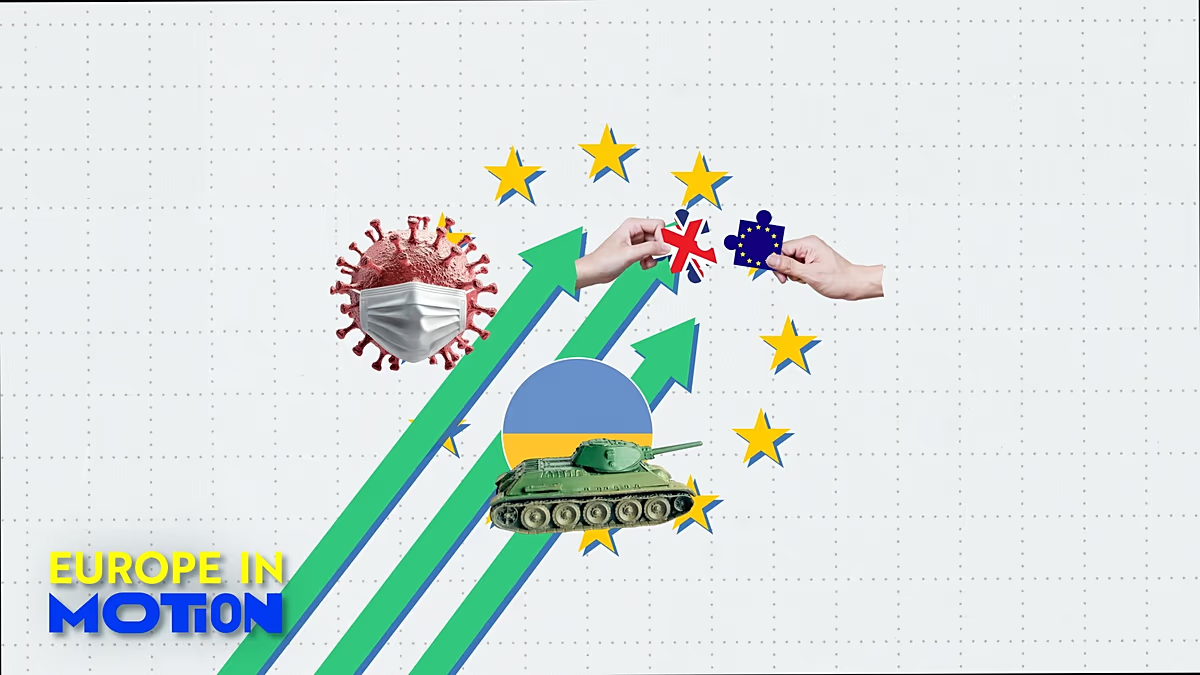
A decade has passed since the United Kingdom’s historic vote to leave the European Union, a seismic event that sent shockwaves across the continent and fueled predictions of the bloc’s imminent unravelling. At the time, the political climate was saturated with Euroscepticism; from Marine Le Pen’s calls for a “Frexit” referendum in France to Geert Wilders’ advocacy for a “Nexit” in the Netherlands, the very foundation of the European project seemed under threat. In nations like Greece, battered by the eurozone debt crisis, and Italy, where movements questioned the euro itself, confidence in Brussels had hit a profound low. The Brexit referendum appeared not as an isolated incident, but as the potential catalyst for a domino effect. Yet, ten years on, the prevailing narrative has undergone a remarkable reversal. Contrary to the forecasts of disintegration, public affinity for the European Union has not only recovered but has surged to new heights across much of the continent, suggesting a renewed, albeit complex, appreciation for the benefits of collective European action.
This resurgence in support is vividly illustrated by comprehensive data from Pew Research. Tracking attitudes since 2016, Pew finds that the median favourability toward the EU across eight major European nations has climbed significantly, from 49% at the time of the Brexit vote to 62% today. The increase is widespread and substantial: in Germany, support jumped from 50% to 68%; in France, from a low of 38% to 52%; and in the Netherlands, from 51% to 63%. Perhaps most strikingly, even within the UK itself—the nation that chose to leave—favourable views of the EU have soared from 45% during the referendum to 67% now. This sharp upward trajectory began almost immediately after the 2016 vote, with median favourability leaping to 60% by 2017, directly contradicting theories that Brexit would inspire a wave of copycat exits. The trend accelerated markedly following Russia’s full-scale invasion of Ukraine in 2022, as the EU’s coordinated response on sanctions, humanitarian aid, and support for Ukrainian accession highlighted the practical advantages and geopolitical necessity of a united European front.
However, this broad rise in popular approval for the EU exists alongside a paradoxical and potent political reality: the concurrent growth of parties historically critical of Brussels. In Germany, the Alternative for Germany (AfD) increased its share of the vote in federal elections from 12.6% in 2017 to 20.8% in 2025. In France, the National Rally and its allies commanded about a third of the vote in the first round of the 2024 legislative elections, while Geert Wilders’ Party for Freedom became the largest party in the Dutch parliament following the 2023 general election. This suggests that rising EU favourability does not equate to blanket satisfaction with the status quo. Instead, analysts note a strategic evolution in the rhetoric of many of these parties. Learning from the complex and often tumultuous Brexit process, which failed to deliver the clear-cut benefits promised by its champions, most far-right and populist parties have pivoted. They have largely abandoned explicit calls for their own countries to exit the EU or the euro.
The new focus, as seen with France’ s National Rally and the Dutch PVV, is on advocating for radical reform from within. The agenda has shifted to restoring national border controls, prioritising domestic law over European regulations, and fiercely criticising Brussels-led policies on immigration and asylum. This represents a significant tactical change—from seeking to dismantle the club to demanding a rewrite of its rules. A notable exception is Germany’s AfD, which has kept various forms of “Dexit” on its agenda. Yet, the overarching trend indicates that the blunt instrument of exit referendums has lost its appeal. The lived experience of Brexit has served as a cautionary tale, discouraging nationalist politicians from outright secessionist policies and channeling discontent into a push for a Europe reconfigured along more nationalist lines. The debate, therefore, is no longer primarily about “in or out,” but about the nature and power of the union itself.
Delving deeper into the demographics of this support reveals significant and enduring divides. The strongest backing for the EU comes consistently from younger generations across the continent. In Italy, for instance, a striking 80% of adults under 35 view the bloc favourably, compared to just 56% of those over 50. This pattern is repeated in numerous other countries surveyed. For many young Europeans, the EU represents mobility through programmes like Erasmus, a collective stand on climate change, and a digital single market—issues that resonate more powerfully than historical sovereignties. Political ideology also remains a powerful fault line. In Poland, Pew recorded one of the largest ideological gaps, with 86% of those on the political left holding a favourable view of the EU, contrasted with only 42% on the right. This underscores that the EU remains a deeply polarising symbol, intertwined with domestic cultural and political battles.
In conclusion, the decade since the Brexit referendum has unfolded a story of European resilience and transformation. The initial panic about continental disintegration has given way to a more robust, though nuanced, public endorsement of the European Union. This support, galvanised by external crises like the war in Ukraine and informed by the sobering example of the UK’s experience, reflects a pragmatic recognition of the EU’s value in an unstable world. Yet, this affirmation is not wholesale approval. It coexists with potent political forces that, while largely forsaking the dream of exit, now vigorously contest the EU’s internal policies and fundamental direction. The result is a Europe more united in popular sentiment than it was in 2016, but also one engaged in a fierce and ongoing internal negotiation about its future shape, values, and boundaries. The legacy of Brexit, therefore, is not the triggering of a wave of exits, but the hardening of a new European battleground—fought not at the gates, but within the walls of the union itself.