


A Deepening Crisis: Crimea’s Fuel Supply Cut Off Amid Escalating Conflict
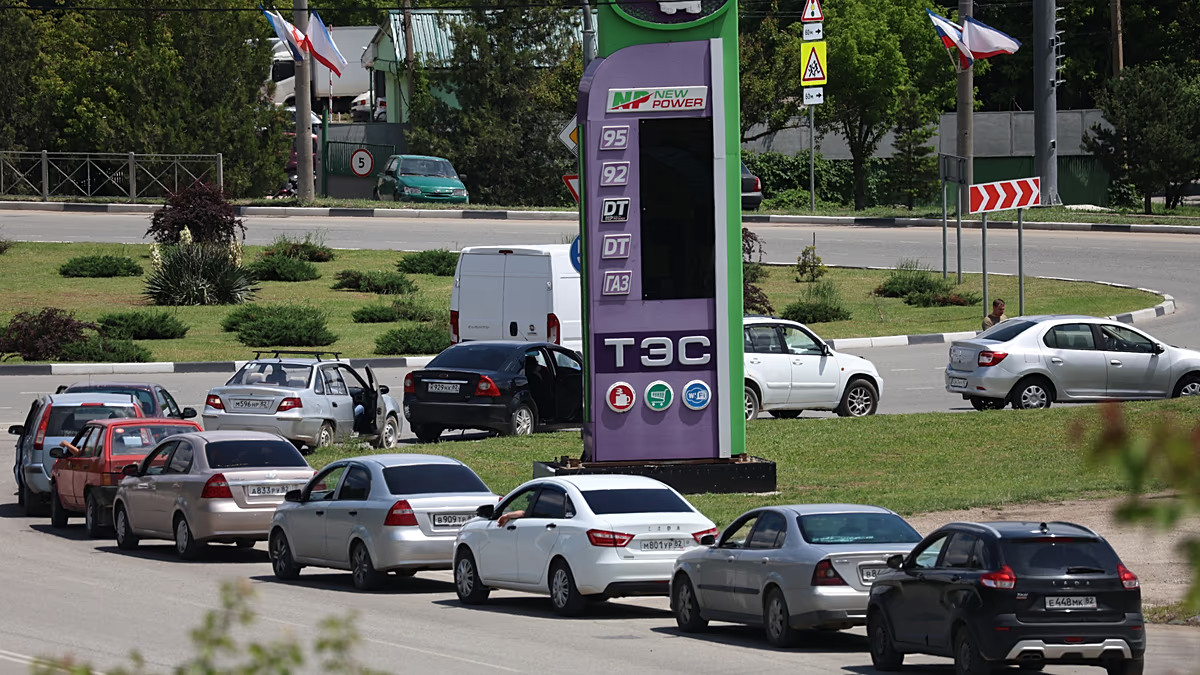
In a stark indication of the escalating strain on resources within Russian-occupied Crimea, authorities announced a severe and immediate halt to fuel sales for the general public. Beginning on the morning of Sunday, June 21, 2026, all petrol stations on the peninsula ceased selling fuel—whether by cash, card, or voucher—to both private individuals and businesses. This drastic measure, declared by Moscow-backed governor Sergey Aksyonov, reserves the remaining fuel exclusively for government agencies tasked with maintaining basic security and infrastructure. Aksyonov’s plea for public calm underscores the severity of the situation, as this suspension formalizes a fuel crisis that has been worsening for weeks, marked by long, desperate queues at gas stations and increasingly scarce supplies. This move effectively rations a critical resource, prioritizing the machinery of occupation over the daily needs of the population, and signals a profound logistical breakdown.
The root of this crisis lies hundreds of kilometers away, in a sustained and strategic Ukrainian campaign targeting Russia’s energy backbone. In recent months, Ukrainian forces have meticulously struck a network of refineries, storage terminals, and distribution depots across Russia. These precision attacks have crippled fuel production and disrupted supply chains. The campaign has extended directly to the Crimean peninsula, with Ukrainian President Volodymyr Zelenskyy confirming strikes on facilities “on both sides of the Crimean Bridge,” a vital umbilical cord connecting Crimea to mainland Russia. Attacks on a key oil depot in occupied Kerch and maritime logistics in the Krasnodar region exemplify a deliberate strategy to sever the fuel lines feeding the occupation, turning energy infrastructure into a frontline.
Ukraine’s strategy is explicitly designed to achieve strategic isolation. As articulated by Mykhailo Fedorov, Ukraine’s Minister of Digital Transformation, who also oversees drone warfare, the objective is to systematically cut off Crimea’s logistics. In a telling interview, Fedorov suggested that the relentless drone attacks could soon transform Crimea into a “de facto island,” severed from reliable Russian supply routes. This isolation, he argued, would precipitate “unexpected consequences” for Russian forces, undermining their operational stability and morale. The fuel suspension is a direct and tangible result of this pressure campaign, demonstrating that Kyiv’s long-range drones and missiles can create tangible humanitarian and logistical crises far behind the front lines, eroding the normalcy that occupying powers seek to project.
While Ukraine applies pressure on Crimea, the conflict’s brutal exchange continues unabated in the country’s east. On the same weekend the fuel crisis in Crimea reached its peak, Russian attacks inflicted a heavy toll on Ukrainian civilians. Local authorities reported that strikes in the Dnipropetrovsk region killed one person and wounded nine others across three districts. The violence extended to the Poltava region, where an attack on two businesses the previous day proved even more deadly, killing two people and injuring thirteen. These incidents are grim reminders of the war’s relentless human cost, a daily reality of loss and trauma for Ukrainians living under the threat of bombardment, contrasting with the slow-strangulation crisis unfolding in occupied Crimea.
The concurrent realities—a civilian population in Ukraine burying its dead from sudden bombardment, and a population in Crimea grinding to a halt due to a manufactured fuel famine—illustrate the multi-dimensional nature of modern warfare. Ukraine’s campaign against Russian energy targets is a calculated effort to degrade military logistics and challenge the Kremlin’s hold on annexed territory, even as it defends its own cities from attack. The fuel suspension in Crimea is not merely an inconvenience; it is a symptom of successful asymmetric pressure, a sign that the reach of the conflict extends far beyond trench lines into the economic and functional viability of occupied zones.
Ultimately, the images of empty petrol stations in Crimea and shattered buildings in Dnipropetrovsk are interconnected chapters of the same story. They reveal a conflict where battlefields are not defined by geography alone but by supply chains, energy grids, and civilian resilience. The announced fuel cutoff marks a significant moment, proving that the war’s effects can ripple outward to create acute crises of governance and daily survival in territories Russia claims to have secured. As both sides seek advantage, the civilian populations on all sides of the front line continue to bear the weight of these strategies, facing either the sudden terror of missiles or the slow, paralyzing dread of a society running out of fuel.