



In recent years, our collective gaze has turned upward with renewed intensity. Astrotourism—travel driven by celestial events and the desire to connect with the cosmos—has surged into the mainstream. This renaissance has been fueled by spectacular phenomena like the heightened northern lights displays, courtesy of the current solar maximum, and the inspirational Artemis missions, which have rekindled a sense of cosmic wonder. The momentum shows no sign of abating, with a major solar eclipse set to sweep across Greenland, Iceland, and Spain this August, and the much-anticipated “eclipse of the century” on the horizon for 2027. Against this backdrop of growing public fascination, a new and monumental gateway to the stars is being forged in one of the world’s most ancient landscapes: the desert near Saudi Arabia’s AlUla.
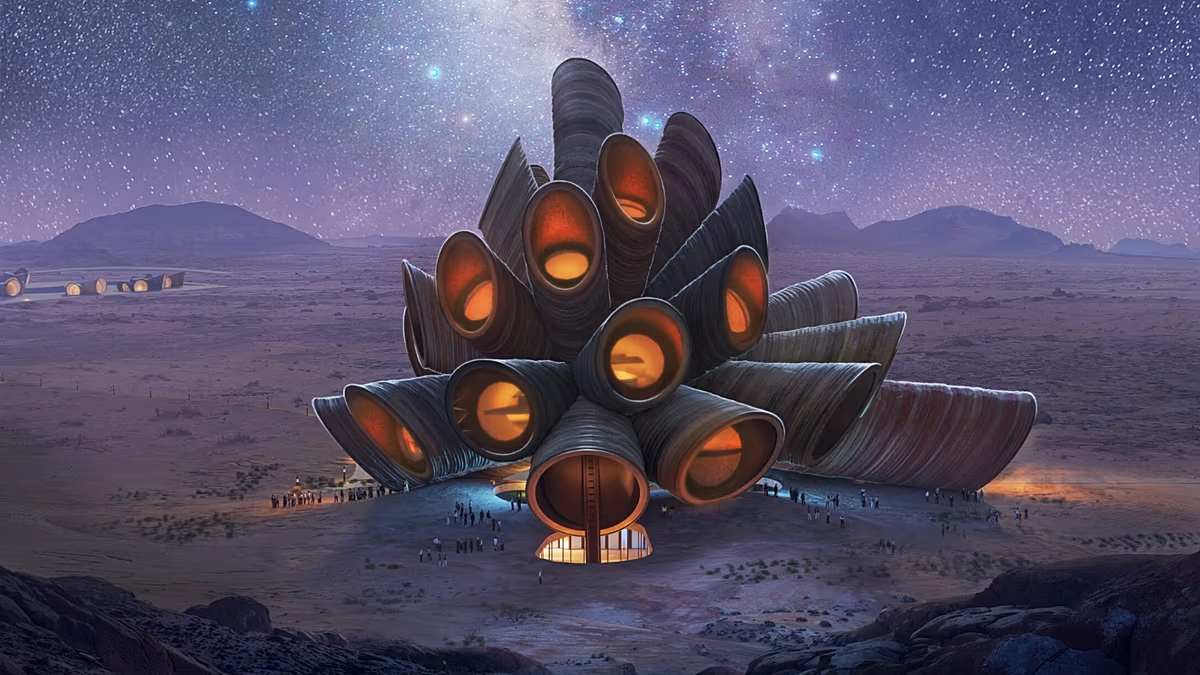
While AlUla is globally celebrated for its breathtaking Nabataean tombs at Hegra, a UNESCO World Heritage Site, its treasures extend far below the earthly realm. The region’s profound, crystalline darkness has already earned it recognition as one of the Middle East’s first Dark Sky Parks, a sanctuary from light pollution. It is here that the visionary AlUla Manara (meaning “lighthouse” in Arabic) is taking shape. More than just an observatory, this facility is conceived as a holistic destination, blending a world-class visitor centre with an active research hub. Its instrumental power will be formidable, featuring a primary telescope with a massive four-metre diameter and two secondary telescopes each measuring two metres, placing it among the largest and most significant astronomical facilities on the planet. The broader masterplan promises a fully immersive experience, complete with on-site accommodation and a dedicated stargazing lodge, inviting guests to dwell within the stillness of the desert night.
The architectural philosophy behind AlUla Manara seeks to dismantle the traditional barriers between complex science and human awe. Designed by the acclaimed Heatherwick Studio, the building itself is a physical poem to the universe. Its form draws inspiration from the grand, spiralling patterns observed throughout the cosmos—from galaxies and planetary rings to the mathematical sequences found in natural phenomena on Earth, such as seashells and unfurling ferns. This deliberate blurring of the line between the celestial and the terrestrial aims to create an intuitive and welcoming environment. As Stuart Wood, an executive partner at Heatherwick Studio, explains, the goal is to move beyond remote and sterile technical outposts to forge a space where visitors can “step inside the wonder of the cosmos,” making advanced science feel accessible, immersive, and profoundly inspiring.
Within this sculptural shell, the visitor experience will be meticulously curated. The main centre will house expansive exhibition spaces designed to educate and captivate, a state-of-the-art planetarium for virtual journeys across the universe, and a restaurant where one can reflect on the vastness overhead. A rooftop observation deck will serve as the culminating point, where the abstract theories and stunning visuals from inside meet the raw, unmediated spectacle of the real night sky. This seamless journey from education to experience underscores the project’s core mission: to foster a deep, personal connection with astronomy. It promises not just to show people the universe, but to make them feel a part of it, standing under the same stars that guided ancient civilizations through these very deserts.
For international travellers eager to witness this new marvel, the journey to AlUla is part of the adventure. Currently, there are no direct flights from Europe to AlUla International Airport; access is typically routed through major Saudi hubs like Jeddah and Riyadh, or via connecting flights from nearby Gulf centres such as Doha and Dubai. This path to AlUla Manara will therefore involve a voyage through the modern Middle East, offering a contrast between bustling urban gateways and the serene, timeless desert awaiting at the destination. While an official opening date has yet to be announced, the project’s development signals Saudi Arabia’s significant investment in positioning itself not only as a custodian of human history but as a pioneer in humanity’s future exploration—both cultural and cosmic.
In conclusion, AlUla Manara represents a pivotal next chapter in the story of astrotourism. It transcends the concept of a simple viewing platform by creating a dedicated, architecturally profound sanctuary for cosmic contemplation. By marrying cutting-edge scientific capability with an deeply human-centric design, it aims to democratize the sublime experience of astronomy. As the world’s interest in celestial events continues to grow, this desert “lighthouse” is poised to become a beacon, guiding a new generation of explorers, dreamers, and stargazers to look up and wonder, connecting them to the eternal rhythms of the universe from the heart of an ancient, silent landscape.