



Paragraph 1
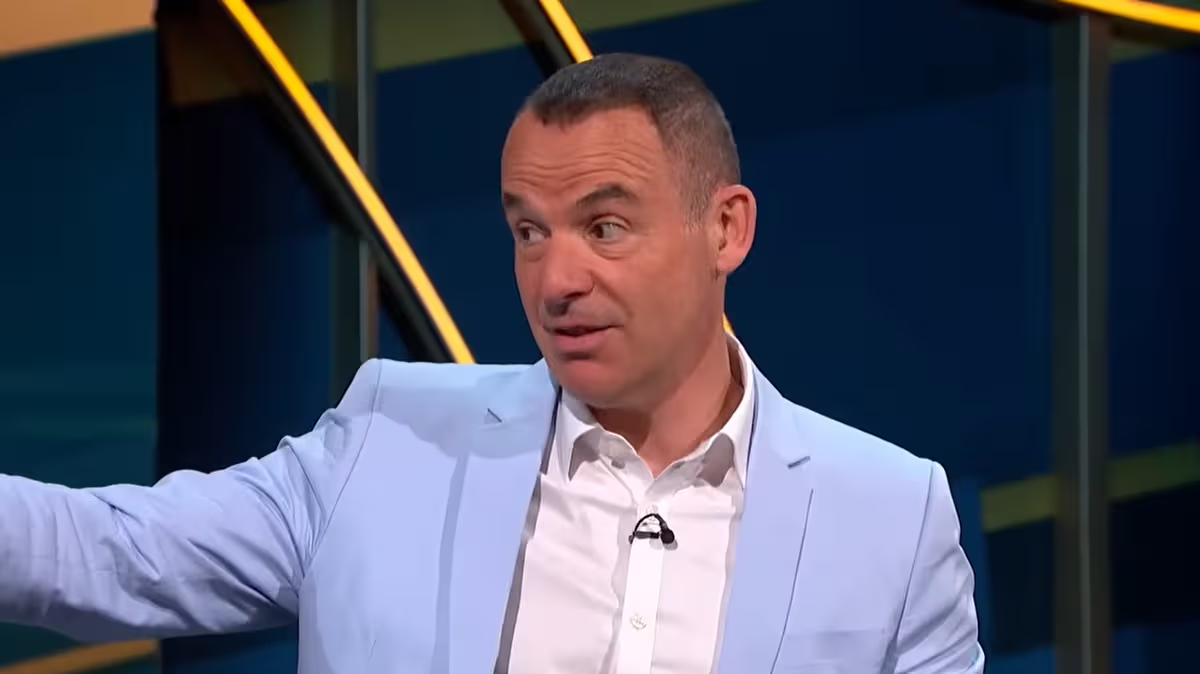
Personal finance authority Martin Lewis recently shared a poignant story on his BBC podcast that underscores a critical, yet often overlooked, financial reality for unmarried couples. He recounted a conversation with a taxi driver named Joe, who revealed that he and his partner of 33 years had decided to marry specifically because of advice Lewis had given about inheritance tax. Joe explained that after having his wife listen to Lewis’s podcast, they understood the significant financial disadvantage their children would face if they remained unmarried. This encounter prompted Lewis to detail the substantial legal and financial protections that marriage or civil partnership affords, protections that are entirely absent for cohabiting couples, no matter how long-standing or committed their relationship may be.
Paragraph 2
The core of the issue lies in how the UK’s inheritance tax system treats legally recognized relationships versus cohabitation. Lewis clarified that the term “marriage” in this context equally applies to civil partnerships, which offer the same legal recognition without the religious connotations. The first and most direct benefit is that any assets—be it cash, property, or investments—left to a surviving spouse or civil partner are entirely exempt from inheritance tax. This means that upon the first death, the surviving partner can inherit everything without the estate incurring any immediate tax liability, providing crucial financial security and stability during a period of loss.
Paragraph 3
However, Lewis emphasized that an even more powerful benefit is the ability to transfer unused inheritance tax allowances between spouses. Every individual has a “nil-rate band” of £325,000 they can leave tax-free. Furthermore, if passing a main residence to direct descendants like children or grandchildren, an additional “residence nil-rate band” of £175,000 applies, creating a potential total allowance of £500,000 per person. When the first spouse dies and leaves everything to the survivor, they typically use none of their own allowance. This unused allowance is then transferred to the surviving spouse.
Paragraph 4
The cumulative effect of this transfer is profound. It means that upon the second death, the surviving spouse can pass on up to £1 million (£500,000 of their own allowance plus the transferred £500,000 from their partner) to their children completely free of inheritance tax. This is a monumental advantage designed to protect family wealth across generations. For cohabiting couples, this mechanism simply does not exist. Each partner’s allowance remains separate and cannot be pooled, creating a potentially costly scenario for their heirs.
Paragraph 5
Lewis illustrated the stark difference with a clear example. Imagine an unmarried couple with joint assets worth £1 million, including their home, split evenly. When the first partner dies, leaving their £500,000 share to the other, their £500,000 personal allowance is used up. The survivor now owns the full £1 million estate. When they later pass away, they only have their own single £500,000 allowance to apply. Therefore, £500,000 of the £1 million estate would be subject to inheritance tax at 40%, resulting in a devastating £200,000 bill for their children.
Paragraph 6
Contrast this with a married couple in the same financial position. When the first spouse dies, the entire estate passes to the survivor tax-free, and the deceased’s £500,000 allowance is preserved and transferred. Upon the second death, the combined £1 million allowance covers the entire estate. The children inherit the full £1 million without a penny lost to inheritance tax, saving the family £200,000 compared to the unmarried couple. Lewis’s conclusion is that while marriage is a deeply personal decision, the financial implications, particularly around inheritance tax, are so substantial that couples who are cohabiting, especially those with children or significant shared assets, should at the very least be aware of them. For many, like Joe and his partner, this knowledge can be a compelling reason to formalize their relationship legally, ensuring their hard-earned wealth ultimately benefits their loved ones as intended.