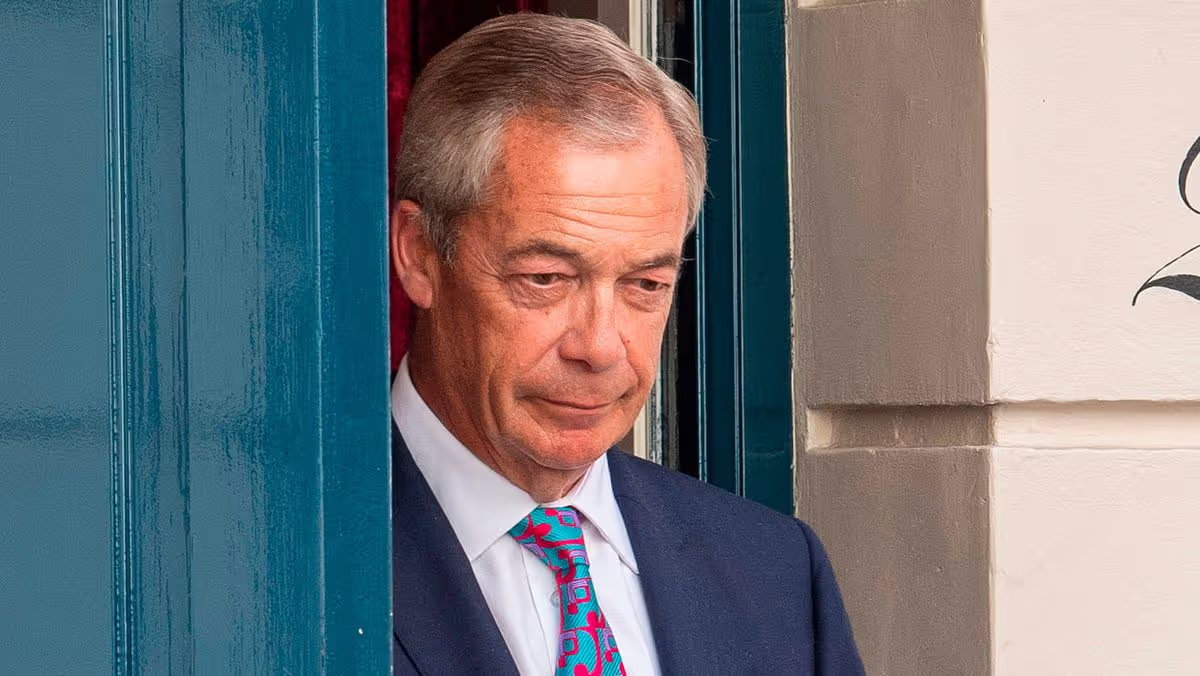



The tragic and deeply unsettling case of Henry Nowak, an 18-year-old who died in police custody after being stabbed, has erupted into a fierce political and social controversy, centering on the conduct of Reform UK leader Nigel Farage. In the aftermath of the killer’s sentencing, Farage released a video and social media posts asserting that the UK is living under a “two-tier” policing system where “the rights and privileges of white people matter less than those of ethnic minorities.” His most incendiary remark was a call for the public to respond with “pure cold rage.” These statements have been widely condemned as exploiting a family’s unbearable grief and dangerously inflaming community tensions, shifting the focus from a quest for justice to one of divisive grievance.
The condemnation was swift and direct, most notably from Prime Minister Keir Starmer during a heated Prime Minister’s Questions. Starmer emphasized that Henry Nowak’s own father had publicly pleaded for his son’s death not to be used to create “division, hatred or tension.” The Prime Minister stated that to ignore this heartfelt request from a grieving family was “unforgivable,” accusing Farage of showing “exactly who he is” by choosing to appeal for rage rather than reflection. This sentiment was echoed across the political spectrum, with Liberal Democrat leader Ed Davey urging politicians to treat knife crime as a national emergency rather than a “political football,” and Policing Minister Sarah Jones labelling Farage’s comments “irresponsible” and “unhelpful.”
The immediate consequence of this charged rhetoric was a night of violent disorder in Southampton. Hours after Farage’s posts, clashes erupted outside a police station, resulting in injuries to eleven officers. While not solely attributable to one individual’s words, the timing underscored the volatile climate his statements helped cultivate. Farage subsequently doubled down, telling Times Radio that the violence was “just the beginning,” warning of worsening division if “large numbers of young white males” believe the police are prejudiced against them. This narrative frames complex policing failures within a simplistic and inflammatory lens of racial grievance, a move heavily criticized by anti-racism organizations.
These groups forcefully rejected the foundation of Farage’s claims. Samira Ali of Stand Up to Racism argued that the “two-tier policing” idea is a “lie used by the far right to justify their racism,” noting that data consistently shows Black and Asian people face disproportionate policing, including stops, criminalization, and deaths in custody. Dr. Shabna Begum of the Runnymede Trust stated there is no evidence to support the claim that white people are systemically treated more harshly, warning that such “fabricated narratives” distort public understanding of real, documented inequalities. Their critiques highlight how Farage’s argument inverts and exploits legitimate debates about racial bias in policing.
Amidst this political storm, the stark human tragedy at its core risks being overshadowed. The released bodycam footage is harrowing, showing a handcuffed Henry Nowak telling officers he had been stabbed and could not breathe, pleas that were not acted upon with sufficient urgency. The Independent Office for Police Conduct is investigating these grave failures. The central, unifying plea from Henry’s father, Mark Nowak, is for his son’s story to make streets safer for everyone and to not be weaponized to sow further hatred. This call for unity and constructive change stands in direct opposition to the political strategy of stoking division.
The episode presents a critical juncture in UK public discourse. On one side is a demand for evidence-based scrutiny of institutional failings, driven by a family’s quest for answers and justice. On the other is a political tactic that leverages raw emotion and selective framing to foster a narrative of victimhood and societal fracture. The government’s response, supporting a thorough IOPC investigation and announcing a review of police anti-racism guidance, attempts to navigate a path of accountable reform. However, the enduring challenge lies in whether the national conversation can honor a grieving family’s wish for unity and safety, or if it will remain captive to a cycle of rage and recrimination that serves only political interests while leaving the hard work of justice and reconciliation undone.