


Paragraph 1
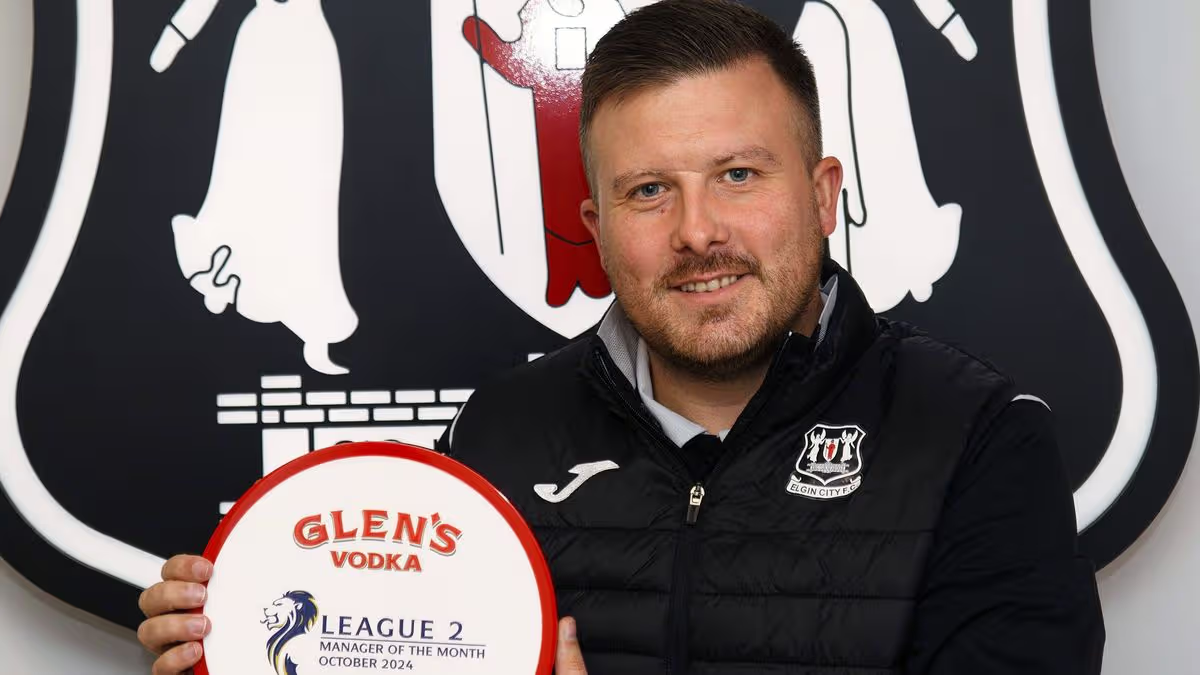
In a surprising and disruptive move at the close of the Scottish football season, Elgin City Football Club has suspended its manager, Allan Hale, with immediate effect. The club, which competes in League Two, the fourth and bottom tier of the Scottish Professional Football League (SPFL), issued a terse official statement confirming the suspension is pending an ongoing internal investigation. The announcement, coming just days after the team played its final match of the campaign, has cast a shadow over Borough Briggs, with the club refusing to elaborate further until its investigative process is complete. This decision places the club in a state of limbo during what is typically a period of planning and reflection, leaving supporters and players alike to speculate about the reasons behind such a drastic step.
Paragraph 2
Allan Hale’s tenure at Elgin City, spanning two-and-a-half years, had been largely viewed as a period of stabilisation and gradual progress. He arrived in December 2023 with the club mired in a relegation battle, having made the step up from the Highland League alongside his assistant, Stefan Laird. Hale successfully achieved his initial mandate, steering the Black and Whites clear of the drop that season. He then built upon that foundation, orchestrating a remarkable push into the promotion play-offs in his first full season, where they were ultimately defeated by Annan Athletic. This season, while narrowly missing out on the play-offs and finishing sixth, the team had shown resilience under his leadership, making his sudden suspension all the more unexpected to many observers.
Paragraph 3
The context of Hale’s work is crucial to understanding his perceived impact. In a recent interview just before the suspension, Hale himself highlighted the unique and significant challenges of managing Elgin City. He pointed not to a lack of ambition, but to the “geographical challenges,” the realities of operating with a modest budget, and the difficulty of attracting players willing to make the lengthy commutes required to represent a club based in the far north of Scotland. He reframed the club’s 27-year residence in League Two not as a failure, but as a testament to the club’s “resilience” in the face of these persistent obstacles. From this perspective, Hale had positioned himself as a pragmatic leader who understood and battled the club’s inherent constraints.
Paragraph 4
The timing of the suspension is particularly jarring, as it follows a season that, while ending on a disappointing run of five winless games, was not outwardly considered a crisis. The club secured 44 points from 36 games, with a nearly even record of wins, draws, and defeats. There was no publicly apparent turmoil suggesting such severe disciplinary action was imminent. This disconnect between the public narrative of steady management and the private action of suspension is what fuels the current uncertainty. The investigation must, therefore, be examining matters not visible in league standings or post-match interviews—issues that the club’s board has deemed serious enough to warrant removing Hale from his post before the investigation concludes.
Paragraph 5
For the players, staff, and loyal supporters of Elgin City, this period will be fraught with anxiety and unanswered questions. A manager’s suspension creates an immediate leadership vacuum, disrupting plans for player contracts, pre-season preparations, and squad building for the next campaign. The community surrounding a club like Elgin is tight-knit, and such internal drama can be deeply felt. Fans are left to balance their appreciation for Hale’s previous work in solidifying the team against the sobering reality that the club has seen fit to take this action. Their trust is now placed in the integrity and transparency of the club’s internal investigation, with the hope that a clear resolution emerges promptly.
Paragraph 6
Ultimately, this episode underscores the often-unseen pressures and complexities within football clubs, even at the lower professional levels. Allan Hale’s suspension is a stark reminder that success is measured beyond the pitch, and that the relationship between a manager and a club’s hierarchy is multifaceted. As the investigation proceeds behind closed doors, the future for both Hale and Elgin City is on hold. The club’s statement promises no further comment until the process ends, meaning a quiet but tense wait lies ahead. The hope for all involved must be for a fair and swift conclusion that provides clarity and allows Elgin City Football Club, a institution embodying the resilience its now-suspended manager spoke of, to move forward with purpose and unity once more.