

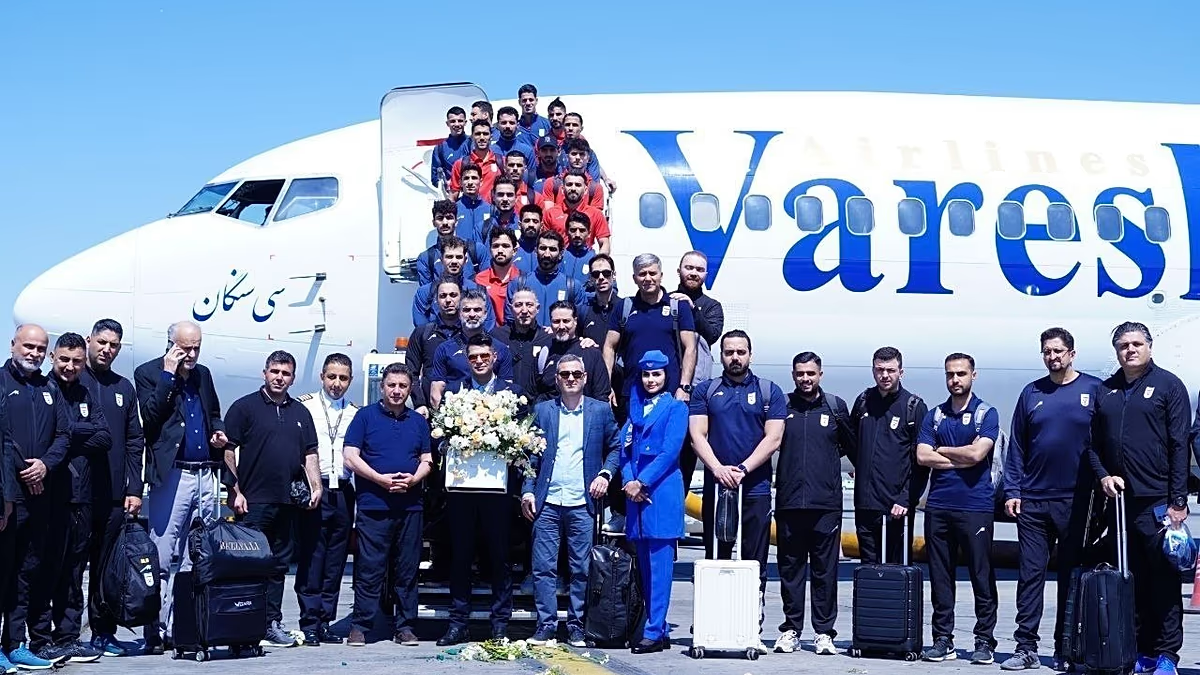
The journey to the 2026 FIFA World Cup, a pinnacle of global sport meant to unite nations, has become for Iran’s national football team a labyrinth of political tension and logistical paralysis. As the squad departed for a preparatory training camp in Turkey, a cloud of uncertainty hung over them, emblematic of the deep-seated geopolitical fissures between Tehran and Washington. The core issue is stark: the team lacks the necessary U.S. visas for players and coaching staff. Iranian Foreign Ministry spokesman Esmail Baghaei has condemned this situation as “not acceptable” and a “violation,” accusing Washington of inventing “self-made excuses” to block their entry. With all three of Iran’s group-stage matches slated to be played in the United States, this is no minor administrative delay but a fundamental crisis threatening their participation. Federation chief Mehdi Taj confirmed the stark reality, stating that not a single visa had been issued, leaving the team in a state of limbo even as they pursue friendlies in Turkey and a planned match in Arizona, contingent on visas that may never come.
This visa impasse is inextricably linked to the U.S. designation of Iran’s Islamic Revolutionary Guard Corps (IRGC) as a terrorist organization. U.S. Secretary of State Marco Rubio has been unequivocal: individuals linked to the IRGC will not be permitted entry. This policy has already had direct consequences, as Taj himself was recently turned back at Toronto airport when attempting to attend a FIFA Congress in Canada. The situation creates an almost impossible vetting process for U.S. authorities and immense anxiety for the Iranian delegation, as associations with state-sponsored institutions in Iran can be complex and far-reaching. The team’s send-off ceremony in Tehran’s Revolution Square, replete with “Death to America” chants and Hezbollah flags, while likely aimed at a domestic audience, only serves to amplify the political tensions surrounding the squad and complicate perceptions of them as apolitical athletes seeking only to compete on the world’s stage.
Compounding these external pressures are severe internal divisions that have left the team fractured and underprepared. The most poignant symbol of this is the absence of star striker Sardar Azmoun, a veteran of two previous World Cups and one of Iran’s most talented players. Azmoun was excluded from the preliminary squad following his public support for protesters during the January unrest, his criticism of government-mandated internet shutdowns, and his political statements during the recent war. Media outlets affiliated with the IRGC, such as Fars News Agency, argued for his exclusion, stating he would need to apologize to be considered—a demand he has refused. In a chilling postscript, Fars also reported that his property has been seized by order of a provincial prosecutor. This episode illustrates how political allegiance has been enforced within the squad, sacrificing sporting merit and weakening the team’s competitive edge.
The consequences of this political turmoil are evident in the team’s stark lack of preparation. Since the outbreak of war in February, most planned international friendlies have been cancelled. The Italian assistant coach unilaterally terminated his contract, depriving the team of valuable technical expertise. Their last “match” before the camp was merely an internal scrimmage at Tehran’s Azadi Stadium. Head coach Amir Ghalenoei is thus tasked with molding a cohesive unit from a group that has been isolated from top-level competition and is missing its iconic striker. The planned friendlies in Turkey against The Gambia and other sides are now critical, but they are a poor substitute for the robust preparation typical of World Cup contenders. This underpreparation risks not only early elimination but also a dispiriting experience for the players who have trained for this moment.
Beyond the pitch, a profound disconnect has emerged between the national team and a significant portion of the Iranian public. Critics note that public enthusiasm has cooled sharply following the January protests, the pervasive internet blackouts, and the squad’s perceived political alignment with state positions. The sight of players attending official state and religious events to endorse government policies has, for many citizens, transformed the team from a unifying source of national pride into an extension of the political establishment. This erosion of the team’s traditional role as a civic unifier adds a layer of emotional complexity to their campaign. They are not only navigating international hostility and internal factionalism but also carrying the weight of a divided nation’s sentiments, with some cheering them as patriots and others viewing them with indifference or even resentment.
In this fraught context, the role of FIFA as football’s global governing body is under intense scrutiny. Iranian officials have met with senior FIFA executives in Turkey, receiving assurances that the organization would do all it could to uphold its principles, which ostensibly include ensuring access for qualified teams to compete. The world now watches to see if FIFA can effectively mediate between U.S. security policy and the fundamental right of a qualified team to participate. The coming weeks will determine whether a compromise can be found—perhaps through stringent, individual vetting—or if the 2026 World Cup will be marred by the absence of a nation that has earned its place on the field. For the Iranian players, caught in a web of politics far beyond their control, the dream of playing in a World Cup remains hostage to a diplomatic standoff, turning what should be a celebration of sport into a stark reflection of our world’s deepest divisions.