



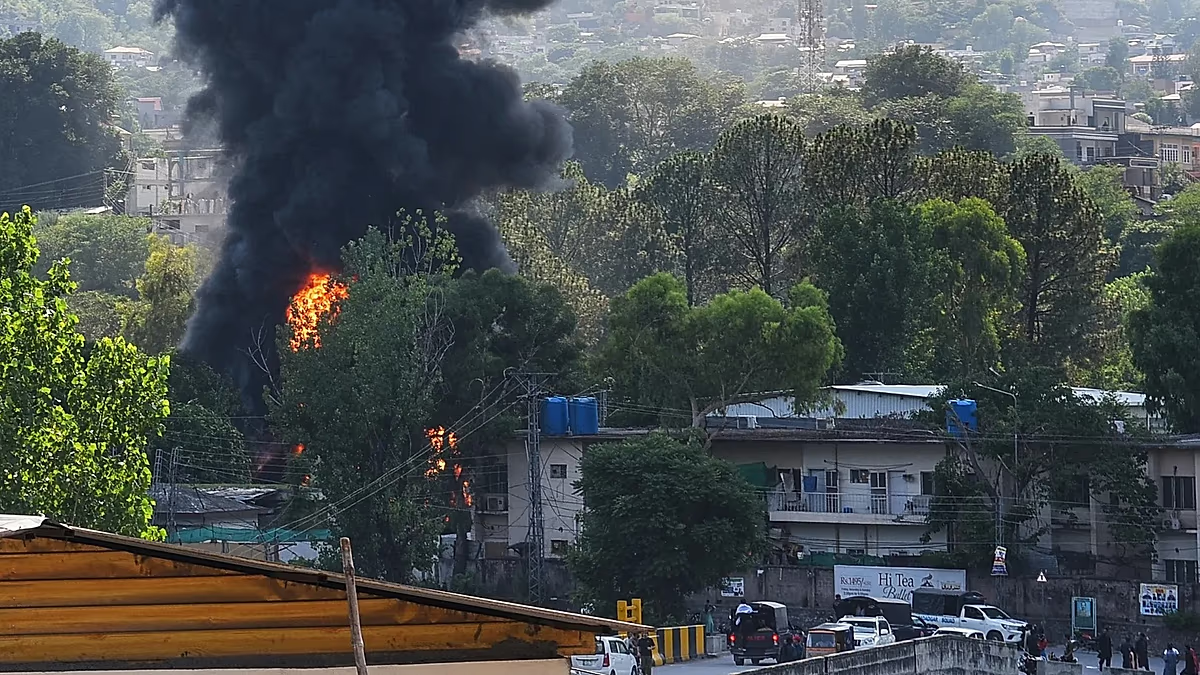
In a somber announcement on a Wednesday in June 2026, the Pakistan military confirmed a devastating loss. An Mi-17 helicopter, a workhorse of the Army Aviation corps, crashed near the city of Muzaffarabad, the capital of Pakistan-administered Kashmir. The cause, according to an official statement from the military’ s media wing, was attributed to a technical fault that occurred shortly after take-off from a local helipad. The statement carried the heavy, formal language of such tragedies, noting that all personnel on board had “embraced Shahadat,” a term meaning martyrdom that underscores the profound respect afforded to fallen soldiers within the national narrative. While the exact number of lives lost was not immediately disclosed, the finality of the message left no room for hope, confirming there were no survivors from the crash.
The incident unfolded against a complex and tense regional backdrop. Muzaffarabad, situated in the picturesque yet politically charged valleys of Kashmir, was reportedly the site of an ongoing protest and strike called by a recently banned alliance of groups known as the Joint Awami Action Committee. The military was careful to state that it did not suggest any link between the civil unrest and the mechanical failure that led to the crash. Eyewitnesses described the suddenness of the event—the helicopter going down not long after lifting into the sky—a jarring moment that swiftly summoned emergency response. Ambulances rushed to the scene, transporting the victims to a nearby hospital in a grim and futile race. The military confirmed that rescue and recovery teams arrived immediately, their efforts now shifted from lifesaving to the solemn duty of retrieval.
In the wake of the crash, a wave of national mourning was initiated from the highest offices of the state. Pakistani President Asif Ali Zardari and Prime Minister Shehbaz Sharif issued separate statements expressing their deep sorrow and paying tribute to the slain personnel. Their words, formal yet palpably heavy, conveyed heartfelt sympathies to the grieving families who had, in an instant, lost loved ones in service to the nation. Army Chief Field Marshal Asim Munir added his voice to the chorus of condolence, expressing profound grief and extending his support to the families of the fallen. These official responses, while a standard protocol, reflect the collective weight such an event carries within Pakistan, where the military is a central pillar of national identity and its sacrifices are deeply felt across society.
The location of the tragedy adds a profound layer of significance and sensitivity. Kashmir is not just any region; it is a territory etched into the very soul of Pakistan’s national consciousness and security doctrine. Claimed in full by both Pakistan and India, the Muslim-majority region has been a source of conflict since the partition of British India, witnessing frequent skirmishes along the contested Line of Control and several full-blown wars. For the Pakistani military and government, events in Kashmir are scrutinized with intense gravity. The crash of an military aircraft in this region, regardless of the stated technical cause, resonates far beyond the immediate loss of life, touching nerves connected to national sovereignty, perpetual vigilance, and a decades-old struggle.
Beyond the immediate statements of grief and the deployment of recovery teams, the military moved swiftly to investigate the precise circumstances of the failure. A board of inquiry was ordered, a standard but crucial procedure aimed at piecing together the final moments of the flight and determining the exact nature of the technical fault. Such investigations seek answers not only to provide closure but also to inform future safety protocols, ensuring that lessons are learned to protect other personnel. The Mi-17 helicopter itself, a robust and widely used Soviet-designed model, is a familiar asset in militaries worldwide, and understanding this specific malfunction is a task of both technical and solemn importance.
This crash, as reported with contributions from international news agencies like the Associated Press and Agence France-Presse, is ultimately a human story set within a geopolitical fault line. It is a story of servicemen who began a routine flight and never returned, leaving behind families shrouded in sudden grief. It is a story that momentarily united the nation’s leadership in shared mourning. And it is a story that unfolded in the shadow of Kashmir’s beautiful, scarred mountains—a constant reminder of the enduring human cost of service and the unresolved tensions that define this part of the world. The technical explanation provides a cause, but the aftermath reveals a tapestry of loss, respect, and the ever-present complexities of a region where every event is felt with acute intensity.