



The Human Cost of a Relentless War: A Weekend of Loss and Escalation
The war in Ukraine, now deep into its third year, continues to be measured in the starkest of human terms: lives abruptly ended, families shattered, and communities left to pick up the pieces of their homes and livelihoods. This brutal reality was underscored yet again over a single weekend in late June 2026, as a wave of Russian attacks across eastern and central Ukraine resulted in the deaths of at least three people and left 22 others wounded. Behind these sterile numbers lie individual stories of tragedy—a 70-year-old woman killed in her own community, six children among the injured, and countless others whose sense of security was obliterated along with their damaged homes and businesses. These incidents are not isolated battlefield reports; they are chapters in the ongoing saga of a civilian population enduring relentless violence far from the front lines.
The assaults were widespread and indiscriminate, employing a devastating mix of weaponry. In the Dnipropetrovsk region, local governor Oleksandr Ganzha detailed a harrowing barrage, stating the enemy had attacked more than twenty times using drones, artillery, and air bombs across three districts. The toll here was one life lost—that of the elderly woman in the Nikopol district—and nine people wounded, with residential houses and a car also damaged in the strikes. Simultaneously, in the Poltava region, the violence took a different but equally devastating form. There, the attacks focused on civilian infrastructure, striking two commercial businesses. The aftermath, as described by regional head Vitaliy Dyakivnych, was particularly heartbreaking: two people killed and thirteen injured, a figure that included six children. These episodes illustrate a grim pattern of the conflict, where civilian areas and economic sites remain in the crosshairs, exposing ordinary people to perpetual danger.
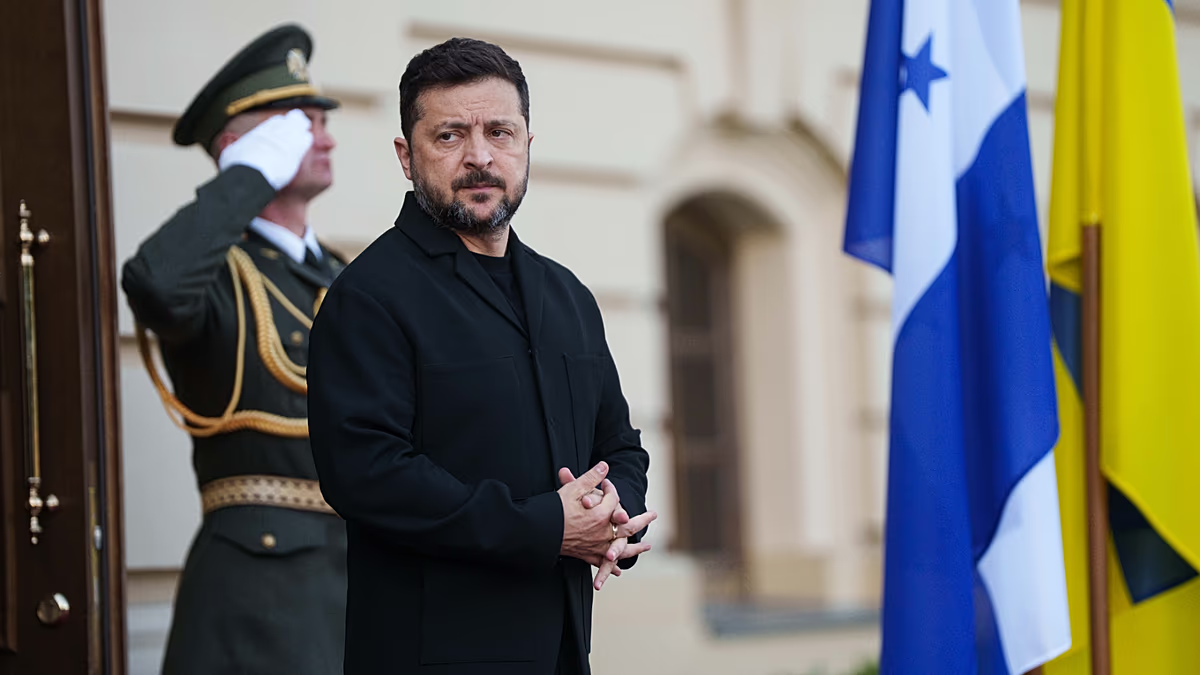
In a significant and escalatory development, Ukrainian forces demonstrated a newly extended reach deep into Russian territory. President Volodymyr Zelenskyy announced that Ukraine had successfully targeted an oil-processing facility in Russia’s Tyumen region, located in Western Siberia—a strike covering a remarkable distance of approximately 3,000 kilometers. Zelenskyy credited the operation to newly upgraded “FP” drones, praising the engineers behind this technological advancement. This attack is part of a concerted and intensifying Ukrainian campaign targeting Russian energy infrastructure, a strategic move aimed at disrupting Russia’s military logistics and challenging its sense of domestic security. This shift marks a new phase in the war’s dynamics, as Kyiv leverages innovation to project force far beyond the immediate theater of combat.
The contrasting narratives of the weekend’s events—localized civilian casualties in Ukraine versus a long-range strike on industrial infrastructure in Russia—highlight the war’s complex and expanding dimensions. On one hand, Ukrainian communities continue to suffer the immediate, visceral horrors of shelling and bombardment, a daily burden of fear and loss. On the other, Ukraine is actively pursuing a strategy to undermine Russia’s war machine at its source, hitting refineries and energy hubs with increasing frequency and range. This dual reality reflects the totality of modern warfare, where the front line is both the village square and the remote industrial complex, and where the definition of the battlefield has become virtually limitless.
Amidst the strategic calculations and military updates, it is crucial to return the focus to the human element that persists through each escalation. Each statistic reported by regional authorities represents a life upended: the family mourning a grandmother, the children recovering from physical and psychological wounds, the business owners whose livelihoods were destroyed in an instant. The war’s narrative is too often dominated by territorial maps and weapon systems, yet its true weight is carried by individuals facing the consequences every day. Their resilience is met with continual adversity, as the sound of air raid sirens and the threat of sudden attack remain a pervasive part of existence for millions.
As the conflict grinds on with no diplomatic end in sight, the weekend’s events serve as a sobering reminder of its entrenched and worsening nature. The development of longer-range drones capable of striking Siberia signals a technological arms race that promises to widen the war’s geographic scope. Concurrently, the continued attacks on Ukrainian towns and cities underscore that civilians remain tragically vulnerable. This cycle of action and retaliation, of innovation in weaponry matched by enduring human suffering, defines a war that has settled into a devastating rhythm. The international community watches as these parallel stories unfold—one of advanced warfare and strategic pressure, the other of profound personal loss—both inextricably linked in the ongoing tragedy that is the war in Ukraine.