



A New Rhythm for Hungary: Celebration, Change, and a Dancing Minister
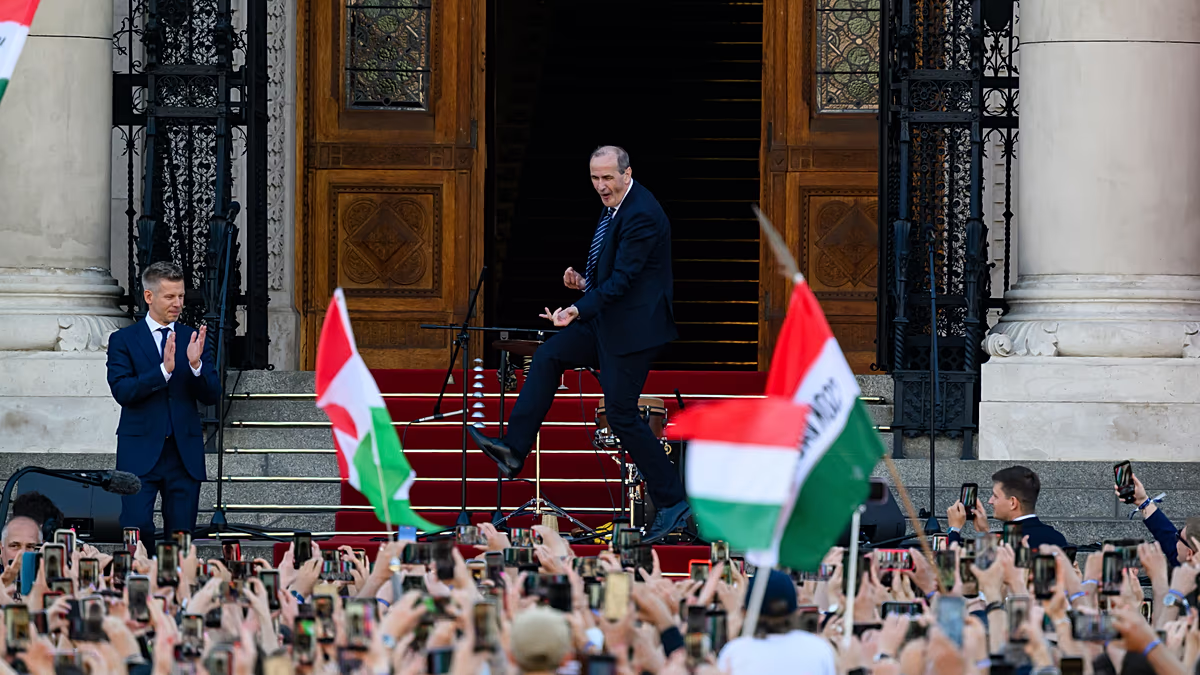
The political landscape of Hungary shifted decisively on a recent Saturday, as the nation’s new National Assembly was inaugurated and Péter Magyar was sworn in as Prime Minister, marking the end of Viktor Orbán’s 14-year parliamentary dominance. In an atmosphere more reminiscent of a vibrant folk festival than a solemn state ceremony, the moment was captured not just in speeches and official protocols, but in a spontaneous, joyful dance. At the heart of this celebration was Zsolt Hegedűs, the Health Minister-designate, who, swept up in the historic tide, began to dance with unrestrained joy in front of the Parliament building in Budapest. This was not a rehearsed performance for the cameras, but a genuine, human expression of relief and hope, a physical manifestation of a country stepping into a new political era. The image of a senior official dancing in public, as supporters clapped and waved flags, became a powerful symbol of the day’s mood—a deliberate break from the more rigid and controlled political style of the past.
This was, notably, a repeat performance for Hegedűs, who first went viral for his dancing during his party’s election victory celebrations in April. That earlier dance, a moment of pure elation after the Tisza party’s surprising surge, had already made him an unlikely folk hero to many Hungarians weary of conventional politics. By choosing to dance again at this culminating constitutional moment, he did more than just celebrate; he forged a connection with the public. His actions communicated a message of approachability and shared humanity, suggesting that those now taking the reins of government are not distant figures, but people who feel the nation’s emotions as deeply as any citizen. In a role as critical and often stressful as Health Minister, this display of relatable joy offered a glimpse of a leadership style rooted in empathy and common feeling, potentially signaling a more transparent and engaged administration.
The context for this jubilation is of profound historical significance. Viktor Orbán’s Fidesz party had maintained a supermajority in parliament since 2010, shaping Hungary’s domestic and foreign policy with a powerful, often contentious, vision of national conservatism. The landslide victory for Péter Magyar’s Tisza party represents the most substantial political change Hungary has witnessed in over a decade. The crowds waving flags and dancing outside Parliament were not just party supporters; they were citizens participating in a palpable sense of transition. For many, the dance was an expression of long-held aspirations for change, a release of political tension, and an embrace of a future whose path is now uncharted. It was a public reclaiming of a space—both physical in front of the legislature and metaphorical in the political sphere—that had felt fixed and unmovable for years.
However, the work ahead is formidable, and the dance must soon give way to the difficult steps of governance. Péter Magyar, a former member of Orbán’s inner circle who turned critic, now faces the immense task of uniting a polarized nation and addressing complex challenges, from economic pressures to diplomatic relations within the European Union. Zsolt Hegedűs, once the dancing minister-designate, will now have to navigate the intricate realities of Hungary’s healthcare system. The genuine joy of the moment is a valuable reservoir of public goodwill, but it is a currency that must be invested wisely. The new government will be judged not by its celebratory moments, but by its policy outcomes, its competence, and its ability to translate the hope of inauguration day into tangible improvements in the lives of ordinary Hungarians.
Yet, the symbolic power of such a human moment in politics should not be underestimated. In an age of often-cynical political discourse, where leaders are frequently seen as scripted and remote, Hegedűs’s unguarded dance broke through the noise. It served as a reminder that politics, at its best, is about people and their collective spirit. It provided a narrative of optimism and renewal that can help foster a sense of shared national purpose. This act of celebration becomes part of the story Hungary tells itself about this turning point—a story that began not with a dry decree, but with a collective, rhythmic expression of a new beginning.
Ultimately, the sight of a health minister dancing in front of Parliament will be remembered as the opening scene of Hungary’s next chapter. It perfectly encapsulated the dual nature of the moment: the culmination of a dramatic electoral battle and the anxious, hopeful commencement of a new governing experiment. As the music of that day fades, the real test begins. The challenge for Magyar, Hegedűs, and their team is to ensure that the energy, unity, and humanity of that dance can be channeled into the arduous, daily work of building a stronger, healthier, and more cohesive Hungary. The first step was taken with a dance; the following steps will determine the direction of the journey.