
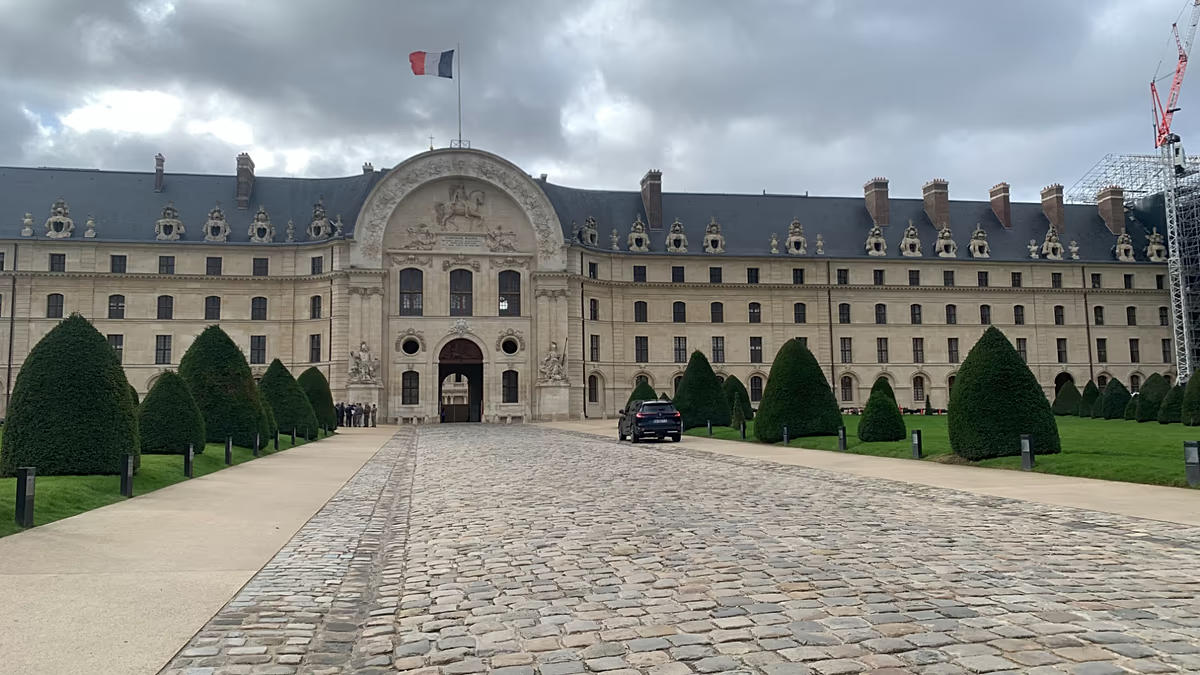


Nestled in the heart of Paris, beneath the shimmering gold leaf of its iconic dome, Les Invalides is universally recognized as the final resting place of Napoleon Bonaparte, drawing over a million visitors each year. Yet, behind this monumental façade, originally commissioned by King Louis XIV to project his absolute power, lies a living, breathing institution with a profoundly human mission that has continued uninterrupted for 350 years. Far from being merely a mausoleum or museum, Les Invalides is, at its core, a home and a sanctuary. Founded in 1670 and opening its doors to its first residents in 1674, it was conceived as a revolutionary act of state responsibility—a “gesture of gratitude,” as its current governor, General Christophe de Saint Chamas, describes it. At a time when care for wounded veterans fell to religious charities, Louis XIV decreed that the state itself would provide lifelong care for his old and injured soldiers. This founding principle, that the nation owes a perpetual debt to those who have borne the wounds of its conflicts, remains the very soul of the institution today.
Within its serene, sprawling courtyards and historic halls, a small community of 64 residents finds peace and highly individualized care. Remarkably, this community now extends beyond soldiers to include civilian victims of war and terror, among them some of France’s most revered Holocaust survivors. Residents like 101-year-old Ginette Kolinka and 98-year-old Esther Senot, both survivors of Auschwitz and Mauthausen, have chosen Les Invalides as their final home. For Senot, the choice was deeply personal; having lost seventeen family members in the camps, she later found connection here through her brother, a liberating soldier with the French 2nd Armoured Division who lived at Les Invalides for a decade. “I found myself alone… I came here,” she explains simply. Their presence creates a poignant continuum of memory, linking the wounds of the 20th century’s darkest chapters to the institution’s age-old mandate of providing “tranquillity after the horrors.”
Alongside these witnesses to history live modern-day soldiers like Master Corporal Mikaele Iva, injured in a parachuting accident in Gabon in 2021. For him and others, Les Invalides is a place of rebuilding, both physical and social. “This really has become our second family,” Iva says, highlighting the unique esprit de corps that flourishes here. Despite using a wheelchair, he actively participates in fencing, archery, and golf through the institution’s sports club, representing Les Invalides at national ceremonies. This spirit of mutual support is vital. “We have to get back up despite our injuries… That’s part of being a soldier,” he reflects. The environment, where medical staff work alongside officers in uniform, consciously bridges military and civilian life, allowing residents to retain their dignity and identity while receiving care. As nursing coordinator Mustapha Nachet states, the staff devote themselves “body and soul,” seeing their work as the nation’s tangible expression of thanks.
To meet the complex needs of its residents, Les Invalides operates as a cutting-edge specialist hospital for severe disabilities, with world-class expertise in prosthetics, rehabilitation, and neurology. Its teams have treated victims of the Bataclan attacks and continue to pioneer research to improve mobility for amputees and wheelchair users. However, the nature of warfare ensures that the institution’s medical mission is constantly evolving. General Sylvain Ausset, its director, outlines this painful progression: from the “gueules cassées” (shattered faces) of World War I, to the surviving paraplegics of World War II, to the complex multiple amputations from recent conflicts in Iraq and Afghanistan. “Each conflict leaves its own mark, and none ever erases the previous one,” he notes. Today, the signature wound is increasingly psychological, presenting new challenges for long-term care and requiring the institution to adapt continually to the changing face of trauma.
This enduring mission, now supported by a €100 million renovation of its ageing facilities, is more than a historical artifact; it is a active covenant. For General de Saint Chamas, maintaining this promise is fundamental to the very contract between France and its servicemen and women. “This allows troops on active service to deploy in the knowledge that if something happens to them, France will be there,” he asserts. This assurance of lifelong care and respect is the quiet, powerful counterpoint to the booming cannons and grand parades of military tradition. It is a promise carved not just in stone, but in the daily rhythm of care, companionship, and specialized medicine offered within these walls.
Thus, Les Invalides stands as a unique tapestry, woven from threads of memory, sacrifice, and gratitude. It is a place where the glittering dome overlooks a courtyard where a Holocaust survivor and a wounded corporal find common ground in peace and protection. It seamlessly connects the grand vision of the Sun King with the intimate, personal battles for recovery and dignity fought by each resident. More than a monument to past glory, it is a living testament to a nation’s ongoing duty to those who have borne the physical and psychological cost of conflict, ensuring that for those who have given so much, there will always be a home.