



In the summer of 2026, amidst the routine groundwork for a new administrative building in the historic German city of Paderborn, archaeologists from the Regional Association of Westphalia-Lippe (LWL) made a discovery that would instantly captivate historians and the public alike. Their find emerged not from a grand tomb or a temple foundation, but from a far more humble context: one of five medieval latrines. As Dr. Barbara Rüschoff-Parzinger of the LWL explains, such places, while perhaps surprising to the modern imagination, are often treasure troves for archaeologists, preserving organic materials that would otherwise vanish in the earth. It was within this sealed, oxygen-deprived environment that a remarkable object survived the centuries: a small, personal notebook, dating back roughly 700 to 800 years. Its survival is a direct result of the very place it was discarded; the consistently damp, anaerobic conditions of the latrine acted as a perfect time capsule for materials like wood, leather, and wax.
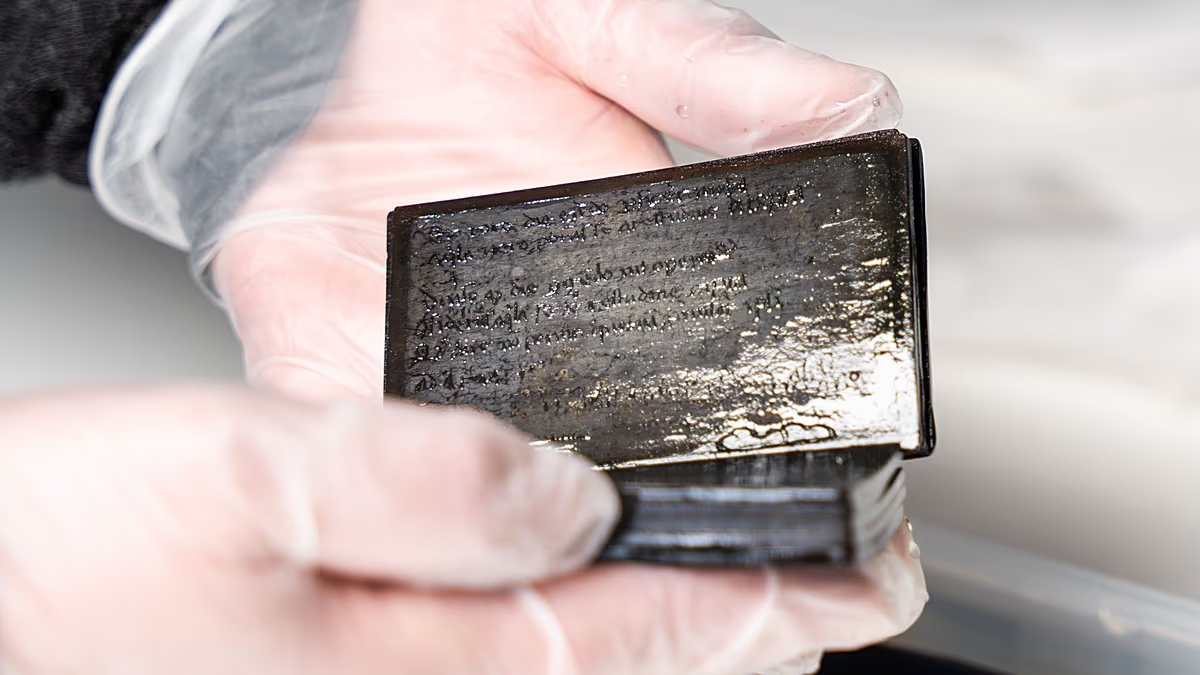
The notebook itself is an intimate artifact, a window into the daily life of a long-gone individual. Measuring a mere 10 by 7.5 centimeters, it was designed for practicality and reuse. It consists of wooden tablets coated with wax, protected by an embossed leather cover featuring a delicate lily motif. In an age before cheap paper, this was a portable and renewable writing surface. Using a pointed stylus, the owner could inscribe notes, lists, or memos into the soft wax, then smooth them over to start afresh. This particular booklet contains ten pages, eight of which bear inscriptions on both sides, all seemingly written by a single hand in Latin. The very existence of such an object speaks volumes. In the High Middle Ages, literacy was a specialized skill, largely confined to the clergy, the nobility, and certain professionals. The discovery of this notebook in a urban merchant district of Paderborn immediately suggests a worldly and educated owner, likely a prosperous trader or a civic official who needed to keep records and correspondence.
Further corroborating the high social status of the latrine’s users was another poignant find: remnants of silk fabric. Archaeologists posit that this luxurious material may have been used as a form of toilet paper, a stark reminder of the vast economic disparities of the era and a testament to the wealth that flowed through this central German city. The juxtaposition of the practical, functional notebook and the extravagant use of silk creates a vivid, almost intimate, portrait of a affluent medieval household. Their refuse tells a story of commerce, literacy, and daily comforts that many of their contemporaries would never have known. This latrine was not a communal facility but a private one, serving a wealthy urban residence, making its contents a curated collection of a specific household’s discarded items.
The journey of the notebook from a lump of wet soil to a legible historical document is a story of modern archaeological painstaking care. When first unearthed, the object was inconspicuous, encased in muck and, as LWL restorer Susenne Bretzel noted, still carrying a distinctly unpleasant odor after centuries. Its true nature was only revealed during meticulous cleaning in the LWL’s restoration workshop in Münster. A minor miracle of preservation was discovered within: the pages had been tightly pressed together, shielding the fragile wax writing surfaces from dirt and deformation. Critically, the wooden tablets had not warped over time, meaning the ancient scratches in the wax remained astonishingly clear and readable. This physical stability is rare for such an old organic artifact and provides an unparalleled opportunity for scholars.
Currently, the notebook is undergoing an extensive conservation and analysis process expected to take up to a year. To prevent deterioration, its organic components are stored in distilled water. Scientists are meticulously examining the materials—the composition of the wax, any resin binders, pigments in the cover, and the types of wood used—to understand the craftsmanship and trade networks that produced it. This material analysis is the essential precursor to the most anticipated phase: the deciphering of the text itself. What secrets does this 13th- or 14th-century notebook hold? They could be mundane household accounts, merchant inventories, legal notes, or perhaps fragments of literature or personal musings. Each word scratched into that wax will offer an unfiltered, immediate connection to the thoughts and necessities of a single individual from medieval Paderborn, far more direct than any formal chronicle or religious manuscript.
This discovery, therefore, is multilayered. It is a testament to the unpredictable nature of archaeology, where profound insights into the past can emerge from the most unglamorous of places. It highlights the advanced conservation techniques that allow such fragile finds to speak again. But most importantly, the Paderborn notebook is a powerfully human artifact. It transcends its origins as refuse to become a direct line to a person who, centuries ago, held this very object in their hands, jotting down things they deemed important enough to record, even if only temporarily. Once fully studied, its contents will enrich our understanding of medieval urban life, commerce, and literacy, not in broad strokes, but in the precise, personal handwriting of someone who lived it.