

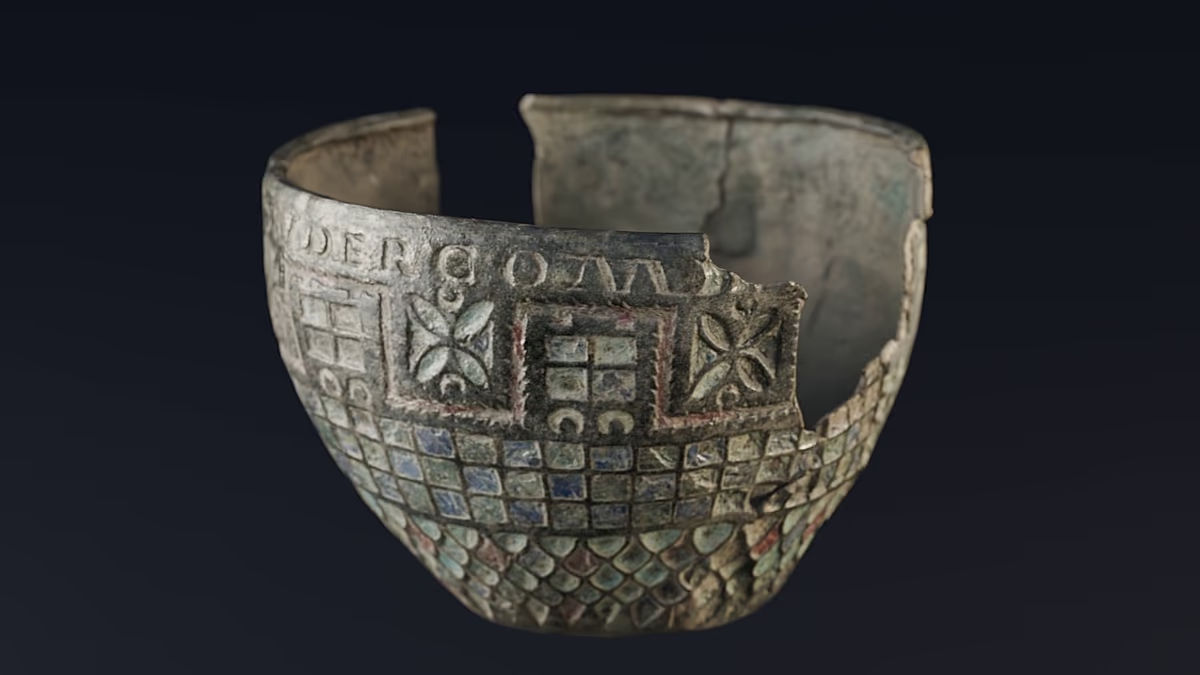
Nearly two millennia ago, a Roman soldier, his long service complete, prepared for an arduous journey home. He was a Celtiberian, a man from the lands of what is now central Spain, who had spent years stationed at the Empire’s wild northern frontier in Britannia. As he packed his belongings, amidst the practical items, he carefully wrapped a small, beautiful object: an enamelled bronze cup. This was no mere drinking vessel, but a detailed miniature replica of the very barrier he had helped to guard—Hadrian’s Wall. This cup, today known as the Berlanga cup, would lie forgotten in the Spanish earth for centuries, until its chance discovery would offer scholars a stunning new chapter in the story of this legendary frontier and the lives of those who served upon it.
This exceptional artifact is the subject of a landmark study, revealing its significance. Hadrian’s Wall, the 73-mile stone fortification built across Britain, is iconic. Less known are the exquisite commemorative cups associated with it. Only a handful of these paterae were known to exist, each a hemispherical bowl decorated with enamel friezes of the Wall’s turrets and, critically, inscribed with the names of its forts. All previously known examples listed forts only from the wall’s western sector. The Berlanga cup shatters this pattern. It is the sole cup in the world that names forts from the eastern sector: Cilurnum, Onno, Vindobala, and Condercum. This makes it an unparalleled archaeological find, filling a gap in our historical record and offering a more complete cartographic picture of the Wall as celebrated by the Romans themselves.
Although found fractured and misshapen, modern technology has allowed researchers to resurrect the cup virtually. Through photogrammetry, a precise digital twin was created, revealing it to be the largest of all known Wall cups. Its vibrant enamel work in red, green, turquoise, and blue depicts the Wall’s silhouette, while the inscribed fort names are set in delicate glass paste. Intriguingly, the order of the names runs from west to east, as if the viewer is standing on the Roman side of the barrier looking along it—a unique perspective among these souvenirs. Scientific analysis confirmed its origins: the metal’s composition and lead isotopes trace it unequivocally to British sources, likely mines in northern England or Wales. Crafted from a zinc-lead bronze common in 2nd-century Britannia, the cup was almost certainly made by skilled local artisans near the Wall itself, dating it to between 124 and 150 AD.
This leaves a compelling, human mystery: how did a cup made in northern Britain wind up buried in a field in central Spain? The research points to a deeply personal narrative. The Romans routinely recruited soldiers from conquered provinces, and historical records confirm that a Celtiberian unit, the Cohors I Celtiberorum, was stationed on Hadrian’s Wall. The Berlanga cup, a high-quality prestige object, was likely a commissioned memento—a veteran’s trophy. The most plausible explanation is that our soldier, upon his honorable discharge, packed this tangible symbol of his distant service and embarked on the epic, months-long journey back to his homeland. The cup was not just a souvenir, but a potent emblem of his identity: a Celtiberian who had become a Roman soldier, and who carried proof of his life at the edge of the known world back to the heart of the empire.
The cup’s discovery did more than solve an ancient puzzle; it led to the uncovering of a lost Roman landscape. Archaeologists, intrigued by the find, surveyed the area near Berlanga del Duero. Using ground-penetrating radar and aerial photography, they detected the remains of a Roman villa, a farming estate active from the 1st to the 4th centuries. They identified building foundations, rooms, and even surviving paving. This villa likely represents the veteran’s homeland, the very community he returned to. The cup, perhaps kept as a cherished heirloom, ultimately spent its centuries of silence not in isolation, but within the context of a working rural estate—a testament to the reintegration of a world-traveled soldier into the peaceful rhythms of provincial life.
Today, the Berlanga cup is being carefully restored and will reside permanently at the Numantine Museum in Soria. It holds the distinguished honor of being only the second piece of this rare series ever found in Iberia, and the first to remain in Spain. Its journey—from a workshop near a windswept British wall, to the knapsack of a homesick soldier, to a villa in Celtiberia, and finally into the light of the modern museum—encapsulates the vast, interconnected nature of the Roman Empire. More than a map in metal, it is a bridge between two distant provinces, and a silent, poignant testament to the individual human experiences of service, memory, and homecoming that lie at the heart of history.