



The Unmasked Artist: Thomas Bangalter’s Journey Beyond Daft Punk
Five years after the stunning announcement that brought the legendary era of Daft Punk to a close, the silence of one robotic helmet has been filled with a profound and surprising creative energy. Thomas Bangalter, once half of the world’s most iconic electronic duo, has not retreated from artistry but has instead embarked on a remarkable, genre-defying journey. Far from the pulsating dance floors he helped define, Bangalter has immersed himself in the worlds of film scoring, operatic soundtracks, and symphonic composition for ballet, proving that his creative spirit is not bound by any single musical language.
His 2023 solo debut, ‘Mythologies,’ served as a powerful declaration of this new chapter. In a move that delighted and astonished listeners, Bangalter traded four-on-the-floor beats for a sweeping, 90-minute orchestral work. The piece was a revelation—a Baroque-inspired tapestry woven with threads of Vivaldi’s grandeur, Philip Glass’s minimalism, and echoes of Bach and Debussy. Critics rightly noted that his approach to melody and influence mirrored the very art of sampling that Daft Punk perfected, now applied to centuries of classical tradition. This wasn’t a rejection of his past, but a magnificent evolution, demonstrating that the same mind that crafted timeless electronic hooks could also architect sublime, classical structures.
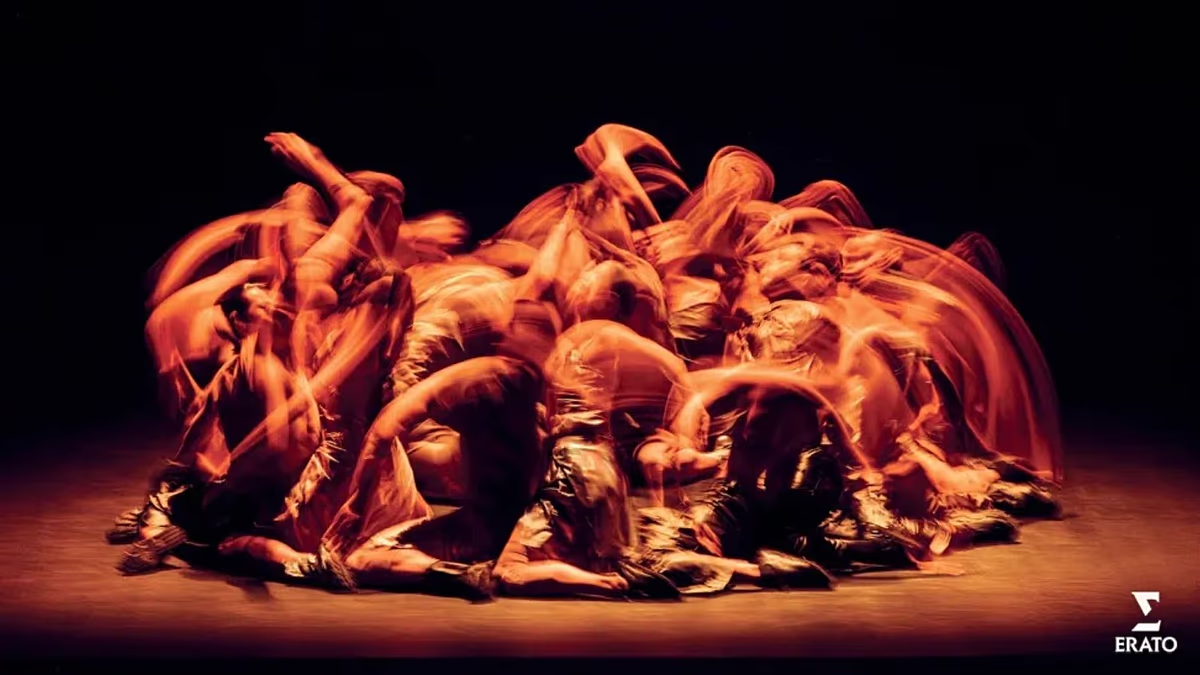
Now, Bangalter continues to chart this unique path with the announcement of a new project, ‘Mirage – Ballet For 16 Dancers.’ Billed as a vast piece of “electronic minimalism,” this score represents a fascinating synthesis of his dual musical worlds. Created for a ballet choreographed by Damien Jalet and visual artist Kōhei Nawa, the music aims to trace the “changing states” of the performance, suggesting a fluid, atmospheric soundscape that breathes alongside the dancers’ movements. It promises a hybrid form, where the precision and atmosphere of electronic music meet the expressive narrative needs of contemporary dance.
Yet, for those who might wonder if Bangalter has permanently left the realm of electronic innovation, a simultaneous announcement offers a thrilling answer. In a characteristically dynamic move, he will also host a “massive immersive event” at Art Basel in Switzerland. The installation, titled Warehouse Artefacts, combines a DJ set from acclaimed German producer Rampa with visual art by Julian Charrière, described as “a sensory overload aimed squarely at the intersection of music and fine art.” This project confirms that Bangalter’s artistic identity is not a binary choice between classical and electronic, but a spectrum he navigates with equal authority.
This dual output—the contemplative ballet score and the immersive art installation—embodies the essence of Bangalter’s post-Daft Punk career. He operates not as a figure confined by genre, but as a true composer in the broadest sense, applying his meticulous craft and visionary ideas to any format that inspires him. From the concert hall to the art gallery, his work continues to explore the profound relationship between sound, movement, and visual experience, a pursuit that was always at the core of Daft Punk’s mythic presence.
‘Mirage – Ballet For 16 Dancers’ is set for release on June 5, 2026, offering the next chapter in Bangalter’s ongoing and fascinating artistic revelation. His journey reminds us that creative reinvention can be the most authentic form of continuation. By removing the iconic mask, Thomas Bangalter has revealed not an artist resting on past glory, but a restless, prolific composer building a legacy that is both deeply respectful of tradition and boldly forward-looking, ensuring that his voice in the world of music remains as vital and unexpected as ever.