




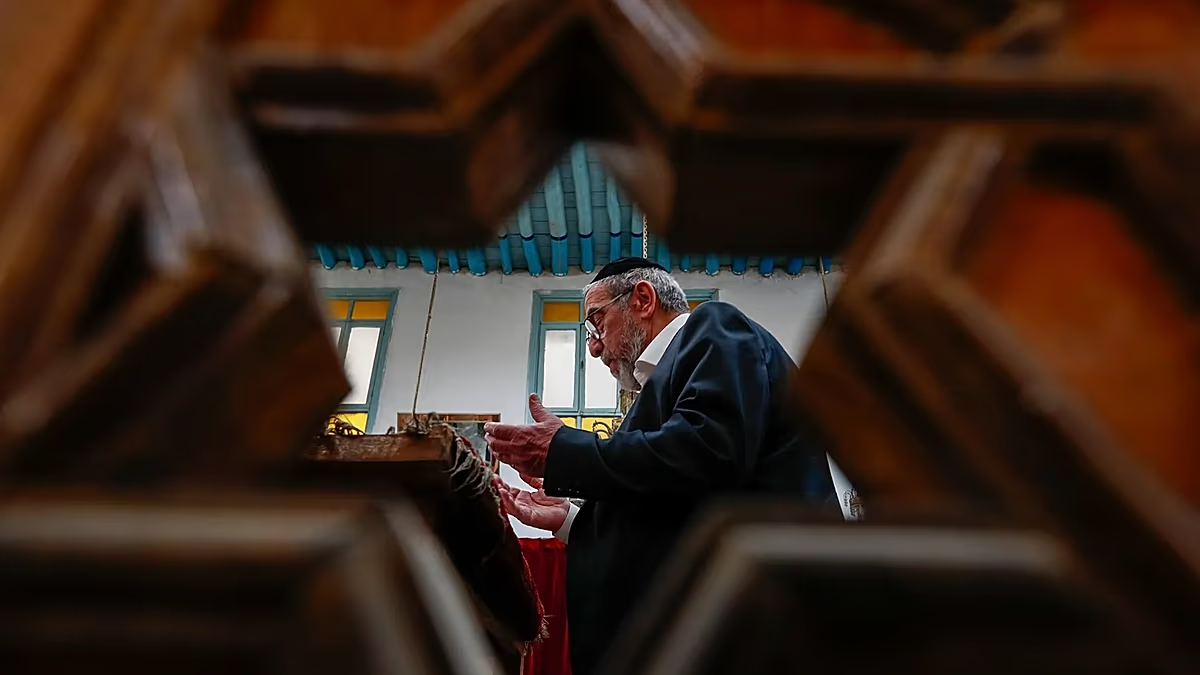
The Fading Flame: Syria’s Remnant Jewish Community Navigates Survival
In the historic, winding lanes of Damascus’s ancient Jewish Quarter, a profound silence speaks of a vibrant past. Once home to a thriving community numbering in the tens of thousands, Syria’s Jewish population today is estimated at fewer than one hundred souls, scattered and isolated. This stark decline renders the maintenance of religious tradition not merely a challenge, but an urgent existential question. The struggle for continuity is most viscerally felt in the most fundamental of daily needs: food. Specifically, the search for kosher sustenance has become a poignant symbol of a community clinging to its identity against overwhelming odds, highlighting how ancient practices now depend on fragile, individual efforts in a landscape from which the community has all but vanished.
The central pillar of this struggle, as explained by Bakhor Shamntoub, the head of Syria’s Mussawi (Jewish) community, is the strict requirement of shechita, the ritual slaughter. Kosher law permits meats like lamb, beef, and chicken, but only under exacting conditions. The butcher must be a Jewish person holding official certification—a requirement that has become nearly impossible to meet in contemporary Syria. Shamntoub recalls a time when a Jewish butcher worked alongside a Muslim colleague in Damascus’s Al-Qassaa district, but that individual has long since left the country. “Regardless of how correctly the Muslim butcher performs the slaughter, it is not considered kosher, because the condition is that the butcher must be Jewish,” he states, underscoring a theological barrier that transcends skill or intention. The ritual further demands a blade of pure diamond for a swift, painless cut and a meticulous post-slaughter inspection of the animal for any signs of disease or prior injury. These layers of sacred protocol, designed to ensure spiritual purity and compassion, now form an almost insurmountable wall for Syria’s last Jews.
Consequently, the community’s sustenance has become a patchwork of precarious external solutions. Before Syria’s civil war, kosher meat was imported regularly from Turkey. That supply chain collapsed, forcing Shamntoub and others to rely on personal efforts: occasional personal imports from Turkey, care packages sent by relatives in the United States, and supplies brought in by the rare Jewish visitor on a short stay, all carefully stored in communal refrigerators. Looking forward, Shamntoub harbors a plan to revive local production by bringing a certified Jewish butcher to Damascus, but this remains a hope rather than a reality. The idea of dedicated kosher restaurants is met with skepticism due to the tiny local population. Instead, a compromise exists at places like the Semiramis Hotel in the Old City, which offers a section for Jewish cuisine using imported meat and strictly new, dedicated cookware—a small concession in a city largely devoid of such options.
The broader economic and social landscape reveals deep divisions over the very idea of catering to this vanishing community. Restaurant owners in the Old City expressed mixed views to Euronews. Some objected on principle to specialized kosher establishments, arguing that restaurants should serve everyone equally. Others focused on the stark economics: the minuscule local Jewish population and still-nascent tourist traffic simply cannot justify the significant investment required for kosher-certified slaughterhouses, chefs, and equipment. This practical viewpoint acknowledges a harsh reality—without a sustainable customer base, such ventures are not financially viable, turning religious accommodation into a question of commercial sense.
More ominously, several business owners raised grave security concerns, pointing to the hostile reaction the Semiramis Hotel faced online after announcing its Jewish section. “The security situation does not allow us to open such a door,” one owner warned, fearful that extremists could target any establishment perceived as serving Jewish patrons. This fear is a chilling reminder of the underlying tensions that contributed to the community’s exodus. Yet, a countervailing perspective also exists: some see kosher dining as a potential bridge, a way to attract Jewish diaspora tourism and help rebuild a severed connection to Syria’s ancient heritage. They acknowledge, however, that this remains a distant dream, constrained by the same practical and political realities.
For now, the daily reality for individuals like Shamntoub is one of careful adaptation. In the absence of accessible kosher meat, fish—which has fewer preparation restrictions—becomes a staple. When dining in ordinary Damascus restaurants, Shamntoub opts for vegetarian dishes like hummus or ful (fava bean stew) to adhere to his dietary laws. This quiet, personal compromise mirrors the community’s larger stance: a resilient but dwindling flame maintaining its glow through individual perseverance, reliant on global diaspora networks and awaiting a future where increased tourism and stability might allow tradition to be practiced openly once more. Their story is not just one of religious observance, but a profound testament to preserving identity in the quiet, stubborn face of extinction.