

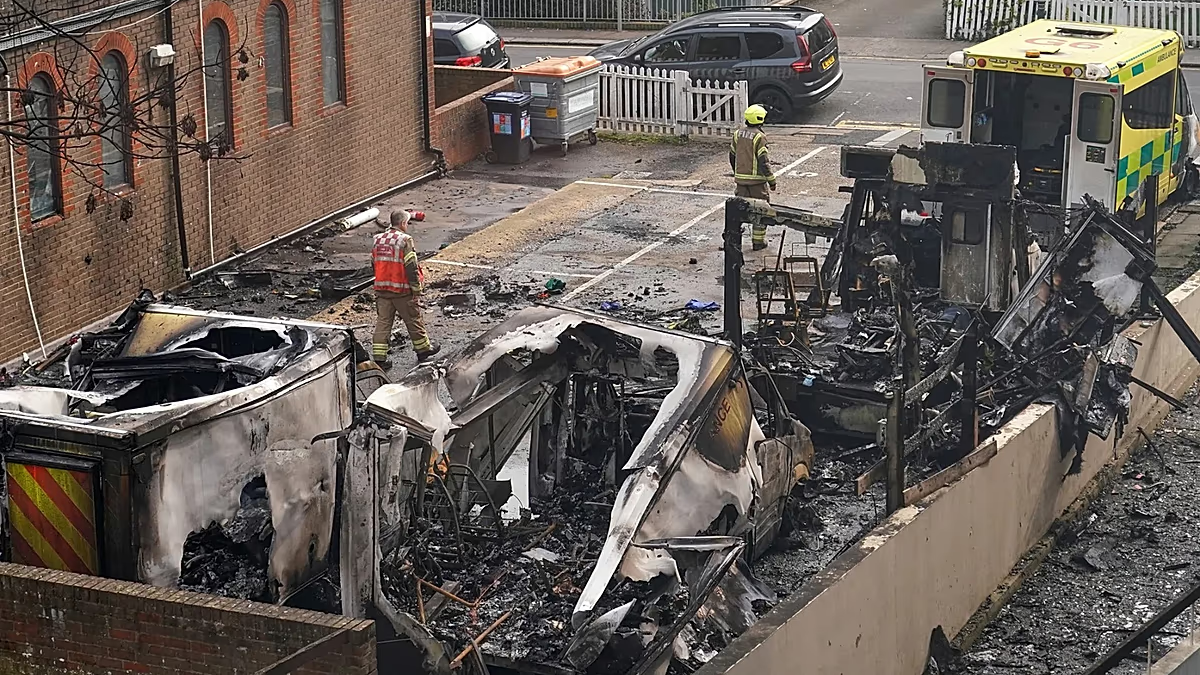
On the morning of March 23rd, 2026, the quiet, residential neighborhood of Golders Green in north London was shattered by violence. Four ambulances belonging to Hatzola, a volunteer-run Jewish emergency medical service, were set ablaze in a deliberate arson attack. The fire was so intense that gas cylinders on the vehicles exploded, shattering windows in a nearby apartment block and forcing the precautionary evacuation of local homes. While miraculously no one was physically injured, the psychological impact on the community was immediate and profound. This was not a random act of vandalism; it was a targeted assault on a symbol of Jewish life and care, a service established in 1979 that provides free, critical medical response to all in need across north London.
The attack sent shockwaves through the United Kingdom and prompted a swift and severe response from the highest levels of government. Prime Minister Keir Starmer condemned the act as a “deeply shocking antisemitic arson attack,” expressing his solidarity with a Jewish community waking to “horrific news.” His words underscored a grim reality: this was not an isolated event. The Golders Green incident was part of a concerning spate of similar attacks across London, primarily targeting venues and symbols associated with Jewish people or Israel. In response, London police launched a significant investigation, leading to a total of 25 arrests. Authorities have pointedly stated they are examining whether those carrying out such attacks are acting as “paid proxies,” suggesting a sinister layer of orchestration behind what might appear as grassroots criminality.
This investigation led to the first court appearance of four young men charged in connection with the Hatzola ambulance attack. On a Friday in late April, the gravity of the charges brought them before Judge Bobbie Cheema-Grubb at the Central Criminal Court of England and Wales, the historic Old Bailey. Two of the defendants, 20-year-old Hamza Iqbal and 19-year-old Rehan Khan, sat in the dock wearing grey tracksuits. The others, 18-year-old Judex Atshatshi and a 17-year-old who cannot be named due to his age, appeared via video link from custody. The proceedings were procedural but tense. The defendants confirmed their names and ages, with Khan briefly remarking to the judge that conditions in detention were “hard.” Beyond these formalities, the hearing set the course for a long legal process, with a trial date fixed for January 27th, 2027, expected to last four weeks.
The judge’s decisions highlighted the serious nature of the alleged crimes. She ordered all four defendants to remain in custody until trial and ruled that the case for all, including the 17-year-old, would be heard at the Old Bailey. Typically, a defendant of that age would be tried in a youth court, but Judge Cheema-Grubb noted factors like the small age difference between the accused and the severity of the charges in justifying a single, unified trial at the senior court. This legal consolidation reflects the courts treating the arson not as juvenile delinquency, but as a major act of conspiratorial violence with significant societal implications. The long wait for the trial, nearly three years after the arrest, illustrates the complexity of building a case that may involve examining digital evidence, witness testimonies, and the broader context of the alleged network behind the attacks.
That broader context points to an alarming international dimension. British security services have explicitly accused the Iranian state of using criminal networks to conduct attacks on European soil. Britain’s MI5 domestic intelligence service revealed that in just the year leading up to October 2025, more than 20 “potentially lethal” Iran-backed plots had been disrupted within the UK. The targets of these alleged state-sponsored operations often include Iranian opposition media outlets and, concerningly, Jewish community institutions. While the specific evidence linking the four defendants in the Old Bailey directly to Tehran has not been publicly detailed in court, the police’s mention of investigating “paid proxies” places this local arson attack within a shadowy global pattern of intimidation and violence, where local grievances can be exploited and amplified by foreign state actors.
As the case moves toward its 2027 trial, it represents a critical junction for community relations, national security, and the justice system in Britain. For the residents of Golders Green and the volunteers of Hatzola, the charred remains of their ambulances were a visceral reminder of vulnerability. For the state, the challenge is twofold: to meticulously prosecute those accused of carrying out the violence, and to unravel and counter the alleged networks that may have enabled it. This case is more than a prosecution for property damage; it is a test of societal resilience against hatred and a probe into the unsettling ways in which international tensions can manifest as local terror. The awaited trial will seek not only to assign legal responsibility but to publicly confront the ideologies and orchestrations behind an act meant to frighten and divide a community.