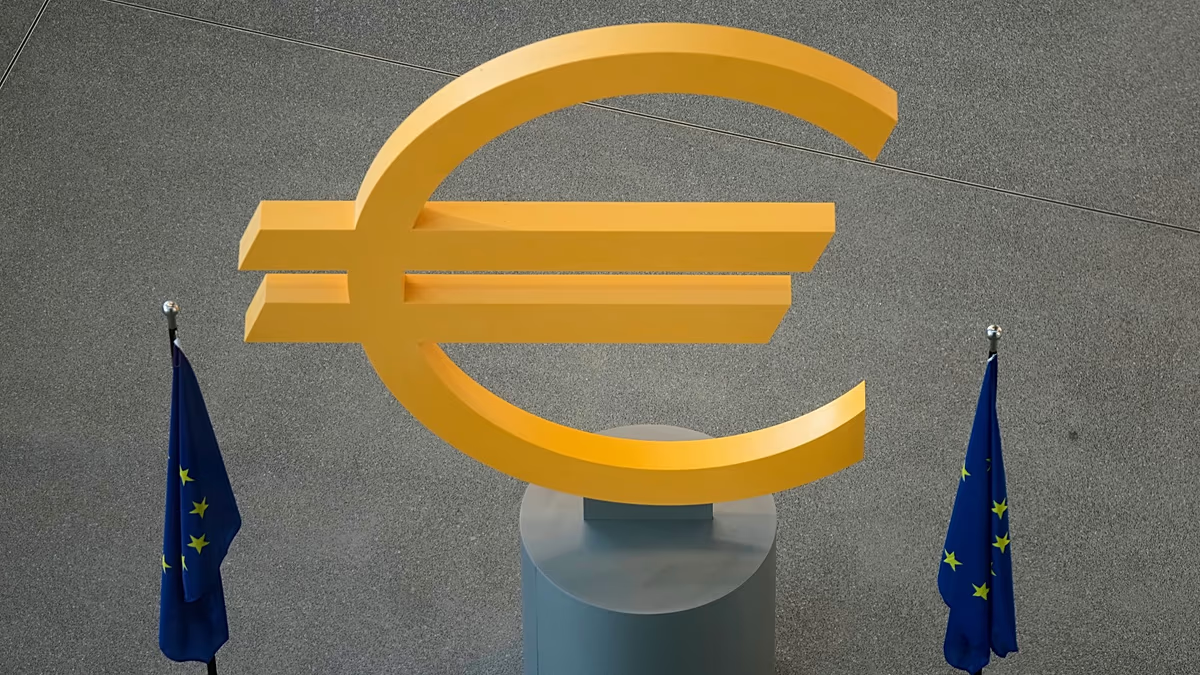





Europe stands at a pivotal crossroads, grappling with a fundamental question that will shape its financial future: who controls the money in our digital age? The continent is embroiled in a complex, high-stakes struggle over the creation of a digital euro, a form of electronic cash issued directly by the European Central Bank. This is not merely a technical upgrade to payment systems; it is a profound political and economic endeavor. Driven by a desire for strategic autonomy, the push for a digital euro is a direct response to the dominance of American payment giants like Visa and Mastercard, which facilitate the majority of card payments in the eurozone. Furthermore, the rapid emergence of private digital currencies, from corporate stablecoins to crypto assets, has sparked a fear of ceding monetary sovereignty to unregulated private entities. Europe’s answer is a middle path—a state-backed, tightly regulated digital currency designed to preserve the public good of money in the 21st century, ensuring that even as our wallets become virtual, the foundation of our payments remains a public utility under democratic oversight.
However, this vision faces fierce and entrenched opposition, primarily from Europe’s powerful commercial banking sector. Banks perceive the digital euro not as a complement, but as a direct competitor to the deposits and payment services that form the core of their business. Industry figures argue that by offering citizens a risk-free alternative to bank accounts, the ECB would disrupt the financial ecosystem, potentially destabilising the traditional model of credit creation. Their concern crystallises around the proposal to grant the digital euro “legal tender” status, which would mandate most merchants to accept it, just as they must accept physical cash. Banks contend this creates an unfair playing field, forcing them to compete with a public institution that enjoys a unique, state-backed privilege. This opposition is symbolised by platforms like Wero, a new European payments initiative backed by major banks, which views the project with deep suspicion despite sharing the broad goal of European payment autonomy.
Proponents of the digital euro counter that the banking industry’s fears are misplaced and that its arguments misunderstand the project’s core purpose. Advocates, such as those at the non-profit Finance Watch, frame the issue in simpler terms: the digital euro is the logical evolution of cash for a digital society. Just as physical banknotes and coins are a public good that ensure everyone, regardless of wealth, has access to a means of payment, so too should its digital equivalent exist. They argue that without legal tender status, the digital euro would languish as a niche product, failing to achieve the critical mass necessary to guarantee the continued availability of public money in daily life. The ECB has sought to assuage banking concerns by emphasising that the private sector will be integral to the system’s distribution, with commercial lenders acting as customer-facing intermediaries who would be compensated for their services. Yet, the philosophical divide remains deep—is the digital euro an essential public infrastructure, or is it an unnecessary intrusion into a functioning market?
The debate extends beyond boardrooms and banking halls, touching raw nerves around privacy and freedom. A diverse coalition of privacy advocates, decentralisation campaigners, and some within the crypto industry warns that a centrally issued digital currency could become a tool of surveillance and control. They fear it could grant governments unprecedented visibility into citizens’ financial lives and, in a worst-case scenario, the technical ability to program restrictions on how or where money can be spent. While the ECB’s design includes promises of strong privacy protections for offline payments and a holding limit to prevent large-scale fund movements out of banks, scepticism persists. This highlights the delicate balancing act at the heart of the project: crafting a digital currency that is both robust enough to ensure sovereignty and privacy-friendly enough to earn public trust in an era deeply wary of institutional overreach.
Currently, the fate of this entire project rests significantly in the hands of one man: Fernando Navarrete Rojas, the Spanish centre-right MEP tasked with steering the legislation through the European Parliament. His role has become the epicentre of the political battle. With a background in the Spanish banking sector and think-tanks, Navarrete has been openly sceptical, prioritising private-sector solutions and expressing concern that the digital euro could stifle innovation. In closed-door negotiations, he reportedly advocated for a severely limited version of the currency, restricted to offline use only—a move that would have neutered its relevance in the online commerce that defines modern life. This stance created tense, polarised negotiations within the Parliament, pitting his European People’s Party group against a broad coalition of Socialists, Liberals, Greens, and the Left who largely support the Commission’s proposal. While his preferred “offline-only” model has been dropped from the draft text, his influence continues to shape the pace and parameters of the debate.
As of now, the legislative journey is advancing, albeit slowly. A critical committee vote is expected by the end of June, followed by a plenary vote in the European Parliament. Once the Parliament finalises its position, the final and most crucial phase will begin: “trilogue” negotiations between the Parliament, the European Commission, and the Council representing EU member states. The goal is to reach a final agreement and adopt the legislation before the end of 2026, paving the way for a potential launch of the digital euro for retail use by 2029. The outcome is far from certain. The coming months will determine whether Europe can forge a consensus around a innovative digital public good, or if political fractures and private interests will delay or dilute a project aimed at securing European sovereignty in an increasingly digital and fragmented global financial landscape. The result will ultimately define how every European pays for their coffee, receives their wages, and navigates their economic life for generations to come.