



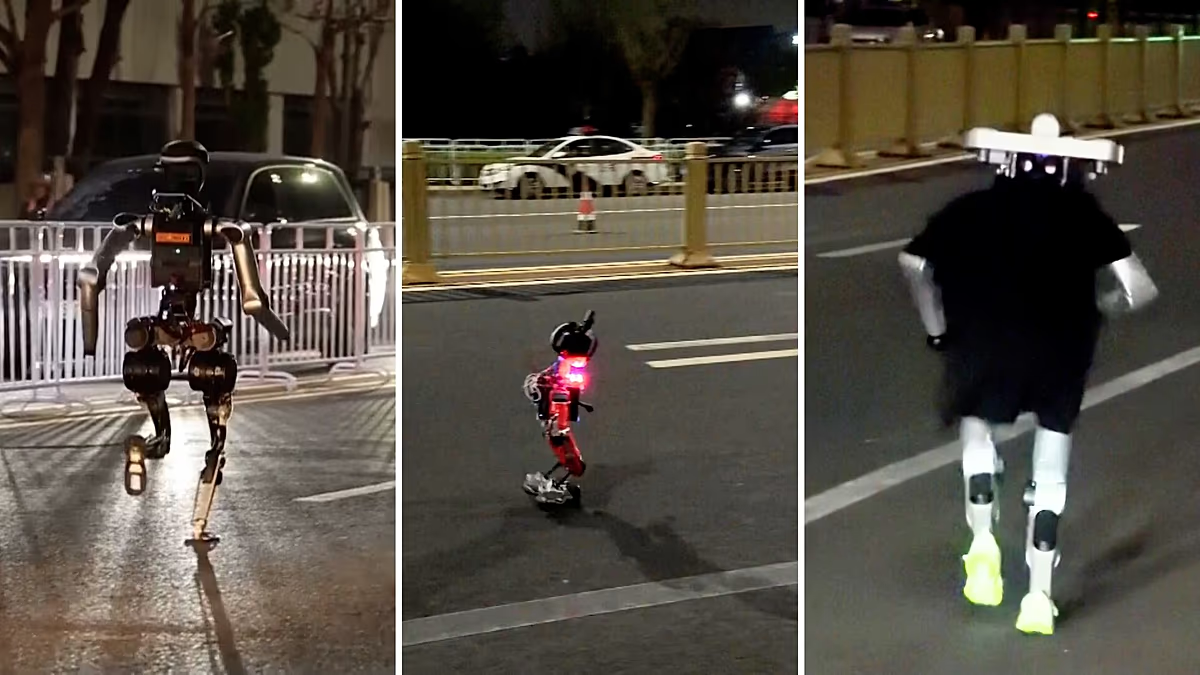
In the quiet, high-tech corridors of Beijing’s E-Town development zone, a remarkable and somewhat surreal scene unfolded recently. More than seventy humanoid robots, their mechanical limbs moving in a syncopated rhythm, embarked on an overnight 21-kilometre journey. This was not the main event, but a critical trial run for China’s second robot half-marathon, scheduled for 19 April. Teams from universities, tech companies, and research institutes subjected their creations to a full-course simulation, testing everything from route navigation and equipment coordination to emergency responses. The trial served as a stark preview of the challenges ahead, mirroring the official race’s demands and allowing organisers to fine-tune the complex logistics of an event where the athletes are not biological, but engineered.
The scale of participation alone marks a dramatic evolution in this fledgling field. Compared to last year’s inaugural race, the number of teams has surged nearly fivefold—a clear indicator of the explosive interest and investment in general-purpose humanoid robotics within China. Beyond mere growth, the technological ambitions have also escalated. According to Liang Liang of the Chinese Institute of Electronics, approximately forty percent of teams this year are employing fully autonomous navigation systems, removing direct human control during the race. This introduces “a significant challenge for the robots,” forcing them to independently perceive their environment, make pathfinding decisions, and adjust to unforeseen obstacles—a monumental task in dynamic, real-world conditions.
Yet, for many of these teams, the primary goal remains strikingly humble: simply to finish. The harsh realities of last year’s race, where only six out of twenty-one starting robots completed the course, loom large. Organisers have even introduced new awards reflecting this fundamental struggle, including prizes for endurance and for the basic achievement of reaching the finish line. This underscores that the event is less a polished display of perfection and more a raw, open laboratory for real-world stress testing. Teams are there to learn, to experiment, and to expose their designs to the brutal demands of continuous, long-distance locomotion—a test that human bodies are evolved for, but robot bodies are painstakingly built for.
The stories from the trial run vividly illustrate this experimental ethos. Yang Kechang, from China Agricultural University, revealed that his team assembled their robot only at 1 PM on the day of the test and entered it immediately. For them, participation itself was a victory. Despite setbacks like overheating joints that required cooling during battery changes, Yang remained optimistic, noting that future improvements would hinge on optimising the robot’s control algorithms rather than just hardware. Similarly, Xu Bo of Genisom AI described his 1.3-metre-tall machine grappling with overheating motors and rapidly draining batteries. These are not tales of flawless performance, but of perseverance and incremental progress, where each failure provides crucial data for the next iteration.
The overarching challenge binding all these narratives is energy management and thermal control—the core bottlenecks of mobile robotics. A humanoid robot running a half-marathon is an extreme exercise in power efficiency. Every joint actuator, every sensor, and every processing unit generates heat and consumes electricity. The machines must balance the need for powerful, dynamic movements with the finite capacity of their batteries and the risk of critical component failure from overheating. Solving these issues requires advances not just in mechanics, but in integrated system design, lightweight materials, and intelligent power allocation software. The race course, therefore, becomes a brutal proving ground for these integrated systems.
Ultimately, China’s robot half-marathon symbolizes a pivotal moment in the journey toward practical, general-purpose robots. It transcends a quirky spectacle to become a serious, coordinated effort to push technology out of controlled labs and into unpredictable environments. The dramatic increase in participants, the shift toward autonomy, and the focus on resilience over speed all point to a field maturing rapidly. While the images of robots stumbling, overheating, or persevering across a finish line may seem whimsical, they represent the tangible, arduous steps toward a future where machines can share our physical spaces and tasks, built not just for precision, but for endurance.