




A Crossroads for European Labor: Innovation, Burnout, and the Fight for Rights
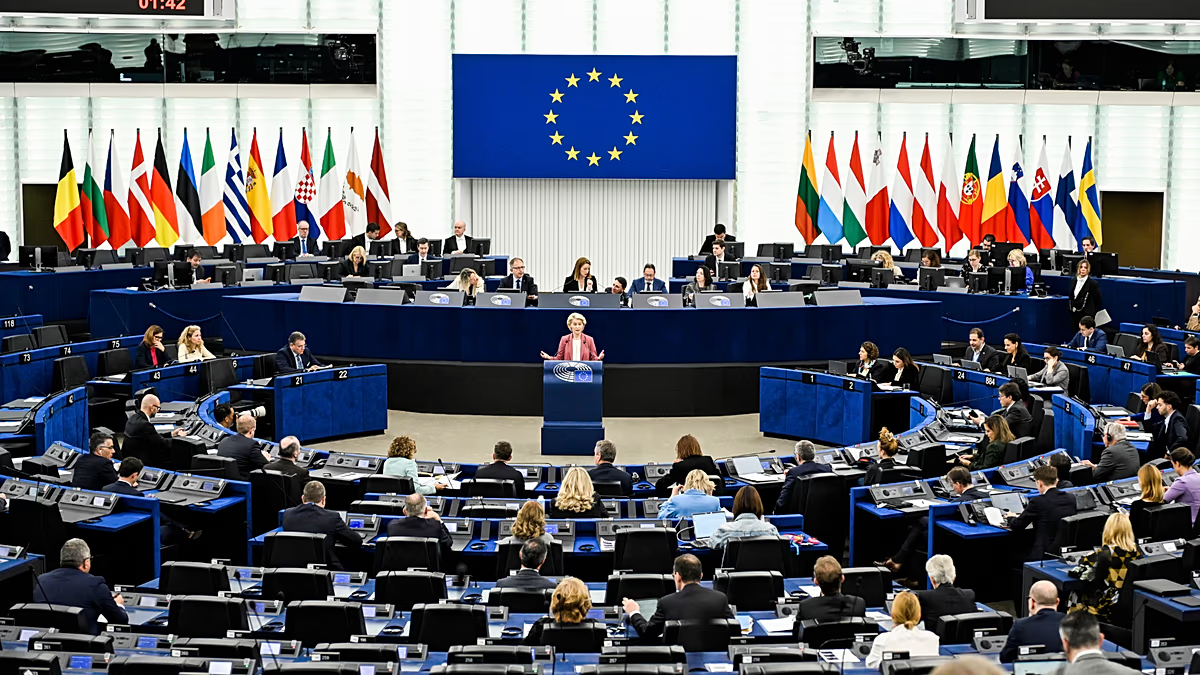
As Ursula von der Leyen commences a second term leading the European Commission, her agenda places competitiveness and innovation at the very heart of Europe’s future. This drive, however, is unfolding against a backdrop of profound anxiety for the continent’s workforce. Recent policy proposals, such as the creation of a new, business-friendly “28th regime” legal framework and calls for broader deregulation, have sparked concern among labor advocates. They warn that in the pursuit of economic dynamism, the hard-won rights and well-being of workers risk being marginalized or even rolled back. This tension frames a critical question for International Labour Day: can Europe foster a cutting-edge, competitive economy without sacrificing the social protections that form the bedrock of its identity?
The challenges facing European workers today are both acute and systemic. Esther Lynch, General Secretary of the European Trade Union Confederation (ETUC), paints a concerning picture: “Whether it’s artificial intelligence and the lack of safeguards, the amount of stress and burnout that workers have at the moment, or scrupulous companies using loopholes to undermine rights and entitlements.” Burnout, in particular, has reached crisis levels, yet our understanding of it remains frustratingly vague. As researcher Mikkel Barslund notes, the lack of harmonized data across Europe—with estimates of affected employees ranging from 20% to 60%—severely hampers our ability to diagnose and treat this epidemic of workplace stress. This data vacuum extends to the root causes, leaving policymakers and unions grappling in the dark to find effective solutions.
Compounding this stress is the meteoric rise of artificial intelligence. While its full impact on employment levels remains uncertain, Barslund highlights a more immediate threat: the potential for AI-powered surveillance tools to create oppressive and anxiety-inducing work environments. Clark Parsons, CEO of the European Startup Network, acknowledges the “incredibly massive disruption” AI is already causing. Yet, from his perspective, this technology is also a unparalleled engine for European innovation, fueling “incredible breakthrough technology, new labs, new startups, and new investment.” This dichotomy encapsulates a core conflict: the same force heralded as Europe’s economic salvation is also a primary source of worker anxiety and potential exploitation.
At the center of the political debate is the proposed “28th regime” or “EU Inc.,” designed to streamline company creation and operation across the single market. Lynch views this initiative with deep alarm, arguing it would “undermine every single employment right that everybody is currently protected by.” She points to provisions allowing companies to register in jurisdictions separate from their employees, to rapidly open and close businesses, and to utilize share options in lieu of stable wages, as fundamental threats to job security and fair compensation. Parsons, conversely, sees it as a vital opportunity to unshackle startups from bureaucratic red tape, fueling growth and job creation. He expresses optimism that dialogue between entrepreneurs and unions can find common ground, a notion that underscores the vast gap in perspective between these critical stakeholders.
Beyond new legislation, Lynch warns of a more direct assault on labor’s foundational power: the right to organize and strike. Citing a damning global index which found that nearly three-quarters of European countries violated the right to strike last year, she condemns a trend of “bad legislation being introduced, in particular to prevent working people coming together to protest.” This crackdown represents, for unions, an erosion of democracy itself within the workplace. The call is not just for innovation-friendly policies, but for governments to unequivocally defend the role of unions and compel employers to engage with them in good faith, ensuring that the balance of power does not tilt overwhelmingly toward capital.
As Europe stands at this crossroads, the path forward requires a nuanced and courageous balance. The ambition for a more competitive, innovative, and agile economy is undeniable, particularly in a global race for technological supremacy. However, this cannot be pursued through a philosophy that implicitly or explicitly views worker protections and collective bargaining as mere friction to be eliminated. The solutions lie not in choosing between innovation and rights, but in innovating for better rights—harnessing data to truly understand the burnout crisis, crafting intelligent regulation that protects workers from algorithmic exploitation, and designing growth frameworks that inherently value stability and dignity. The legacy of Ford’s five-day week reminds us that progress is possible when productivity and humanity are aligned. The task for Europe’s next chapter is to write new rules for a digital age that honor that same principle.