



Of course. Here is a humanized and expanded summary of the content, structured into six paragraphs.
In a bold and captivating curatorial move, the Louvre Museum in Paris has orchestrated a remarkable conversation across the centuries. Its major new exhibition, opening in the spring of 2026, brings together the titanic figures of Michelangelo Buonarroti and Auguste Rodin. This is not merely a side-by-side display of two great sculptors, but an intentional, profound dialogue between the Renaissance master and the father of modern sculpture. By placing their works in direct communion, the exhibition seeks to illuminate the invisible thread of artistic obsession, struggle, and genius that connects the 16th and the 19th centuries, asking us to see each artist anew through the lens of the other.
The connection is far from speculative; it is rooted in historical fact. Auguste Rodin was a devoted and lifelong student of Michelangelo. His pilgrimage to Italy in 1875-76 was a transformative experience, where he spent weeks sketching and studying the Florentine’s works. He was not captivated by Michelangelo’s finished perfection, but rather by his non-finito—the “unfinished” works where figures seem to be eternally wrestling themselves free from the marble block. Rodin saw in this not incompleteness, but a supreme expression of raw emotion, effort, and the very process of creation. This encounter liberated Rodin, showing him that a sculpture could be a record of the artist’s hand and passion, not just a polished final product.
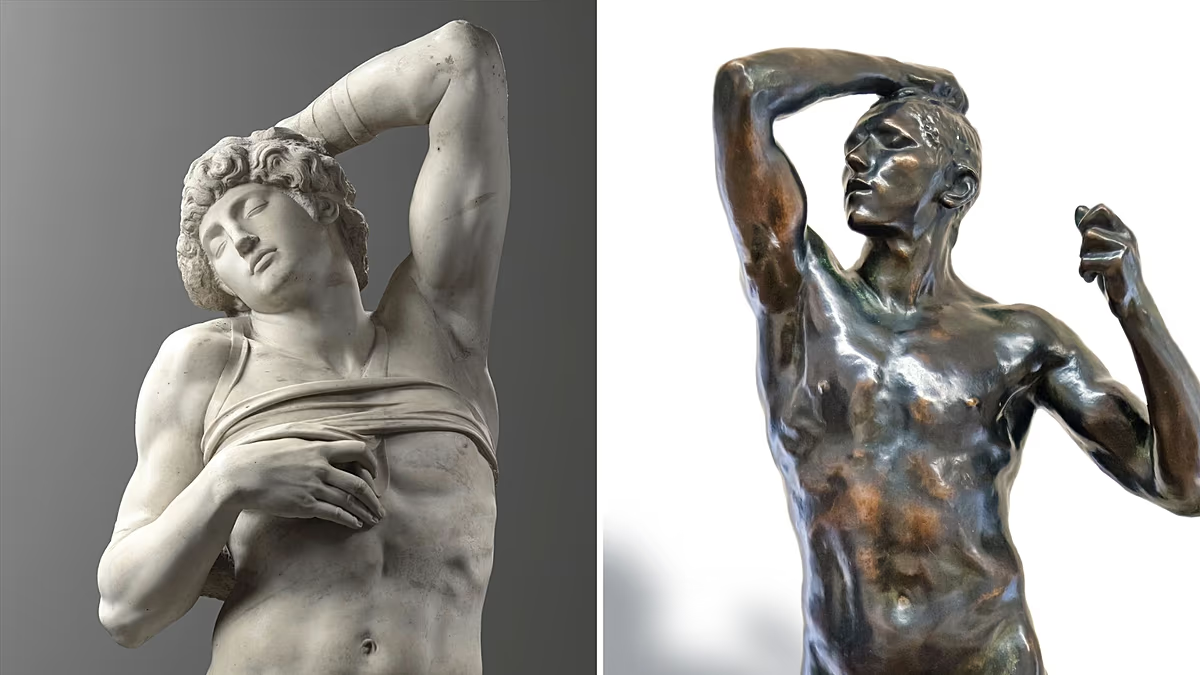
Walking through the exhibition, this spiritual lineage becomes viscerally clear. One can imagine Rodin standing before Michelangelo’s powerful “Dying Slave” or the awe-inspiring “Prisoners” (also known as the “Slaves”), their muscular forms only partially emerged from the stone. The influence echoes unmistakably in Rodin’s own “The Walking Man,” a torso and legs striding with purposeful energy, or in the fragmented, potent bodies of his “Burghers of Calais.” Both artists shared a fascination with the human body as a landscape of emotion—a vessel for expressing anguish, contemplation, and heroic effort. The Louvre’s staging allows us to witness this directly: the tormented twist of a Michelangelo pietà might face the agonized grace of Rodin’s “The Fallen Caryatid,” creating a silent, powerful exchange on the theme of human suffering and resilience.
Beyond technique, the exhibition delves into the shared thematic depths that preoccupied both men. They were both drawn to monumental, existential subjects: the Pietà, the portrait of the thinker, the depiction of mythological and biblical turmoil. Michelangelo’s “Moses” radiates a terrifying, divine authority, while Rodin’s “Balzac” captures the monumental, restless spirit of the literary genius. Both sculptors possessed an almost supernatural ability to make stone pulse with life, thought, and soul. The show prompts us to consider how each artist grappled with the human condition—Michelangelo through the prism of faith and divine order, Rodin through the lens of psychology, individuality, and modern doubt.
Organizing such an exhibition is an immense feat of diplomacy and logistics, involving rare loans from museums across Europe and beyond. It is a testament to the enduring power and prestige of these artists that institutions have agreed to let such fragile, priceless masterpieces travel. For visitors, this is a once-in-a-generation opportunity to see works that are typically anchors in their home collections—be it the Galleria dell’Accademia in Florence, the Musée Rodin in Paris, or other sanctuaries of art—gathered in a single, contemplative space. The Louvre, with its own deep history, becomes the perfect stage for this meeting of giants.
Ultimately, this exhibition is more than an art historical lesson; it is an emotional and philosophical journey. It reveals that artistic innovation is not born in a vacuum, but is often a deep, passionate conversation with the past. Rodin did not copy Michelangelo; he absorbed his essence and transmuted it for a new age. By facilitating this dialogue, the Louvre allows us to understand that the fire of creation—the struggle to give form to the ineffable ideas of the mind and heart—is timeless. We leave not simply having seen magnificent sculptures, but with a felt understanding of how one man’s unfinished struggle five hundred years ago could fuel the birth of modern art, reminding us that beauty, torment, and the relentless pursuit of expression are the eternal links in the chain of human genius.