


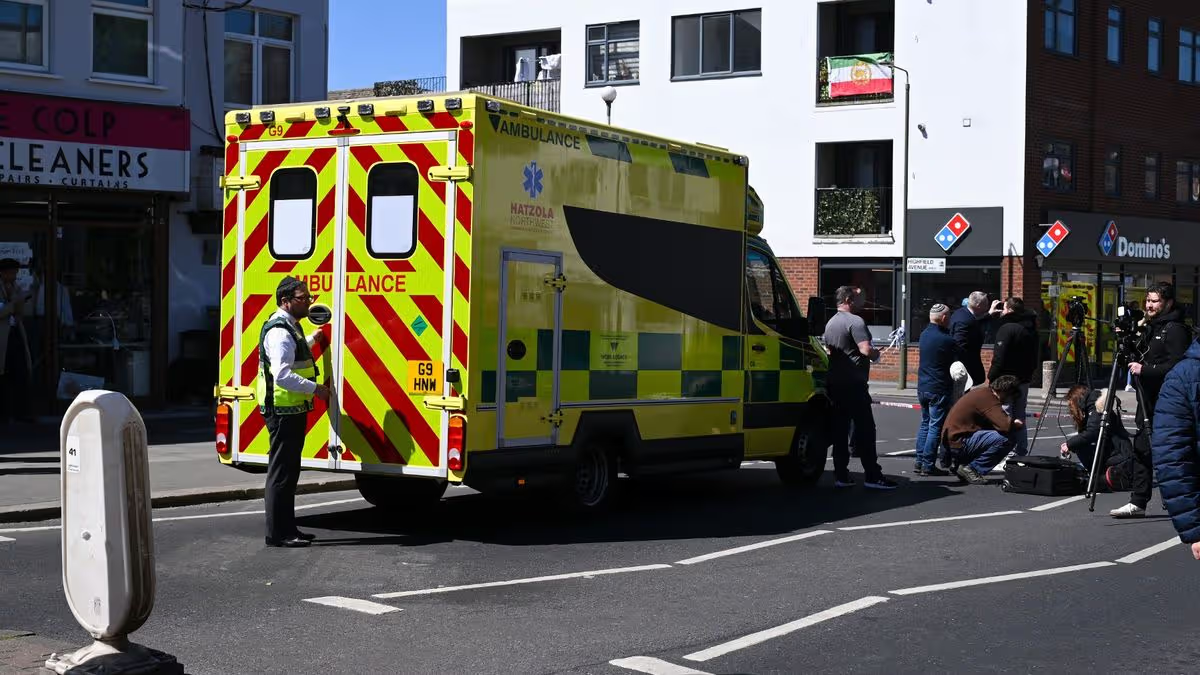
In recent weeks, members of Britain’s Jewish communities have been subjected to a series of terrifying terrorist attacks, intensifying fears and shattering the everyday safety many take for granted. The latest of these assaults occurred in the quiet, leafy streets of Golders Green in north-west London, an area with a significant Jewish population. On a Wednesday morning, two men—one aged 76 and the other 34—were brutally stabbed in what the Metropolitan Police swiftly confirmed as a terrorist attack motivated by antisemitism. This incident is not an isolated horror but part of a deeply troubling pattern, leaving families and communities reeling from the realisation that such hatred can erupt violently in their own neighbourhoods. For a society that prides itself on tolerance and multicultural cohesion, these attacks represent a profound and distressing challenge, striking at the heart of ordinary life and religious freedom.
The human cost of this violence is immeasurable, bringing into sharp focus the lives disrupted and the families left grappling with fear and trauma. Shloime Rand, the 34-year-old victim, was simply walking down the street, going about his daily business, when he was attacked. His mother, speaking to the BBC, shared the relief that he is now in stable condition, but her words carry the weight of a parent’s nightmare. “As a mother, I’m pretty horrified that these things could happen on the streets of London, in an innocent community where we try our best not to hurt anyone,” she expressed, capturing the sense of injustice and vulnerability felt by many. Her hope that Shloime would be home before Shabbat—the Jewish day of rest beginning at sunset on Friday—underscores how such violence intrudes upon the sacred rhythms of faith, family, and community life, turning familiar routines into scenes of anguish.
In the immediate aftermath of the stabbings, the response from law enforcement was rapid and decisive, preventing further harm and leading to an arrest. The suspect, a 45-year-old British man who arrived from Somalia as a child, was apprehended after being confronted by police on Golders Green Road. Disturbing body-worn footage released by the Metropolitan Police shows officers confronting the man, who was armed with a knife and wearing a blue puffer jacket and rucksack. As he advanced, two officers fired Tasers, shouting urgent commands for him to get down and drop the weapon. The scene was one of intense struggle; the suspect resisted on the ground as officers, their voices strained with urgency, continued to demand he release the knife until a plain-clothed individual, believed to be from the Jewish community’s security team, finally wrested it from his grip. The suspect was then handcuffed and arrested on suspicion of attempted murder, with the police watchdog noting no referral regarding the arrest’s conduct.
By Thursday morning, the physical scars of the attack began to recede from public view, as police lifted the cordon that had sealed off parts of Highfield Avenue, Beverley Gardens, and Golders Green Road. Traffic resumed its normal flow, and the visible reminders—items of clothing and trainers scattered on the road, captured in stark images—were cleared away. Yet, the lifting of barriers cannot so easily erase the psychological and emotional toll on the community. For residents, the return to normality is laden with unease, a reminder that the streets they walk are now marked by memory of violence. This process of recovery is slow and fraught, as people balance the need to carry on with daily life against the heightened awareness of vulnerability, questioning how such hatred took root and manifested so close to home.
The broader context of this attack cannot be ignored; it is a stark manifestation of rising antisemitism, which has seen a worrying surge in recent years across the UK and beyond. Each such incident sends ripples of alarm through Jewish communities, forcing a reconsideration of security measures and communal resilience. While authorities work to address the immediate threats and support those affected, there is a growing conversation about the societal factors fueling this prejudice. It is a moment that calls for collective reflection on the values of tolerance and mutual respect, urging not only condemnation of such acts but also a proactive commitment to education and dialogue that can counteract the ideologies of hate.
In the face of this trauma, the resilience of the Jewish community and the solidarity extended by wider society offer glimmers of hope. The swift action by police and the involvement of community security teams highlight the importance of vigilance and cooperation in safeguarding public safety. As Shloime Rand’s mother noted, there is gratitude for his survival and consciousness throughout the ordeal—a small comfort amidst the horror. Yet, her horror that this could happen “in an innocent community” resonates as a poignant call to action. It underscores the imperative for all sectors of society to stand united against antisemitism and all forms of bigotry, ensuring that streets like those in Golders Green remain places of peace, not fear, and that every individual can walk freely, secure in their identity and faith.