


A mother’s journey is often painted in broad strokes of joy and anticipation, but for Jade Crane, the canvas was filled with a decade of heartbreak, medical complexity, and a fragile, unwavering hope. After enduring years of IVF treatment and multiple miscarriages, reaching the 12-week milestone in her pregnancy felt like a monumental victory. Finally, it seemed her dream of motherhood was within reach. However, at just 22 weeks and five days pregnant, that dream was shattered by a doctor’s devastating words: “I’m really sorry, but you’re having a miscarriage.” For Jade, a former mental health nurse from Derbyshire, the pronouncement felt surreal and incongruent; she could still feel her twins moving inside her. Yet, moments later, her body defied all hope for delay, and she went into labour, thrusting her and her babies into a fight for survival that began almost before it had even properly started.
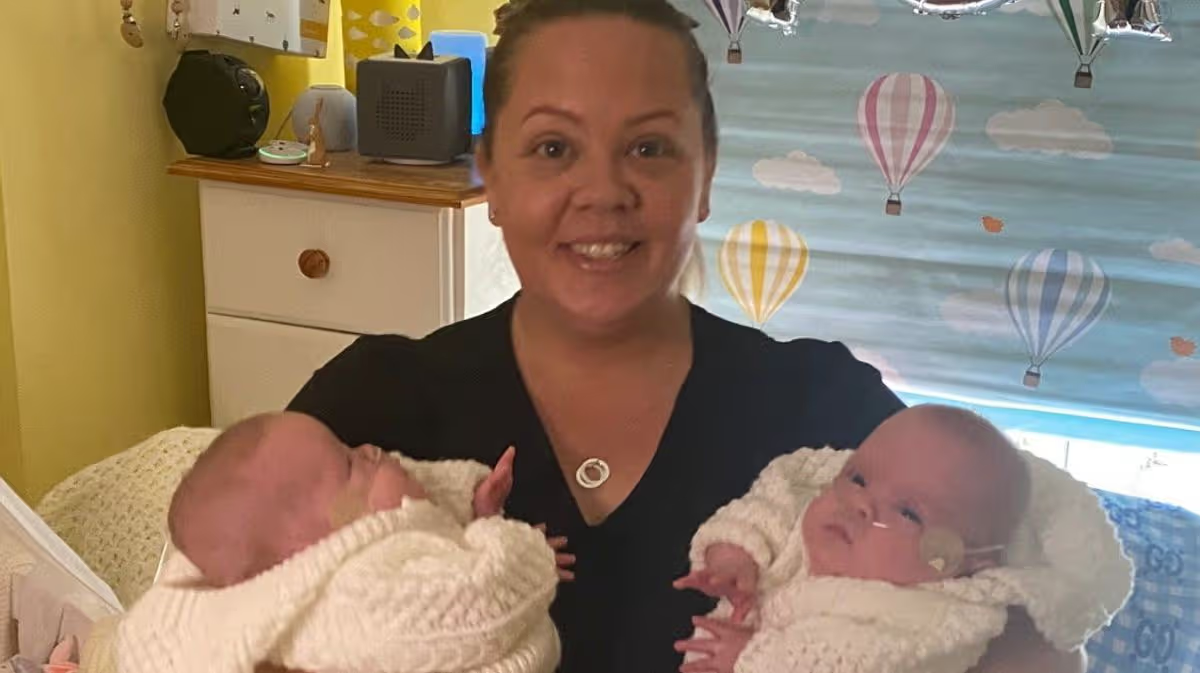
In a whirlwind of fear and urgency, Jade’s daughter, Harley, entered the world weighing a mere 500 grams, followed just over an hour later by her twin brother, Harry, at 520 grams. To visualize their profound fragility, Jade compares them to everyday objects: a block of butter, a Coke can, their perfect fingers like those of a Barbie doll. “At Christmas we laughed because they were literally the size of an elf on a shelf,” she recalls. Harley managed a tiny, kitten-like cry, a sound Jade was told she might never hear, while Harry was born enveloped in his amniotic sac, appearing grey and still before offering his own faint whimper. Immediately, they were whisked away to the neonatal intensive care unit, where the real battle began. Doctors had initially discussed “comfort care,” preparing Jade for the possibility that her children might only live for an hour or a day. But her directive was clear: “If there is any chance you can help them, that’s what I want you to do.”
The following five months were a relentless marathon of medical crises and microscopic victories. Both twins faced a staggering onslaught of complications typical for such extreme prematurity: undeveloped lungs leading to lung bleeds, holes in their hearts, brain bleeds, and the need for eye surgery. Perhaps most critically, both suffered perforated bowels, requiring major surgery. Each day was a precarious balance, with Harley and Harry clinging to life by the thinnest of threads, their survival a testament not only to medical science but to an innate, fierce will to live. Their mother watched over them in the NICU, absorbing the reality of their miniature forms connected to a symphony of machines, hoping for the day she could hold them without a web of tubes and wires.
That long-awaited day finally arrived in March 2022, a full month after the twins’ original due date. Leaving the hospital, however, was not a simple celebration. Jade carried with her two babies who were still dependent on oxygen for their chronic lung disease, turning the joyous homecoming into a terrifying new chapter. “I felt like I was stealing them,” she admits, so daunted by the responsibility that she actually delayed their discharge. The comfort of home was now also a high-dependency unit, but Jade’s resilience, forged through years of struggle, met this new challenge. Remarkably, the strength she witnessed in her children shone through once more; they weaned off their oxygen support within four months, a swift progression that defied medical expectations.
Today, at four years old, Harley and Harry are vibrant, thriving children, though their early arrival has left its mark. They attend a specialist school where their individual needs are supported. Harley, who is non-verbal and autistic, is described by her mother as “feisty,” a spirit that clearly fueled her initial fight. Harry, who has cerebral palsy, is the more “laid-back” of the two, facing life with a calm determination. Their diagnoses are part of their story, but they do not define them. “They are happy, healthy children and we’ve done amazingly well,” Jade states with palpable pride. The fact that neither has required hospitalization since their initial five-month stay is, in itself, a remarkable feat.
Jade Crane’s story transcends a simple narrative of premature birth; it is a profound exploration of the limits of viability, the depth of a mother’s love, and the breathtaking tenacity of the human spirit. Harley and Harry, once the size of a shelf elf, are now living, playing, and growing proof of what is possible. They are not just survivors; they are pioneers of their own lives, embodying what Jade calls “medical evidence of survival.” Their journey from the brink of miscarriage to thriving four-year-olds is a powerful reminder that even the smallest beginnings can lead to the most resilient futures, and that within the most fragile forms can reside the strongest wills.