

Europe finds itself at a pivotal economic crossroads. While the European Union rightly prides itself on being a massive single market of 450 million consumers and the world’s largest trading bloc, a palpable anxiety is growing in Brussels and other capitals. The global competitive landscape is shifting dramatically, with the United States deploying massive industrial subsidies through initiatives like the Inflation Reduction Act and China leveraging state-backed power to dominate future industries. In contrast, the EU’s economic growth remains stubbornly sluggish, weighed down by high energy costs, a perceived overabundance of regulation, and chronic underinvestment in critical areas. This has sparked an urgent, existential debate: can Europe reinvent its economic model to keep pace, or does it risk being permanently squeezed between these two superpowers?
The core of this challenge extends beyond simple GDP figures. Europe is perceived as lagging in the very sectors that will define the 21st century: artificial intelligence, clean technology, advanced defence manufacturing, and the supply chains for critical raw materials. This isn’t merely an economic shortfall; it is a strategic vulnerability that threatens the continent’s ambition for “strategic autonomy”—the ability to act independently on the global stage. The fear is that without significant changes, Europe could become a rule-maker without the underlying industrial power to back it up, watching from the sidelines as the U.S. and China shape the technological and geopolitical future. This high-stakes dilemma frames every discussion about the EU’s path forward.
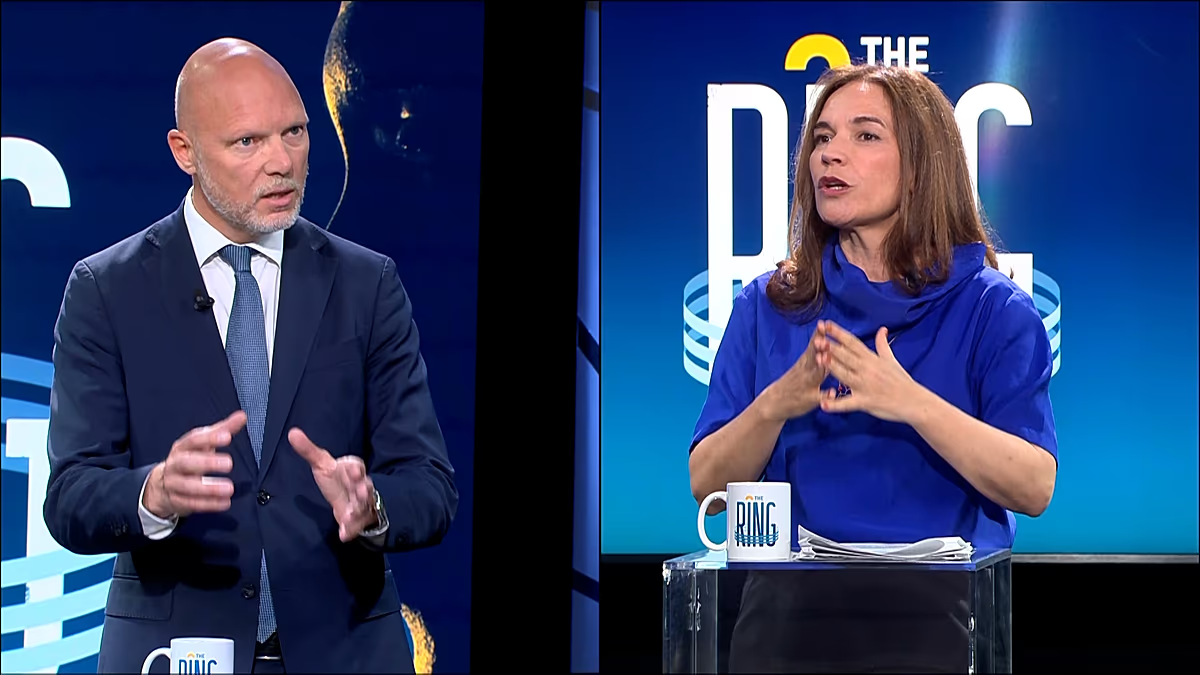
Within the European Parliament, the debate crystallizes into two distinct visions for revival. On one side are voices like Spanish Socialist MEP Lina Gálvez, who argues that fragmentation, not regulation, is the primary obstacle. For her, the solution lies not in dismantling the EU’s rulebook but in deepening integration. She champions finally completing the true single market, especially by establishing a genuine Capital Markets Union to pool investment resources across borders. The goal is to enable Europe to invest collectively—and boldly—in the technologies needed to address climate change and security threats. This “more Europe” approach posits that only through unified action can the bloc compete globally without sacrificing its cherished social protections and ambitious Green Deal objectives.
In direct opposition is the perspective offered by Swedish MEP Jörgen Warborn of the centre-right EPP group. He contends that Europe’s problem is an excessive regulatory burden that stifles innovation and hampers companies, particularly smaller ones. His prescription is a program of strategic deregulation—”cutting the red tape” that holds businesses back—coupled with a pragmatic energy policy that embraces all reliable sources, including nuclear power. Warborn advocates for a renewed focus on free trade agreements to open new markets and insists that “competitiveness” must be the overriding filter for every policy decision made in Brussels. This view prioritizes agility, cost reduction, and market freedom as the keys to unlocking European entrepreneurial spirit.
This fundamental clash—between deeper integration for collective strength versus deregulation for individual agility—reflects a broader philosophical divide about the nature of European power. It is a tension between the desire to protect a unique social and environmental model and the imperative to compete in a ruthless global arena. The path Europe chooses will have profound implications. Will it double down on its regulatory and normative power, betting that its market size allows it to set global standards? Or will it strip back rules to foster home-grown tech giants and industrial champions, even if that risks a “race to the bottom” in social or environmental standards? There is no easy answer, as both paths carry significant trade-offs.
Ultimately, Europe’s quest to remain a global economic heavyweight is more than a technical policy discussion; it is a struggle to define its own identity and role in a new world order. The conversations in Strasbourg, as captured in programs like The Ring, are just the beginning. The real test will be whether European leaders can forge a coherent, actionable compromise that merges the best of both visions—perhaps through smarter, more enabling regulation combined with truly integrated financial and energy networks. The continent’s future prosperity and strategic relevance depend on its ability to navigate this complex balancing act, ensuring it is a shaper of global dynamics, not merely a subject of them.