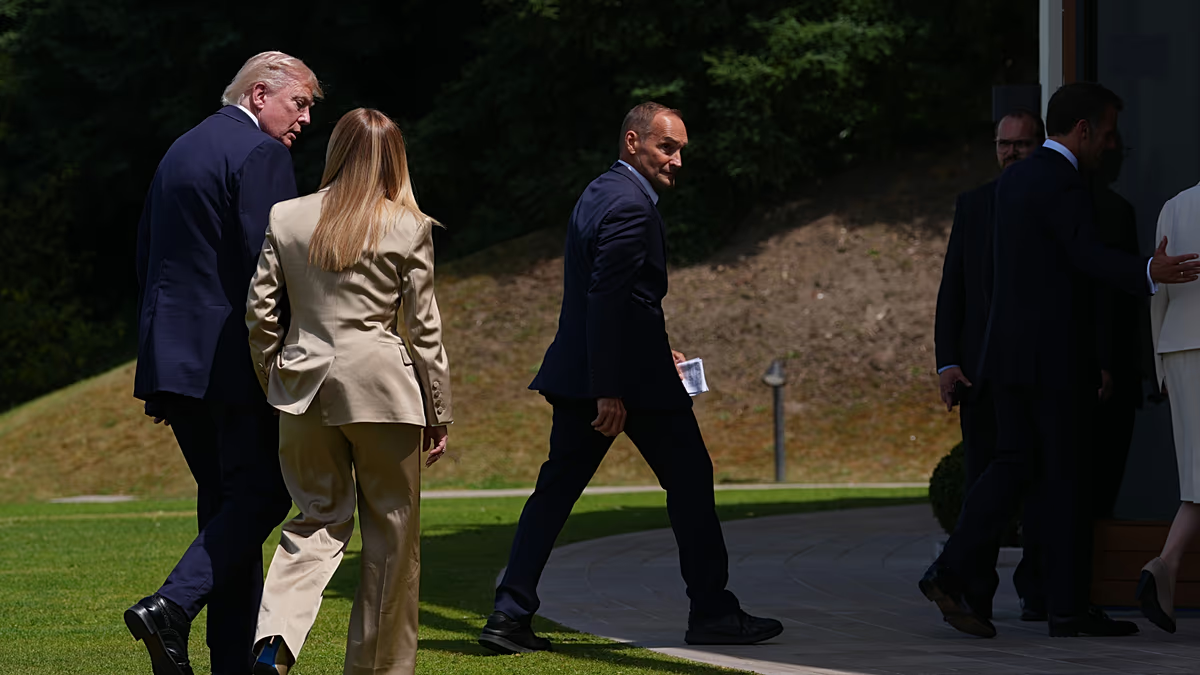





The gathering of G7 leaders in France, with artificial intelligence as a central theme, was intended to be a celebration of Western technological collaboration and a roadmap for safe, rapid innovation. Instead, the summit has been overshadowed by a stark and disruptive reality check. Just days before the meetings, the United States, citing national security concerns, imposed stringent export controls on Anthropic’s most powerful AI models, Fable 5 and Mythos 5. The move forced the company to abruptly cut off access for all foreign nationals, including employees of Anthropic itself based outside the U.S. This decision transformed a theoretical anxiety into a concrete crisis, demonstrating with unsettling clarity that access to American frontier AI is not a guaranteed right for even its closest allies. The incident laid bare a profound power imbalance, leaving European officials and technologists feeling suddenly vulnerable and sidelined, their strategic planning upended by a unilateral switch flicked in Washington.
The emotional and political fallout in European capitals, particularly Brussels, is one of profound frustration and a sense of betrayal. European Commission spokesperson Thomas Regnier articulated the core grievance: while acknowledging the serious risks posed by advanced AI, the bloc argues that protective measures should not discriminate against trusted partners. The timing exacerbated the sting, as the restrictions landed precisely when the EU was preparing to deepen its collaboration with Washington through the Pax Silica alliance on supply chains. For advocates of a united transatlantic front against geopolitical rivals like China, this move was a damaging blow. It underscored a painful lesson: in the current political era, European interests can be overridden by American domestic policy priorities without consultation. The presence of Anthropic’s CEO at the G7 working lunch only heightened the drama, offering allied leaders a direct, if tense, opportunity to confront the practical consequences of this new American posture.
This episode powerfully validates the European Union’s growing focus on “tech sovereignty,” an agenda that has evolved from an abstract concept into an urgent strategic imperative. As MEP Brando Benifei stated, the Anthropic “kill switch” proved that technological dependence carries tangible risks. The vision outlined in the U.S. AI Action Plan—to establish American AI as the global gold standard upon which allies must build—is now viewed in Europe not as a blueprint for cooperation, but as a mandate for subordination. The call from figures like Regnier for Europe to “act on its own terms” has gained immense credibility. While the U.S. dominates the sector, with a commanding presence of its tech CEOs at the summit, its use of export controls may incentivize the very diversification it seeks to prevent. The incident has galvanized arguments for building robust domestic alternatives in AI, from foundational models to critical hardware, to avoid future strategic blackouts.
The underlying fear, now palpably realized, extends far beyond AI research labs. For years, European policymakers have harbored a nightmare scenario: that deeply embedded American technology, whether in defense systems, financial infrastructure, or communication networks, contains a latent “kill switch.” The ability of Washington to instantly revoke access to a core technology like frontier AI models makes that fear visceral. It raises alarming questions about other domains. If access to essential AI can be severed overnight, what about other critical digital systems? This incident transforms tech sovereignty from a matter of economic competitiveness into one of fundamental security and institutional resilience. It forces a sobering reassessment of the vulnerabilities woven into the global digital fabric by asymmetric technological dependence.
However, translating this renewed resolve into a coherent, unified European strategy remains a formidable challenge. While Brussels has mapped ambitious plans, member states are fragmented in their willingness to commit the enormous financial resources and political capital required to unwind deep-seated dependencies. Building a competitive, sovereign European AI ecosystem from the ground up is a long-term, high-cost endeavor that requires unprecedented coordination and sustained investment. The Anthropic episode provides a powerful impetus, but the path forward is fraught with difficult choices about priorities, funding, and the balance between open collaboration and strategic autonomy. The immediate reaction is one of alarm, but the true test will be maintaining the collective will to follow through in the years ahead.
Ultimately, the G7 AI discussions unfold under a new and sobering paradigm. The United States, under the Trump administration, has demonstrated a willingness to weaponize its technological supremacy in a way that treats allies and adversaries with a similar transactional caution. This actions serves as the ultimate catalyst, proving that “kill switches” are anything but hypothetical. While cooperation with democratic partners remains essential, the terms of that cooperation have irrevocably shifted. Europe, and indeed other American allies, now understand they must engage from a position of strength, not dependence. The summit, therefore, is less a planning session for shared AI governance and more a pivotal moment of reckoning—a clear signal that the era of naive technological interdependence is over, replaced by a fragile new order where sovereignty is defined by digital self-reliance.