



The Unspoken Goodbye: A Mother’s Agony and the Hidden World of Assisted Dying
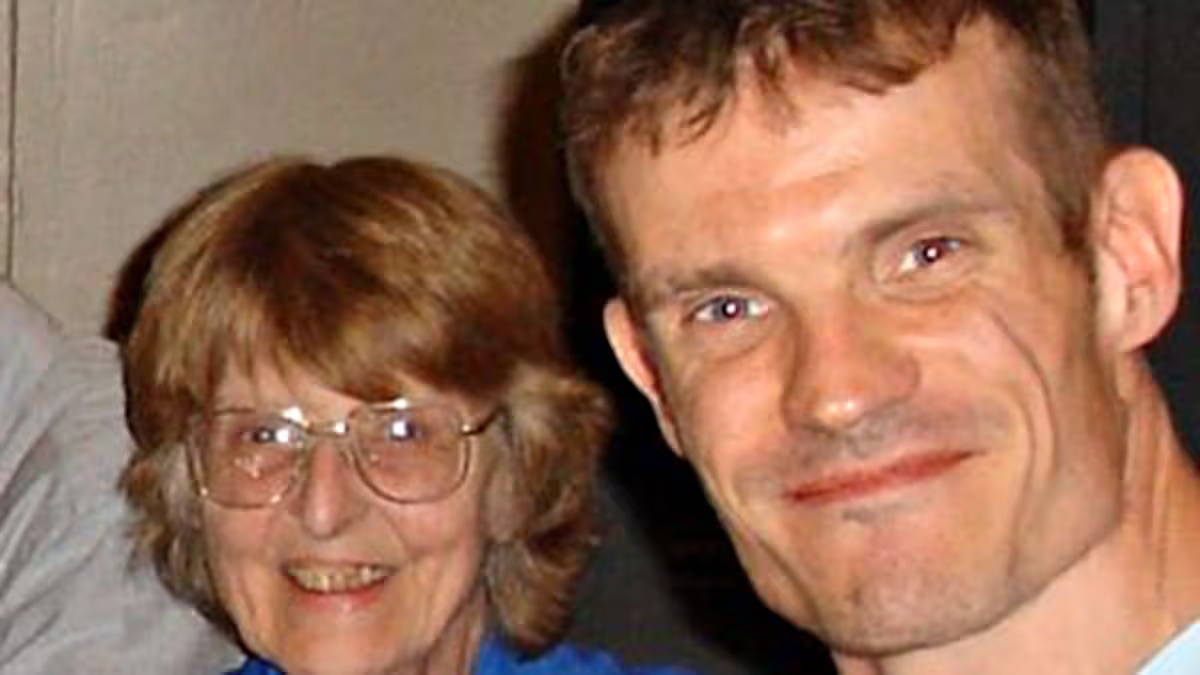
In a quiet London home, an 84-year-old mother named Judith Hamilton lived through a week of unimaginable torment, believing her beloved son was missing, only to have her world shattered by a truth more devastating than her worst fears. Her son, Alastair, a brilliant and beloved 47-year-old chemistry teacher, had not, as he claimed, traveled to Paris to visit a friend. Instead, he had secretly journeyed to the Pegasos assisted dying clinic in Basel, Switzerland, where he ended his life in August 2023. This revelation, delivered by police after tracing his bank records, marked the brutal end of a mother’s desperate search and the beginning of a lifelong grief defined by a goodbye she was never allowed to have. Alastair’s story, and that of his mother left in the dark, exposes the profound human collateral damage that can occur in the shadowed corners of the right-to-die movement, raising urgent questions about ethics, transparency, and the crushing loneliness that can precede such a final act.
Alastair’s final days were a tapestry of quiet deception and unspoken pain. Speaking to his mother from what she believed was Paris, he discussed tourist plans, all while residing in a nondescript building on a Swiss industrial estate, preparing for his death. He had been struggling with unexplained abdominal pain and weight loss, a mysterious decline that halted the active life of gym visits and long walks he so cherished. Despite numerous medical consultations, he received no definitive diagnosis, a lack of answers that compounded his despair. Feeling he had lost control of his health and his future, Alastair made the solitary decision to seek a “gentle end” at Pegasos, a clinic whose ethos states that choice is a human right for “all rational adults of sound mind.” Tragically, he chose not to confide in his family, a decision that would amplify their grief exponentially and set the stage for a painful confrontation with the clinic’s procedures.
The aftermath for Judith and her family was a bureaucratic and emotional nightmare. When Alastair’s communications ceased, they reported him missing, unwittingly launching an international investigation involving British and Swiss police, Interpol, and the embassy. The clinic’s own guidelines stipulate that patients should inform their families, yet Pegasos accepted Alastair’s assurance that a friend had notified his relatives—a claim they did not verify. This failure left Judith utterly robbed: robbed of a final conversation, robbed of the chance to offer comfort or alternative hope, and robbed of the fundamental human right to mourn with knowledge rather than be ambushed by loss. The family’s anguish was further compounded by being unable to obtain a post-mortem, leaving the troubling questions about Alastair’s physical health forever unanswered.
Driven by a need for answers and accountability, Judith and her sons traveled to Switzerland in 2024 to confront Pegasos at its then-industrial location, a place she described as a “grim” final vista for her son. In a meeting filmed for ITV, a clinic representative apologized and pledged to change protocols, vowing to ensure future patients contact their families in the clinic’s presence. However, Judith claims that since that promise, she has learned of at least two other cases from the UK and Ireland where individuals died at Pegasos without their families’ knowledge. This pattern haunts her, as does the recent case of Wendy Duffy, a healthy mother who died at the same clinic after the traumatic loss of her son. While Judith empathizes with Wendy’s profound grief, Wendy’s story reignited her own heartache and her pressing concern about clinics facilitating deaths for those who are not terminally ill but are, instead, in deep psychological pain.
The tragedy has positioned Judith as an unlikely but passionate advocate for reform within the assisted dying framework. She draws a sharp distinction between Pegasos and organizations like Dignitas, which she notes declined Alastair posthumously because he was still mobile and undergoing medical investigations. She supports legislative efforts for terminal illness but insists they must look “nothing like Pegasos.” For Judith, the core failure is the exclusion of family. She argues that whether a family agrees with the choice or hopes to change their loved one’s mind, they deserve the chance to be present—to either say goodbye at the bedside or to try to bring them home. This chance for intervention or shared closure was stolen from her, leaving a void filled with permanent sadness and unresolved questions about what support might have made a difference.
Judith’s personal crusade intersects with a broader, heated debate in the UK, where proposed legislation on assisted dying has recently stalled. Critics like Alistair Thompson of Care Not Killing argue that the focus should be on urgently improving palliative care and mental health support within a struggling NHS, rather than legalizing assisted death. They see cases like Alastair’s and Wendy’s as tragic symptoms of a system failing to care for the suffering. Meanwhile, Pegasos maintains it operates within Swiss law and has improved its processes, emphasizing its non-profit status funded by donations. For Judith Hamilton, however, the debate is not abstract. It is the memory of a gifted son, the echo of a final phone call about Parisian sights, and the enduring scar of a week spent searching for a man who was already gone. Her story is a heartbreaking plea for humanity, transparency, and the simple, sacred right to say farewell.