



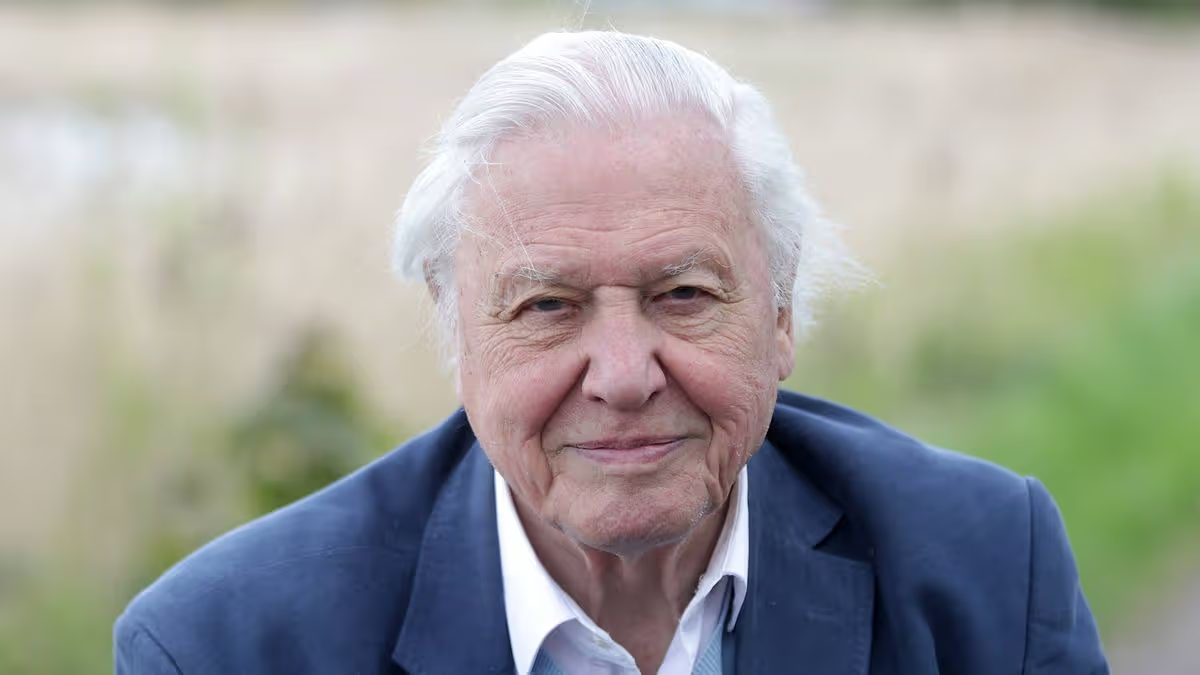
Prince Harry has written a deeply personal and reverent tribute to Sir David Attenborough, marking the naturalist’s centenary not merely as a milestone birthday, but as a moment to reflect on a legacy that has fundamentally shaped humanity’s relationship with our planet. In an essay for Time magazine, Harry elevates Sir David beyond the title of broadcaster or documentarian, anointing him instead as a “secular saint” and the “Voice of Nature.” This framing is profound; it suggests a figure whose authority stems not from religion, but from an unassailable devotion to truth and a unique communion with the natural world. Harry posits that Sir David has become an “institutional pillar as essential to the national fabric as a cup of tea,” a beautifully British analogy that underscores how Attenborough’s calm, steady presence has been woven into the very identity of the nation, providing both comfort and conscience for generations.
Central to Harry’s admiration is Sir David’s unparalleled credibility, born from a lifetime of witness and a total absence of perceived agenda. “When a man who has quite literally seen it all begins to describe the loss of the planet’s stability,” Harry writes, “he isn’t being provocative. He is reporting from the front lines of a planet he has known longer, and more intimately, than almost anyone alive.” This frontline reporting has been his life’s work, transforming critical but abstract issues like climate change and habitat destruction into visceral, undeniable realities. Harry emphasizes that Attenborough’s “measured demeanor” means the alarm bells he sounds carry a unique and urgent weight. He hasn’t shouted; he has simply shown, with patience and wonder, allowing the devastating facts to speak for themselves. In doing so, he has secured the confidence of a global audience, not through rhetoric, but “by simply showing us that our environment is worth appreciating.”
Harry argues that Sir David’s most significant contribution may be the systematic dismantling of our psychological distance from environmental crises. For many, nature is a beautiful but distant spectacle, a source of calm viewed safely through a screen. Attenborough, Harry notes, “has made that distance impossible to maintain.” His genius lies in connecting the dots, illustrating how distant melting glaciers, burning rainforests, and polluted rivers are not just far-off landscapes but integral parts of the delicate systems upon which our own communities, air, water, and food directly depend. Furthermore, he has illuminated the hidden threads that link our daily consumption—the food we eat, the products we buy—to the strain on ecosystems thousands of miles away. He transformed the environment from a remote “destination” into our shared, vulnerable home.
Remarkably, this century-old voice has remained the defining voice for younger generations growing up in a digital age. Harry highlights Sir David’s deliberate and effective embrace of the platforms where young people live, reaching millions through social media and streaming services. “He has bypassed the generational gap,” Harry observes, not by chasing trends, but by carrying his timeless authority into new spaces. In an era overwhelmed by digital noise, misinformation, and uncertainty, “Attenborough represents credible authenticity.” He doesn’t preach to the youth; he shares a perspective that spans a century, offering a bedrock of truth in a shifting landscape. This ability to speak with equal power to a child and a centenarian is a testament to the universal language of wonder he has always spoken.
In concluding his tribute, Harry returns to the spiritual gravity of Sir David’s role, solidifying the idea of him as a secular saint who has provided both a gift and a solemn charge to humanity. “He has shown us the world in all its brilliance and fragility,” Harry writes, leaving us with an enhanced sense of awe coupled with an inescapable duty. Attenborough’s century of work is presented not as a mere catalogue of life on Earth, but as a foundational text for our survival, a compelling argument for stewardship delivered with honesty and grace. The tribute culminates in a pointed transition from praise to provocation.
The final paragraph, and indeed the ultimate purpose of Harry’s essay, is a clear and urgent call to action directed at those in power. He states: “The question now is whether those with the power to act will choose to lead before more of our world – our life support system – is lost.” This sentence reframes the entire homage. While celebrating Attenborough’s unparalleled legacy as a witness and educator, Harry implicitly argues that admiration is no longer enough. The “Voice of Nature” has spoken with crystal clarity for a lifetime; the responsibility now falls to the voices of power to listen, and finally, to lead. The tribute, therefore, is both a loving celebration of a national treasure and a strategic amplifier of his final, most important message.